Get Full Government Meeting Transcripts, Videos, & Alerts Forever!
Get email alerts on the Mobile Food Vendors topic
No spam. Unsubscribe anytime.
Norman council to align local mobile-food rules with Oklahoma House Bill 1076; discusses parking, fees and inspections
Summary
At a Sept. 2, 2025 study session, city attorneys and councilors discussed updating Norman’s mobile food vendor licensing to comply with Oklahoma House Bill 1076, which takes effect Nov. 1, Assistant City Attorney Beth Muckela said.
Norman — At a Sept. 2, 2025 study session, city attorneys and council members discussed proposed local changes to bring Norman’s mobile food vendor licensing into compliance with Oklahoma House Bill 1076, which takes effect Nov. 1, 2025, Assistant City Attorney Beth Muckela said.
The update would require the city to recognize state-issued licenses for mobile food vendors and to verify that vendors meet state requirements before issuing a municipal license, Muckela told the council. “These are updates, in response to state legislation that's effective November 1,” she said.
The changes matter because HB 1076 and related state rules narrow the scope of municipal requirements for food trucks, Muckela said. Key state provisions noted in the session: mobile vendors may not stay in one place for more than 12 hours at a time; on private property they may not remain at a single physical address for more than 14 days without violating state limits; municipalities must accept proof of state licensure and may not impose local rules that are inconsistent with the state act.
Muckela said the city’s existing licensing language largely matches the new state definitions and requirements, so Norman will need mostly wording adjustments. The draft ordinance distributed to councilors adds definitions (mobile food establishment, push cart, retail food, mobile food vendor) and adjusts municipal licensing categories to match the state’s terminology.
The council discussed operational limits and municipal options. Under the state law, Norman may continue to adopt provisions that address public health and safety — for example, restricting noise within a stated distance, requiring permits for parking operations on city property, investigating foodborne-illness complaints and requiring additional insured coverage when vendors operate on municipal property or at city-sponsored events. Muckela said the code will also prohibit the city from requiring multiple health inspections, fingerprint-based security measures, limits on the number of state licenses issued or excessive surety obligations for vendors licensed by the state.
The state fire marshal’s related legislation shifts routine vehicle safety inspections for mobile food preparation vehicles to the state. “These vehicles are subject pretty much exclusively to state fire marshal compliance,” Muckela said, and the city will require vendors to provide proof of a state fire marshal inspection within the past year rather than perform a duplicate inspection.
Councilors focused substantial discussion on municipal property and downtown use. A councilor described a Campus Corner taco truck whose private-lease location will not be renewed and asked whether the city could lease municipal parking or sidewalk space to provide a long-term option. Muckela said the new law expressly permits a municipality to develop a mobile food vendor metered-parking pass that allows operation from metered spaces for longer than otherwise permitted, and suggested that the city could program such permits into FlowBird parking software. She also noted that the city’s business plans for specific lots and existing City parking management policies would affect any leasing decisions.
Councilors raised practical concerns about siting and infrastructure: noise from generator-powered trucks, the value of providing electrical hookups and water to reduce generator use, and whether underused corners of metered lots could be dedicated for food trucks. One council member pointed to parallels in other university towns where leased truck spots provide late-night food options and generate revenue; another urged staff to check whether existing city power infrastructure (110v vs. 220v) could support vendors’ needs.
On fees, the draft amendments add a park food vendor permit (nominal $10) and introduce an annual permit option to match the state’s permitting structure. Muckela said state law limits municipalities to charging licensure fees that cover administrative costs only; the draft proposes keeping an annual license at $50, adjusting shorter-term fees to avoid temporary permits costing more than annual permits, and making renewal fees equivalent to original fees. She noted a broader committee discussion on licensure fees will be needed.
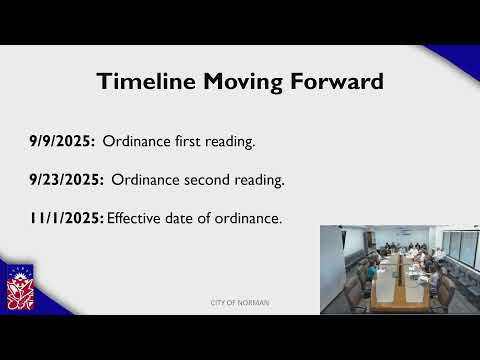
Staff and council agreed on next steps. With council consensus, staff will advance ordinance amendments for first-reading consideration so the local code can be effective on the same date as the state changes; staff will update CityView forms to require vendors to show state fire marshal inspection proof; and staff will report back with the state’s licensing fee schedule and with options for metered parking passes or leases and for infrastructure (power/water) on potential city sites.
No formal vote took place at the study session; the council indicated consensus to move the proposed ordinance amendments forward for first reading.
The council also requested staff follow up on potential committee review (CPTC or Baca were discussed) for parking-lease models and on the feasibility and cost of providing electrical or water hookups at candidate locations. Muckela said staff would return with fee information and recommended ordinance language before the regular September meetings so the ordinance could be adopted and take effect Nov. 1 if the council chooses that timetable.