Get Full Government Meeting Transcripts, Videos, & Alerts Forever!
Get email alerts on the General Plan Update topic
No spam. Unsubscribe anytime.
Glendale council approves $199,580 amendment to update land use, circulation elements and add environmental justice element
Summary
The Glendale City Council approved a contract amendment with De Novo Planning Group to add a state-required environmental justice element, extend the work timeline 18 months and increase the contract by $199,580 to a new not-to-exceed $1,081,309; staff will prepare a program-level environmental impact report and begin outreach this spring.
The Glendale City Council approved a contract amendment Jan. 30 to expand work on the city’s long-range planning update, including preparation of a new environmental justice element required by state law.
The council approved an amendment to the city’s contract with De Novo Planning Group to add preparation of an environmental justice element to the land use and circulation element updates, extend the project timeline by 18 months and increase the contract by $199,580 for a new not-to-exceed total of $1,081,309. The motion to approve the two related items (A and B on the special meeting agenda) carried on the roll call (yes 4, no 1).
Amanda Tropeano, principal with De Novo Planning Group, told the council the city’s land use element was last comprehensively updated in 1986 and the circulation element in the late 1990s, making the updates a multi-decade refresh. “It is time for it to be refreshed and have a comprehensive look, setting the stage for development over the next 20 years,” Tropeano said.
Tropeano outlined goals for the land use update: simplify and clarify land-use definitions, align the land use map with existing zoning and built uses, identify sites where additional residential densities may be appropriate (particularly along multimodal corridors and bus rapid transit), and create a “city-owned residential overlay” to encourage multifamily development on city-owned sites. For the circulation element, she said the work will embrace a complete-streets approach, improve active-transportation connections and identify necessary network improvements and routes for emergency evacuation and goods movement.
Tropeano also explained the new state requirement. Because Glendale is updating two or more general plan elements concurrently, Government Code 65302(h) directs the city to prepare an environmental justice element. She said the element will address at minimum seven topic areas specified in the statute, including pollution exposure and air quality, access to public facilities, food access, safe and sanitary homes, physical activity, community engagement and prioritizing disadvantaged communities.
On technical matters, Tropeano said the team will begin multilingual, in-person and online outreach in the spring, including stakeholder focus groups and public surveys, and will circulate a draft program-level environmental impact report (EIR) before the end of 2024 with a public comment period running into early 2025. “We intend to start circulation of the draft environmental impact report before the end of this year, closing the public comment period in early 2025,” she said.
Council members raised policy and implementation questions during the presentation. A council member suggested examining Brand Boulevard ground-floor uses to encourage more restaurants and retail and reduce contiguous professional-service storefronts that can create inactive stretches downtown. Another council member urged consideration of “missing middle” housing types (duplexes, triplexes, cottage courts) and recommended focusing more on building form and compatibility than on strictly numerical density measures; that member also suggested reconsidering open-space and off-street parking requirements and evaluating impact-fee structures that may discourage smaller units.
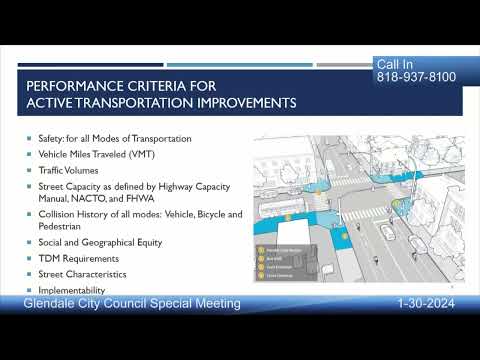
Council members also discussed technical evaluation methods for the circulation element. One council member recommended moving away from the traditional A–F level-of-service grading for local analysis in favor of measures tied to vehicle-miles-traveled, safety, equity, and street-specific characteristics; the presenter said the team will include performance criteria such as collision history, projected traffic volumes, and opportunities to reduce VMT when prioritizing improvements.
The council approved the contract amendment by motion, with the mayor pro tem presiding during Mayor Dan Brotman’s brief illness-related absence. Staff identified the Community Development Department and long-range planning staff as the implementing unit; De Novo will prepare draft policy documents and the program-level EIR, and staff will return draft materials to the Planning Commission and City Council with responses to public comments as part of the public hearing process.
Next steps include spring outreach focused on environmental justice and a fall 2024 target for first draft policy documents, followed by EIR circulation and the public hearing process in 2024–25.