Get Full Government Meeting Transcripts, Videos, & Alerts Forever!
Get email alerts on the Civil Commitment topic
No spam. Unsubscribe anytime.
Clatsop County mental‑health officials outline civil‑commitment process, legal limits and oversight
Summary
County behavioral health staff and the sheriff described the limited, legally defined paths for civil commitment in Oregon, oversight by the Oregon Health Authority and upcoming statutory changes that may alter options beginning next year.
Erin Jones, senior mental health investigator for the county's community behavioral health provider (CBH), and Clatsop County Sheriff Phillips briefed the Human Services Advisory Committee on how civil commitment works in Oregon, emphasizing the narrow statutory criteria and oversight mechanisms.
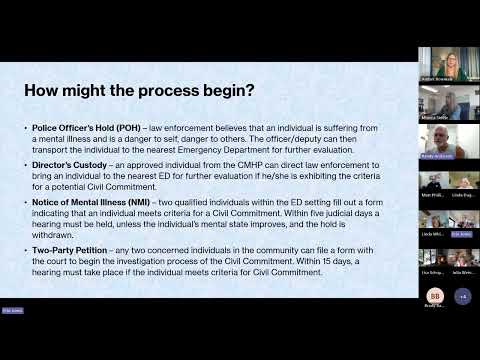
Jones said civil commitment “is kind of a it's a big scary thing that sounds really complicated, but, in the state of Oregon is actually a lot more narrow.” She outlined the main pathways into the civil‑commitment process: a peace officer hold when law enforcement brings an individual to an emergency department for evaluation; a director’s custody request initiated by crisis‑team staff directing law enforcement to transport someone for assessment; two‑party petitions filed by two community members; and, more rarely, a magistrate’s hold started by a judge.
Under the emergency process Jones described, emergency department clinicians — usually a physician and a social worker — may file a Notice of Mental Illness (NMI). An NMI starts a judicial timeline that requires a hearing within five judicial days unless the hold is withdrawn; two‑party petitions require a hearing within 15 days. Jones said CBH staff serve as court monitors and may follow an individual for up to 180 days after placement in inpatient care or while on a monitored trial visit in the community.
Sheriff Phillips added that the controlling statutes include provisions for civil commitment and for related paths such as those for extremely dangerous persons. He referenced the Oregon Revised Statutes governing commitment and related supervision. Both presenters emphasized that homelessness alone is not sufficient grounds for commitment: a person must meet the statutory criteria of posing an imminent danger to themselves or others, or be unable to care for themselves to a degree that makes them imminently dangerous.
Speakers described the practical tensions that arise in the emergency setting. Clinicians may stabilize people enough that they do not meet the legal standard for an NMI even when community providers are concerned about future risk. Jones said CBH can request further review or recommend no hearing when appropriate, and that the Oregon Health Authority (OHA) maintains records and conducts oversight of holds and trends.
Sheriff Phillips and Jones discussed how appellate decisions and evolving standards have affected pathways into treatment. Jones noted a recent legislative change — House Bill 2005 — will take effect in January and is expected to alter options available to providers, including expanded diversion options and some changes that may make commitment possible in additional cases; she said OHA is still finalizing details about implementation.
Committee members asked about individuals with intellectual and developmental disabilities (IDD). Jones said the same statutory standards apply and that investigators take care to distinguish behaviors caused by neurodivergence, trauma, learned behaviors or an acute psychotic break. She described coordination with family, group homes and other supports to establish whether the care environment itself provides protective factors.
Jones and the sheriff urged committee members to treat civil commitment as a narrowly defined safety net and described CBH's preference to keep people in the least‑restrictive setting possible, using monitored trial visits and short diversions when clinically appropriate.
The presentation concluded with an invitation from CBH to submit questions by email and a note that additional slides would be shared with the committee after the meeting.