Get Full Government Meeting Transcripts, Videos, & Alerts Forever!
Get email alerts on the Municipal Finance topic
No spam. Unsubscribe anytime.
Lakeway council adopts $20.784 million budget and 0.16964 tax rate after extended debate
Summary
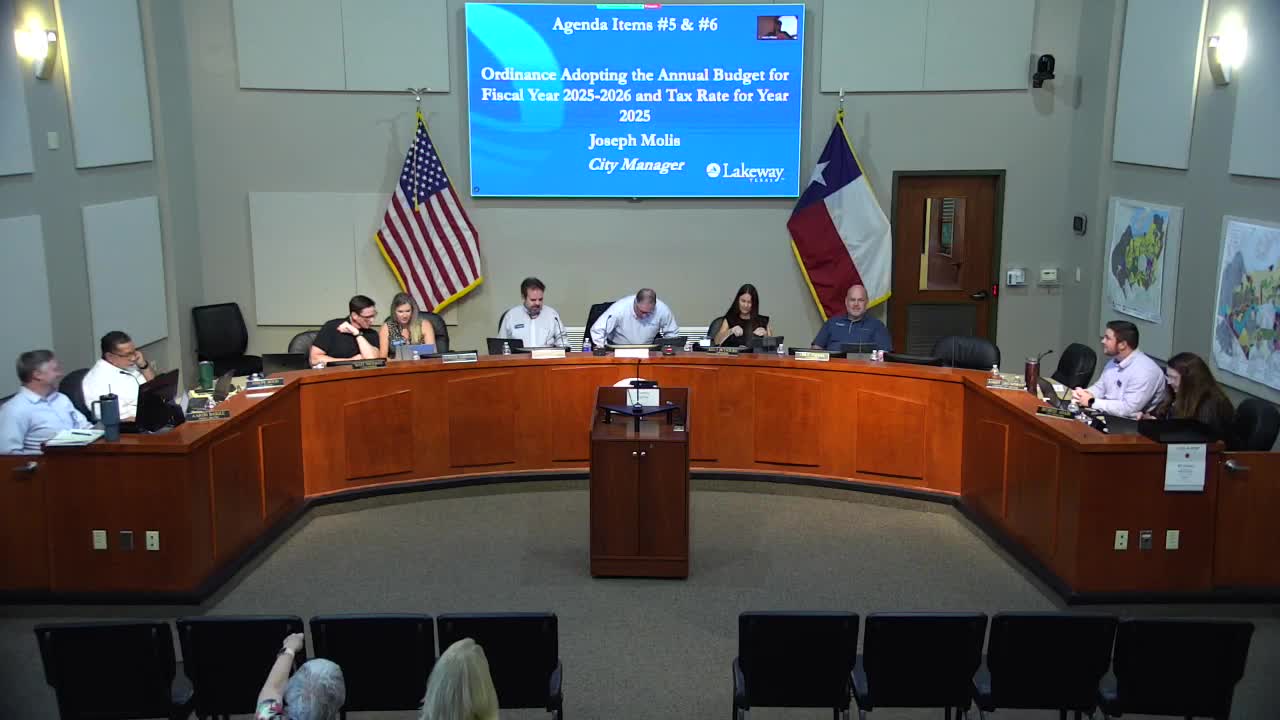
Lakeway City Council on Sept. 22 approved the fiscal 2025–26 budget and a property tax rate of 0.16964 (a 5.2% increase), voting 6–1 after hours of discussion about revenue assumptions, staffing and capital priorities.
Lakeway City Council on Sept. 22 adopted an ordinance approving the city’s fiscal year 2025–26 budget and a separate ordinance setting the maintenance-and-operations and debt-service property tax rate at 0.16964, a 5.2% increase. The council approved the budget ordinance on a 6–1 record vote and the tax ordinance on the same 6–1 tally.
City Manager delivered the staff report and described the budget as “the reflection of the city's values,” urging council to focus on priorities, revenue forecasts and service levels as they finalized numbers for the year beginning Oct. 1, 2025. The transcript shows the council spent most of the meeting negotiating revenue assumptions and supplemental budget items before voting to adopt the package presented at 9:20 p.m.
Council and staff debated several revenue assumptions that shaped the final numbers. The council voted to raise the sales-tax forecast used in the budget from $5.9 million to $6.1 million based on updated Comptroller data and a consultant forecast. Council members also discussed building-development (BDS) permit revenue and vacancy-savings assumptions; during the meeting members proposed and rejected alternative BDS assumptions and ultimately left the revenue assumptions and vacancy estimate as reflected in the adopted spreadsheet. Staff told the council the recommended supplemental items included a 2% cost-of-living adjustment and a 2.2% merit pool (a combined average salary increase of about 4.2% with a budget impact of roughly $529,000) and an estimated vacancy savings entered as a negative $400,000 in earlier worksheets.
The adopted budget shows roughly $20.784 million in expenditures for FY 2025–26 as presented to council. Notable line items discussed during the meeting: an IT assistant position (budgeted at about $106,000 for a full year, with discussion of funding it for six months), adjustments to Police Department pay scales (staff estimated a $109,000 impact), and the addition of a fourth motors officer (an estimated $33,000 operating impact if hired in the fourth quarter). Council also directed that the capital reserve retain funding for radar signs and leave capital funding in place for replacement police motorcycles.
Council members and staff reviewed special revenue and restricted funds in detail. Staff explained that a prior court security fund had been merged with a Court Technology Fund under state law (HB 1950) and that the city had transferred approximately $126,000 into the consolidated court technology balance. Staff also noted the hotel-motel fund would carry a proposed $25,000 line for a commercial data product (Placer AI) to analyze visitor stays and movement for event and lodging metrics. The city continued to show ARPA expenditures wound down and other funds (road tax fund, transportation and parks bond remainders) available for planned capital work.
A resident, Pat Vanderford, spoke during citizens participation urging continued investment in parks and recreation. Parks and recreation leadership told council they had already trimmed their budget where possible and emphasized that parks programming supports community life; in the meeting record the parks director said, “Parks and Rec is what makes you a community.”
Councilmember Fortin moved the budget ordinance as the version discussed through the evening; the motion was seconded and passed on a record vote. Later the council considered and adopted the tax ordinance setting the rate at 0.16964, with the maintenance-and-operations component at 0.11708 and the debt-service portion at 0.05257. The tax ordinance was also adopted on a 6–1 record vote. Councilmember Brittenson cast the lone dissenting vote on both ordinances.
During discussion council and staff flagged a potential implementation contingent: the city currently has an interlocal dispatch agreement with the City of Bee Cave. Staff said that any change in that interlocal agreement would trigger a transition period (statutorily a multi-month process) and would be handled as a separate budgetary and operational issue if Bee Cave acted to withdraw or change the contract. Staff said the contract terms require a transition period (described in the meeting as 120 days under the current contract) and that the city would reassess dispatch budgeting if Bee Cave’s posture changed.
Mayor Tom Kilgore read the record votes and closed the meeting after thanking staff for the “long, grueling process.” The budget and tax rate ordinances take effect as provided in their texts and set the city’s spending and property tax parameters for the fiscal year starting Oct. 1, 2025.