Get Full Government Meeting Transcripts, Videos, & Alerts Forever!
Get email alerts on the Criminal Justice Budget topic
No spam. Unsubscribe anytime.
St. Tammany officials warn cuts to parish funding would strain district attorney, courts and public safety
Summary
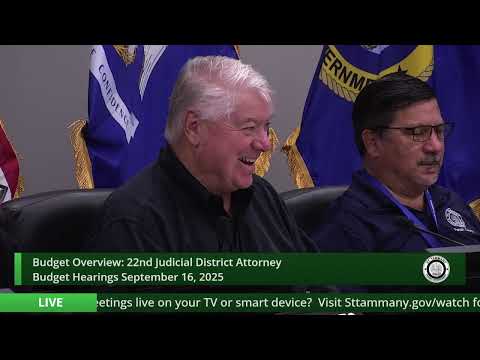
District Attorney Sims told the St. Tammany Parish Council that planned cuts to parish funding would force his office to draw on reserves, leave positions vacant and reduce prosecutorial capacity, and judges warned the 20th Judicial District could only sustain large cuts for about 18 months.
District Attorney Sims told the St. Tammany Parish Council that the parish's planned cutbacks in funding for criminal justice would force his office to draw down reserves, leave positions vacant and erode prosecutorial capacity.
"I can't do that forever," Sims said, describing a strategy of holding 13 vacant positions to slow his office's cash burn as parish receipts fall. He said parish funding for the DA's criminal division was about $6.28 million last year and that a 30% reduction in parish funding would reduce that to roughly $4.9 million.
Why it matters: Council members and court officials said the reductions affect a pipeline of public-safety functions that the parish funds: the district attorney's office, the criminal court custodial fund, the 20th Judicial District and the jail. Officials warned the combination of fewer staff, fewer warrants allocated by the state and declining court fine revenue could lengthen case processing, reduce capacity to pursue complex prosecutions (including child-abuse and opioid-related cases) and increase pressure on pretrial and jail operations.
What officials said
- Sims said his office has been conserving cash for years, using opioid-settlement money and federal forfeiture proceeds to cover mission-specific work and vehicle/technology costs, but those sources "can't come back into the office and supplant" baseline operations.
- Sims described holding vacant positions as a deliberate step: "I'm holding them to affect our cash burn rate," and warned that continued cuts would begin to draw down reserves by roughly $400,000'$600,000 a year once temporary funding sources dry up.
- On warrants and state support: Sims and council members said the judicial district currently receives 30 state-funded "warrants" (a state funding unit worth about $50,000 each). "We haven't added 1 to this parish in 18 years," Sims said; he and others said their delegation is pursuing more warrants and are asking the council to back a resolution or formal letter to the state delegation and governor.
- Judges' representative (standing in for the chief judge) and court administrators told the council the 20th Judicial District runs a high-volume docket with about 12 judges and most court costs concentrated on personnel; they said they could absorb a one-year reduction but not sustain a 30% cut long term. "We can absorb it for a year, but that's not something we can sustain for very long," the judge said, estimating roughly an 18-month horizon under sustained cuts.
Discussion highlights and concerns
- Revenue trend: Finance staff explained the criminal court custodial fund collects fines, costs and forfeitures; those collections have declined from pre-COVID levels and the criminal court fund request for 2026 was presented around $1.2 million (court fines about $800,000 and court costs about $160,000 were referenced).
- Staffing and turnover: Sims described routine attrition after roughly a 10-year threshold (loan forgiveness/retirement milestones) and said he cannot recruit or retain experienced litigators at current pay without risking loss of institutional capacity.
- Public-safety program impacts: Sims highlighted initiatives that could be at risk if cuts are deeper, including a multiagency effort to investigate opioid-related deaths, NCMEC lead investigations and specialized prosecution teams; he warned of a shift toward more plea agreements if the office cannot staff felony trials.
Council reaction and next steps
- Several council members (including President Cooper and councilmembers who spoke) expressed support for pursuing state warrants and for sending letters or a resolution to the state delegation and governor. President Cooper said she would send a letter in support and several council members asked for a formal resolution to appear on a November agenda.
- The council and DA staff discussed opioid-settlement funds, federal forfeiture and the possibility of shifting or applying grant funds (task force recommendations are expected before the council in October) to specialty-court needs; officials cautioned that many grant funds are mission-specific and cannot replace base operating budgets.
What the record shows (decisions vs. discussions)
- Discussion and direction: Council members urged coordinated outreach to the state delegation and supported drafting a resolution and letters to press for additional state warrants. Several members offered to help lobby the North Shore delegation.
- No formal vote: The council did not take a formal vote during the session to change the DA's funding or adopt a resolution; members asked staff to place a resolution and supporting letter on a future agenda.
Ending: Council members and justice-system leaders said they intend to continue joint work on long-range solutions to the parish's structural revenue shortfalls while pursuing immediate state-level relief (additional warrants and legislative assistance). District Attorney Sims and court officials asked the council to consider both short-term mitigation and longer-term tax-restructuring options to create a sustainable funding path for mandated criminal justice services.