Get Full Government Meeting Transcripts, Videos, & Alerts Forever!
Get email alerts on the Elections Electronic Poll Books topic
No spam. Unsubscribe anytime.
Michigan panel hears opposition and support for rule allowing live electronic poll books and seven‑day device deletion
Summary
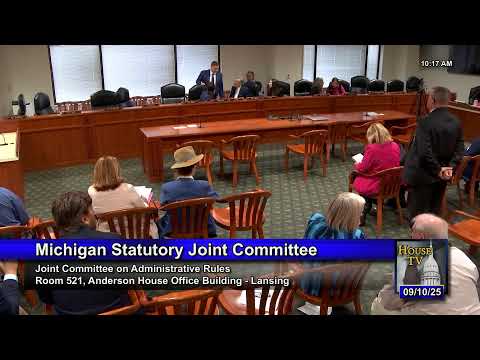
At a Joint Committee on Administrative Rules hearing, state election officials described a rule to permit live, connected electronic poll books on Election Day with a seven‑day minimum before deleting software from devices; clerks, lawmakers and voters raised concerns about record retention, federal law and local custody of records.
The Joint Committee on Administrative Rules heard testimony on a proposed rule (JCAR rule set 25‑49) that would allow clerks to use a live, connected electronic poll book (EPB) on Election Day and require deletion of EPB software and associated files from devices by the seventh day after the final canvas, with uploaded data preserved in the state Qualified Voter File (QVF).
The rule would let clerks operate the EPB with a secure live connection to the QVF where internet access and security standards permit, while requiring clerks to print and retain paper backups and to upload EPB data to the QVF. "Everything out of that poll book has to be printed and it is maintained in a paper form," Aaron Shore of the Michigan Department of State told the committee. "The download serves as that backup."
The change responds to clerk feedback and prior work to develop an early‑voting EPB that several clerks and the Bureau of Elections described as easier for poll workers to use. "Clerks overwhelmingly wanted us to develop the poll book for Election Day," Adam Fercasse, deputy director of the Bureau of Elections, said. He said the seven‑day deletion practice derives from longstanding bureau practice and the operational need to reuse storage devices for subsequent elections, while noting several exceptions: data cannot be deleted if a recount, audit or court matter is pending and security releases have not occurred.
Lawmakers and some former clerks disputed the necessity and legality of removing the EPB software and files after seven days. "This rule set is a power grab by MDOS," said Rep. Smith, who identified himself as chair of the House Committee on Election Integrity, arguing that federal law requires a 22‑month retention period. Former clerks and other speakers urged that original electronic records be kept locally to preserve chain of custody and ease FOIA access. "This rule would allow the destruction of election records at a critical point in the election process," a former clerk testifying as Rep. Bolen said.
Public commenters amplified those concerns. Timothy Smith, a Republican candidate for secretary of state, told the committee the rule "violates both federal and state law" and urged the panel to reject it. Shelly Lake, who identified herself as a deputy clerk, said her FOIA requests found inconsistencies between local flash drive contents and the state’s records and asserted that some local clerks had deleted EPB data at the bureau’s direction.
Department officials said the rule codifies current practice, clarifies that printed records and the QVF upload preserve voter history, and would not mandate EPB use where internet or security conditions are inadequate. Fercasse explained security and audit benefits of a live connection: "One of the benefits...is that it's able to detect voter movement and voter pattern...so that way you're able to prevent any sort of bad actor from going elsewhere." The Department of Technology, Management and Budget (DTMB) developed and supports the system, the bureau told the committee.
Committee members asked about specific elements: which items are preserved in printed reports versus uploaded metadata, whether uploads include time stamps and ballot identifiers, the cost and availability of flash drives, and whether the seven‑day deletion rule conflicts with federal retention statutes for federal elections. Fercasse and other department witnesses said the upload preserves the full data set and metadata that do not appear on printed copies, and that certain retention requirements (for example, 22 months for federal contests) are met by paper and QVF preservation. He also said the seven‑day deletion is not automatic where a recount or other hold is in place.
No formal committee vote on the rule was recorded during the session. The committee recessed with a notice it may revisit the rule on a future date.
The hearing included several procedural motions to adopt minutes of prior JCAR meetings, which the committee approved by unanimous consent before testimony began.