Get Full Government Meeting Transcripts, Videos, & Alerts Forever!
Get email alerts on the Unmanned Aircraft Systems topic
No spam. Unsubscribe anytime.
AirspaceLink tells Michigan House panel it is building drone 'highways' for public safety and commerce
Summary
The Michigan House Committee on Homeland Security and Foreign Influence heard testimony in Lansing from AirspaceLink executives about the company’s FAA-approved system for tracking and authorizing low-altitude drone flights, including operations used by public safety and by upcoming commercial delivery services.
The Michigan House Committee on Homeland Security and Foreign Influence heard testimony in Lansing from AirspaceLink executives about the company’s FAA-approved system for tracking and authorizing low-altitude drone flights, including operations used by public safety and by upcoming commercial delivery services.
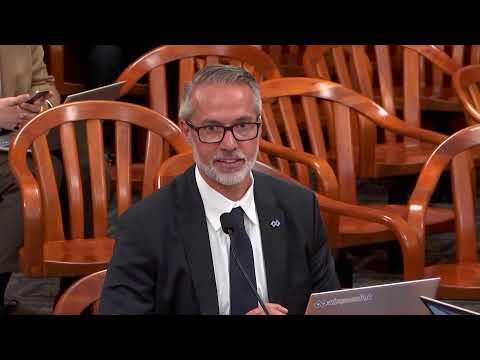
Michael Hillander, cofounder and CEO of AirspaceLink, told the committee that the company runs the FAA’s “Before You Fly” authorization and a broader unmanned-traffic-management layer for flights “400 feet and below.” Hillander said the platform coordinates authorizations with airports and multiple government agencies and that AirspaceLink has been deployed in Detroit and other large U.S. cities to provide a common operating picture for public safety, the FAA and commercial operators. “We are the leading FAA approved low altitude authorization notification capability system,” Hillander said.
Hillander said AirspaceLink’s platform is already used by thousands of operators and public agencies and that it is designed to allow beyond-visual-line-of-sight (BVLOS) operations once federal rules change. “We are building those highways in the sky here in Michigan and throughout the United States,” he said, describing the system as a geospatial back end that integrates radar, communications and remote identification data.
Why it matters: Federal rulemaking and executive actions are expected to expand BVLOS operations for deliveries, medical flights and public-safety responses. Hillander and committee members framed the issue as both an economic opportunity for Michigan manufacturing and a homeland-security and public-safety challenge that will require coordination, funding and training.
Most important details
- Scope and users: Hillander said AirspaceLink’s platform registers roughly 3,000 businesses and about 3,500 municipal, Department of Defense or federal units on its network and that it is integrated with “about 840 airports.” He said the system processes roughly 45,000 authorizations or transactions per day and that platform usage has doubled in the prior six months.
- Remote ID and detection: Hillander explained existing Remote ID rules and the company’s detection capabilities, saying that the platform can currently detect “about 70% to 80%” of drones through a mix of Remote ID broadcasts and additional sensors, and that higher detection rates require more expensive optical or acoustic systems. “That remote ID and or RF detection allows for agencies and our customers to understand what's happening,” he said. He noted that the Remote ID mandate applies to many drones (Hillander said the FAA requirement covers drones above about half a pound) and compared the registry to a license-plate system for UAS.
- BVLOS rulemaking and capacity: Hillander said the FAA has proposed rules under what he described as Part 108 and Part 147 (notice-and-comment rulemaking) that would enable more advanced BVLOS operations, with a final rule expected in the first quarter of next year if the NPRM process proceeds on schedule. He said the industry anticipates 1 operator supervising many drones under those rules and cited a 1-to-40 pilot-to-drone example that will increase the volume of flights to be monitored and coordinated.
- Public-safety and national-security examples: Hillander described deployments for large events (the U.S. Open and a presidential visit), the Blue Angels demonstration, and an incident at a Green Day concert in Detroit where his team helped local authorities locate an operator. He also said AirspaceLink has integrated with federal and local agencies, with work at military installations such as Joint Base Charleston and engagements with Selfridge Air National Guard Base.
- Manufacturing, jobs and training: Hillander said AirspaceLink has raised about $37 million in startup funding and benefitted from early Michigan investments (he cited an initial roughly $100,000 state investment). He described Detroit’s Detroit Air innovation region and an operations center the company is building; he also said the company runs workforce and education programs with local universities and high schools and hosts youth outreach events.
Lawmakers’ questions and company recommendations
Committee members asked about detection accuracy, costs to harden coverage, coordination across jurisdictions, and the role of foreign-made drones in public safety. Representative Menser described county and fire-department uses of drones for search and rescue and inspections and asked about rules around military installations such as Selfridge Air National Guard Base. Hillander said bases and surrounding municipalities must be integrated on the same platform when flights cross fence lines.
On state policy, Hillander urged a sustained, cross-agency state effort — a task force or standing group — to coordinate infrastructure, permitting, funding and regional cooperation. “Someone that wakes up every day or a group or task force that's thinking about how to integrate and attract drone companies … that's number one,” he said. He also recommended stable budgets to keep deployed systems operational and to support public-safety access.
Formal actions at the meeting
Earlier in the session, Representative Menser moved to approve minutes from a previous meeting and the chair recorded approval by unanimous consent; a second motion by Representative Meerman to approve minutes was likewise accepted by unanimous consent. The committee adjourned after the AirspaceLink testimony.
What was not decided
The committee did not vote on any new state law, budget appropriation or formal policy recommendation during the hearing. Lawmakers requested follow-up information and discussed possible state-level coordination and funding but made no formal directive or appropriation on the record.
Context and next steps
Hillander said federal executive actions and rulemaking are increasing momentum for both U.S. drone manufacturing and advanced operations, and he repeatedly framed the topic as dual-use — with civilian and defense applications. He said federal funding and procurement activity (including a prime contract vehicle he described for defense customers) will influence local deployments, and he urged Michigan to sustain investments so companies and workforce development remain in the state.
The committee did not set dates for follow-up votes; staff and members asked for more details about costs, the state role in maintaining infrastructure, and how to keep the industry anchored in Michigan.
Ending
After roughly an hour of testimony and questions, the committee thanked the witnesses and adjourned. No new legislation or rule was advanced at the hearing.