Get Full Government Meeting Transcripts, Videos, & Alerts Forever!
Get email alerts on the Artificial Intelligence topic
No spam. Unsubscribe anytime.
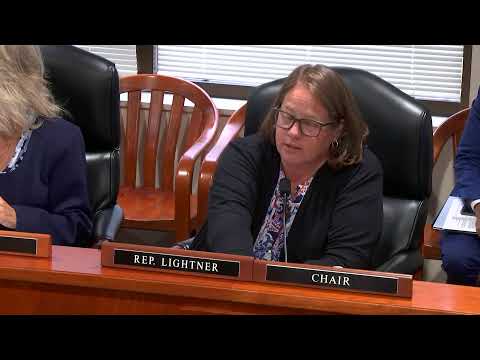
Michigan House Judiciary Committee hears testimony on two AI bills; HB4668 sent to communications panel
Summary
The Michigan House Judiciary Committee heard more than an hour of testimony on bills that would expand criminal penalties tied to AI and establish safety and auditing requirements for high‑risk AI systems, and it voted to send the broader safety measure to the House Communications and Technology Committee for further work.
The Michigan House Judiciary Committee heard more than an hour of testimony on bills that would expand criminal penalties tied to AI and establish safety and auditing requirements for high‑risk AI systems, and it voted to send the broader safety measure to the House Communications and Technology Committee for further work.
Committee Chair (Representative) Leitner moved to refer House Bill 4668, the “Artificial Intelligence Safety and Security Act,” to the Communications and Technology Committee; the motion passed on a recorded voice roll call “10 ayes, 0 nays, 0 pass,” the clerk announced. Committee members did not take a final vote on House Bill 4667, the bill proposing enhanced criminal penalties for crimes committed with the assistance of AI.
Supporters and opponents framed their positions around two central themes: public safety and the risk of a patchwork of state laws. Felix Desimone, organizing director of Paws AI US, said he supports HB4668 and described the bill as “common sense” guardrails for advanced models. Desimone told the committee the bill would require large AI developers to implement "safety and security protocols" and predeployment testing, publish transparency reports and submit to third‑party audits; it would also create whistleblower protections and allow the Michigan attorney general to enforce the law. Desimone noted the bill’s threshold for “critical risks” as models capable of causing "the death or injury of more than a 100 people or causing more than a billion dollars in property damage," and argued the measure applies narrowly to the most powerful models.
Rob Ellavel, cofounder and CEO of Transparency Coalition, said he supports both HB4667 and HB4668 and emphasized the role of whistleblowers in revealing harmful corporate practices. "Without whistleblowers...we wouldn't have had Frances Haugen's testimony," Ellavel said, arguing that the bills’ audit and whistleblower provisions are modeled on safety practices used in high‑risk industries.
Representing business interests, Randy Gross, senior director of legislative affairs for the Michigan Chamber of Commerce, told the committee the Chamber "appreciate[s] the need and the interest in the regulation of AI" but urged that regulation start at the federal level to avoid inconsistent state rules. Tyler Dears, Midwest executive director for TechNet, a technology trade association, also opposed the bills as written, saying "we believe that the regulation of Frontier models is a federal issue" and warning that differing state regimes could impose 50 separate compliance frameworks on companies.
TechNet and other industry witnesses raised specific technical concerns: vague or divergent definitions of terms such as "AI system," the lack of established third‑party audit standards, and potential legal exposure for developers whose models are later misused. Dears recommended delaying state action or creating a state task force to align with developments in other states and at the federal level.
Committee members asked clarifying questions about the scope of penalties in HB4667 and the mechanics of HB4668’s auditing and enforcement provisions. Representative Carter said he is "concerned" about language in HB4667 that could treat any crime committed with AI the same regardless of whether it is a misdemeanor or a felony. The chair acknowledged HB4667 would warrant further discussion and explicitly said the panel would not vote on the criminal penalty bill at the hearing.
For HB4668, proponents said the bill targets only the most powerful models and would not apply to startups whose systems are not capable of the bill’s defined critical risks. Opponents warned the bill’s third‑party audit and reporting requirements could be difficult to implement in the absence of standardized auditing protocols.
The committee’s referral sends HB4668 to a chamber committee that focuses on technology and communications policy for additional drafting and stakeholder negotiation. HB4667 remains with the Judiciary Committee for further deliberation; no final vote was taken on the criminal penalty provisions during this hearing.
Next steps: HB4668 will be considered by the House Communications and Technology Committee; HB4667 will return to further review in the Judiciary Committee at a later date.