Get Full Government Meeting Transcripts, Videos, & Alerts Forever!
Get email alerts on the Passenger Rail Joint Service topic
No spam. Unsubscribe anytime.
State, RTD and Front Range district press ahead on “joint service” plan to start Denver–North rail by 2029
Summary
State and regional rail officials told council a joint‑service effort has entered access negotiations with BNSF and aims to deliver a starter passenger rail service (three daily round trips) between Denver and points north by Jan. 1, 2029, using new state fee revenue plus existing FastTracks funds.
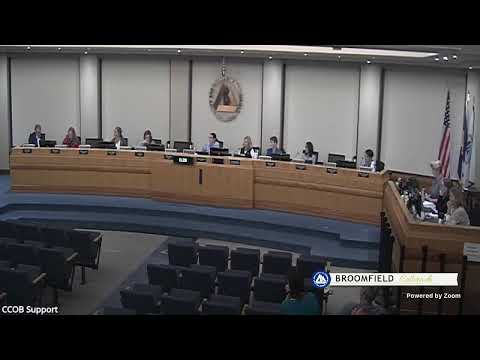
State and regional rail officials told the Broomfield council Tuesday they are pursuing a near‑term "joint service" that blends Front Range Passenger Rail’s long‑range vision with RTD’s Northwest corridor study in an effort to deliver passenger rail sooner.
"Joint service is a collaborative effort between RTD, the Front Range Passenger Rail district, and CDOT to develop a starter passenger rail service by 2029," said Mo Sullivan, assistant director of passenger rail at the Colorado Department of Transportation. Brandon Schafer, special adviser for passenger rail and transit for the state, said the parties have begun negotiating access with BNSF, the freight railroad that owns the corridor.
Officials said the interagency effort was directed by the legislature and funded in part by two recently enacted state fees plus existing FastTracks sales tax revenue: the rental car congestion fee authorized by Senate Bill 184, the oil‑and‑gas fee from Senate Bill 230, and FastTracks collections in the Northwest corridor. Schafer said the entities have formed an intergovernmental framework and an executive oversight committee and that BNSF access negotiations began "almost a month to the day" before the council meeting.
RTD project manager Patrick Stanley summarized the agency’s Northwest Rail Peak Service study, which analyzed a three‑trip morning and three‑trip evening commuter pattern between Longmont and Denver. The study estimated capital costs of roughly $650 million for stations, track infrastructure and supporting facilities and an annual operating cost of $12 million to $16 million. The study’s modeled 2030 ridership was about 1,100 boardings per day for the peak service configuration.
Schafer and other panelists also cited a March 1 state study that estimated an initial capital cost in the neighborhood of $885 million for a starter service depending on scope; they said the access agreement negotiations with BNSF will allow the parties to verify the specific capital projects and firm up costs. "Once we actually start negotiating with BNSF, they will actually verify the engineering," Stanley said.
Officials said the joint service starter would be smaller than the Front Range Passenger Rail district’s full buildout and could begin with three daily round trips and a small number of intermediate stops, while the full FRPR vision plans for more frequent service in later phases. Schafer said the March 1 work modeled adding FastTracks stations such as a Broomfield stop at 100‑sixteenth Avenue and that the joint service approach is intended to preserve station locations within the broader Front Range plan.
On vehicle propulsion and rolling stock, panelists said technology choices remain open. Emerging options such as hydrogen or battery trainsets are under development, but the parties are balancing cost, schedule and proven options to meet the 2029 statutory start date. Officials said an operator decision (likely Amtrak, they said, for indemnity reasons) and the specific rolling stock will be determined later in procurement and are operator‑dependent.
Council members asked about funding certainty, potential litigation or need for eminent domain, station siting, and why Loveland and Fort Collins were included in the regional plan despite not paying RTD sales tax. Panelists said the access agreement will identify the capital scope and schedule and that state fee revenues are dedicated to the initiative. They also said Senate Bill 184 contains accountability language requiring regular reporting if service does not begin by the Jan. 1, 2029 statutory deadline.
"We are in a path to deliver service by 01/01/2029," Schafer said, adding that boards will need to vote on the financial plan and funding appropriations once BNSF provides final costs. Officials asked local elected leaders to engage their RTD board representatives when the parties present a financial plan next year.
Panelists cautioned that timing and costs will be refined as the access agreement concludes and as an operator and rolling stock are procured, but they said the joint service approach is intended to accelerate a starter service by pooling existing revenue streams and technical work completed to date.