Get Full Government Meeting Transcripts, Videos, & Alerts Forever!
Get email alerts on the Permitting Software topic
No spam. Unsubscribe anytime.
Public Works delays contract vote on Clarity Cloud permitting system as citywide OpenGov project advances
Summary
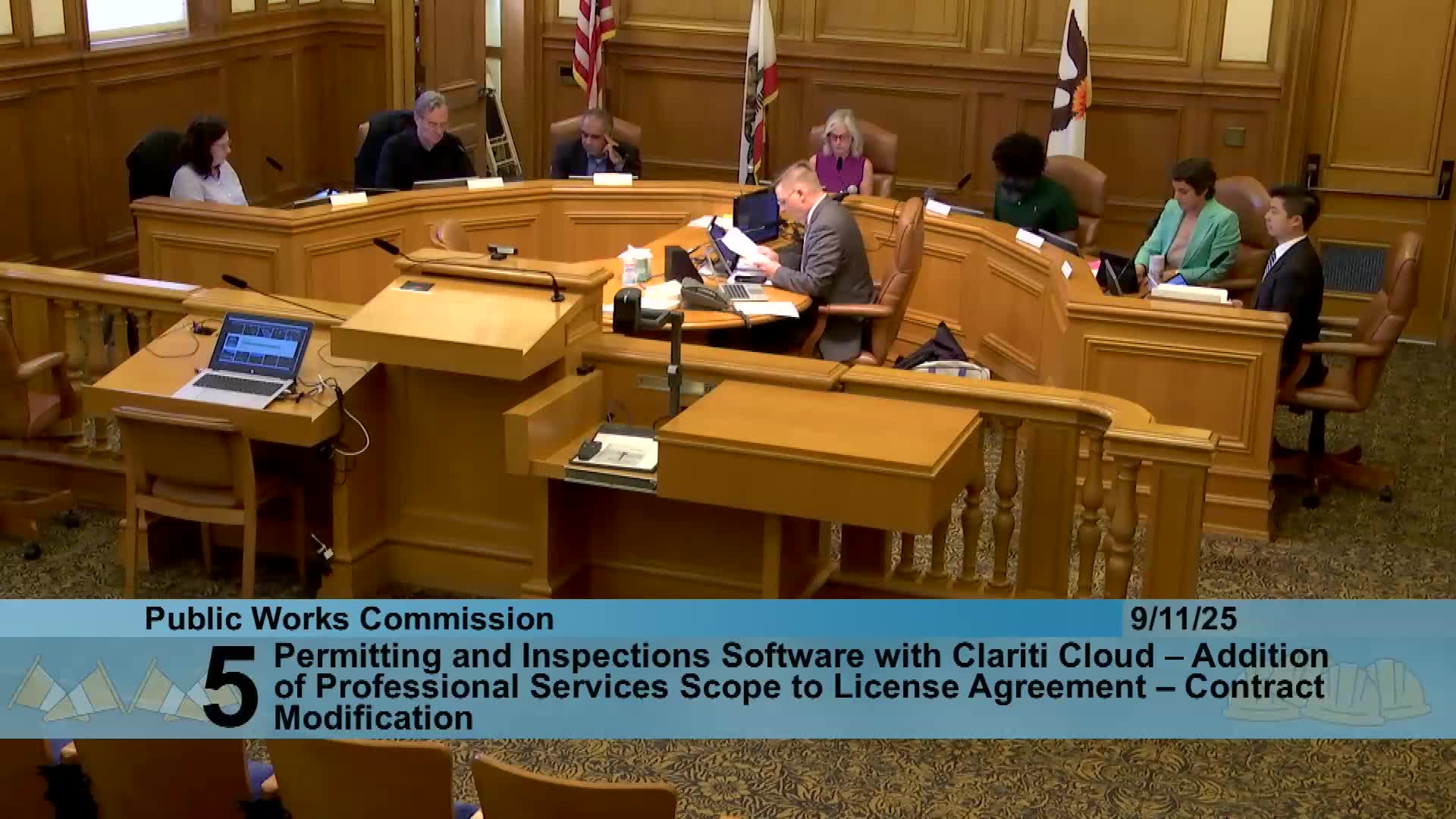
San Francisco Public Works presented progress on its Clarity Cloud permitting and inspection rollout, outlined costs and integrations, and the commission voted to continue consideration of a contract modification to a future meeting while staff coordinates with the citywide OpenGov initiative.
Public Works Commission members received an update on the department’s multi‑phase rollout of the Clarity Cloud permitting and inspection system and voted to continue consideration of a contract modification to a future meeting.
The presentation, given by project manager Bernie C and Director Carla Short, summarized Phase 1 scope (street space permits, temporary occupancy permits, sidewalk repair permits and conformity inspections), a January 2026 go‑live target for Phase 1, and planned Phase 2 work that would follow in 2026–2027. “Phase 1 is composed of street space permits, temporary occupancy permits, sidewalk repair permits, and conformity inspections. And that first phase is scheduled to go live in January 2026,” Bernie C said.
The commission was briefed on schedule, testing and integration work. Staff said iteration‑based builds and testing are under way, with iteration 3 in development and user acceptance testing planned for December. Integrations already completed include Treasury and Tax Collector business‑license lookup, the California state contractor licensing board lookup, and Public Works address and parcel data. Staff said remaining integrations include the city’s payment processor, GIS mapping (for street trees, curb ramps and parking meter locations), and the department’s document management system.
Nut graf: The department asked the commission to consider a contract modification that would fold implementation scope into the Clarity licensing contract and add several integrations and ongoing support services. Commissioners instead voted to continue the contract modification so staff can further coordinate Clarity work with the mayor’s office OpenGov procurement and finalize contract terms.
Public Works provided cost figures and scope clarifications during the briefing. Staff said about $643,000 remains from the prior tech marketplace contract and would be applied to the Clarity contract. New implementation scope was ballparked at about $315,000 and an annual support/licensing component was estimated at roughly $631,000 over six years (approximately $110,000 per year). Staff told the commission the department will have spent about $1.7 million on Clarity implementation and licensing by the time Phase 1 is live.
Commissioners pressed staff on whether Clarity can integrate with the citywide OpenGov permitting platform selected by the mayor’s office. Director Short and Deputy Director Alec de Grafneried said OpenGov (the mayor’s front‑door permitting vendor) and Clarity are separate commercial platforms and a direct technical integration is not assured. “I suspect it will not connect,” Bernie C said when asked whether Clarity would plug directly into OpenGov. Staff said the citywide migration to OpenGov will be phased and that Public Works expects overlap; they emphasized the department’s Clarity work (data cleanup, business rules and integrations) should make any future migration smoother.
Chair Post moved and the commission seconded a motion to continue the contract modification to a future meeting. The motion carried unanimously; staff agreed to return with the contract modification and recommended terms after further coordination with OpenGov and the mayor’s office.
Ending: Commissioners asked for a short progress update once Phase 1 has been used in production; staff suggested returning in roughly six months for a status report.