Get Full Government Meeting Transcripts, Videos, & Alerts Forever!
Get email alerts on the School District Reconfiguration topic
No spam. Unsubscribe anytime.
Kyrene long-range planning committee recommends 4-region map (West A, East B); Millennial identified as proposed K–5 gifted academy
Summary
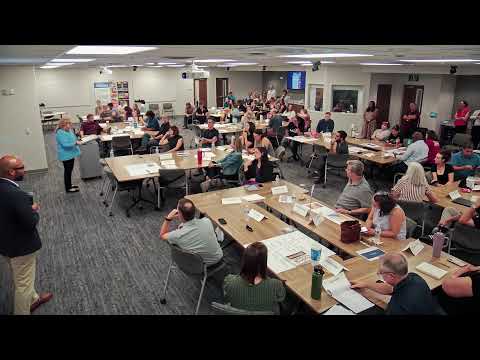
A Kyrene Elementary District long-range planning advisory committee voted by table tally to recommend a four-region reconfiguration — combining the West A and East B maps — to the district governing board and identified Millennial as the proposed K–5 gifted academy.
A committee convened by the Kyrene Elementary District recommended a four-region reconfiguration and selected the West A and East B maps as the package it will forward to the district governing board for consideration.
The advisory group — meeting for its sixth and final session — reported a table tally in which seven of eight tables chose West A on the West Side and five tables chose East B on the East Side (three tables chose East C). No table selected the five-middle-school model at the meeting. The committee’s recommendation will be transmitted to the governing board for action and followed by regional public hearings if the board advances the proposal.
Why it matters: District staff told the committee the district’s current facilities are sized to serve roughly 20,000 students while enrollment is projected to fall. Presenters said the combination of declining enrollment and fixed facility costs is creating a fiscal gap the district must address; staff estimated the near-term loss of revenue at roughly $7 million (district-wide estimate discussed at the meeting). The committee’s recommended map is intended to raise overall school utilization and create a program footprint the district can sustain.
What the committee decided and how it decided it The committee proceeded by reviewing multiple model packages developed by the district demographer. Rick, the district demographer, presented a series of maps and enrollment estimates based on 2024–25 40th-day enrollment and a set of planning parameters the committee established earlier, including maintaining dual language programming on both sides of the freeway and creating a centrally located gifted program option.
After staff presented West and East map options, committee members discussed the trade-offs at their tables and then reported a table vote. Committee co-leads announced that seven of eight tables selected West A on the West Side and five tables selected East B on the East Side; one table on the West Side selected West B, and one table’s initial East A vote moved to East B during the process. The committee did not take a formal parliamentary motion with named movers or seconds; staff recorded the table tallies and announced the package as the group’s recommendation to the governing board.
Legal and implementation constraints Jordan, district legal counsel, outlined statutory and administrative constraints the district must follow before closing or changing schools. Jordan said the district must provide notice to families: "we provide notice to all the people enrolled at the school 10 days before we have the meeting, which has to be 10 days before there would be a public vote." Jordan also noted differences between closing a school and changing boundaries: boundary notices must go to families who would be affected by the boundary change (including addresses for non-enrolled households when required) and maps must be posted online.
Counsel further advised that approvals to sell or lease district property are time-limited under statute (approvals discussed at the meeting were described as effective for 20 years) and that proceeds from a sale may be restricted to capital projects depending on the circumstances; leases can offer different flexibility for general fund uses. Counsel also warned that charter schools that are the highest qualified bidder may be difficult to reject without robust justification.
Program placements and facility reuse A consistent element across the options presented by the demographer was a proposal to designate Millennial as an open-enrollment K–5 gifted academy (no home boundary). Superintendent Tingus clarified that Millennial had been identified with staff as the recommended site for the gifted academy after working with the demographer. Tingus also said two other campuses shown on the maps (identified in the presentation as Manitas and KTA) were recommended for “closed/repurpose” status, not as immediate sales: "Our recommendation to the governing board would be not to get rid of that land or that building. It's in a good location for the district, and the building could be used for something else," Tingus said, listing examples such as an early childhood center, a community use, or another school program.
Staff noted that repurposing a building for continued school use (for example converting a general education campus to a specialty gifted campus or dual-language campus) does not trigger the same notification or school-facilities reporting requirements that a facility withdrawal from education use would.
Operational and capacity details discussed Presenters explained how building capacity is calculated (classroom counts, rooms reserved for specials/electives, grade-level class-size standards) and said the demographer’s enrollment estimates used the district’s most recent 40th-day counts as a baseline. Staff also noted near-term local housing development on the West Side (an area west of 19th Avenue) that project staff estimate could add roughly 250–350 students into district enrollment over time; the demographer said the West-side options preserved capacity for that incoming housing.
Next steps Staff described the calendar for the decision process: the committee’s recommendation will be transmitted to the governing board for consideration the following month; if the board advances the recommendation, the district will hold a series of regional public hearings (organized by middle-school catchment region) and return to the board with final recommendations and a board vote on a timeline presented in December and January for transition planning and implementation logistics.
Votes at a glance (committee table tally) - West Side: West A — 7 tables; West B — 1 table; Five–middle-school model — 0 tables - East Side: East B — 5 tables; East C — 3 tables; East A initially 1 table that moved to East B
What was not decided The committee’s table tallies are a recommendation to the governing board; no board action or statutory closure/boundary change occurred at this meeting. Staff repeatedly emphasized the distinction between committee recommendation, board decision, and the separate public-notice and statutory processes that must follow for closures, boundary changes, leases, or sales.
Documentation and public access Staff reminded the committee that meeting videos and materials are posted on the district website for public review and encouraged committee members to refer members of the public to the recorded presentations.
Ending The committee concluded its sixth meeting after the table tallies and staff outlined next steps. Staff emphasized that the recommendation is the product of a months-long process designed to raise utilization while preserving program continuity, and that implementation will follow statutory notification and public-hearing steps if the governing board advances the package.