Get Full Government Meeting Transcripts, Videos, & Alerts Forever!
Get email alerts on the Public Space Ordinance topic
No spam. Unsubscribe anytime.
Council adopts ordinance tightening rules on storage of personal property in public spaces after amendments and procedural votes
Summary
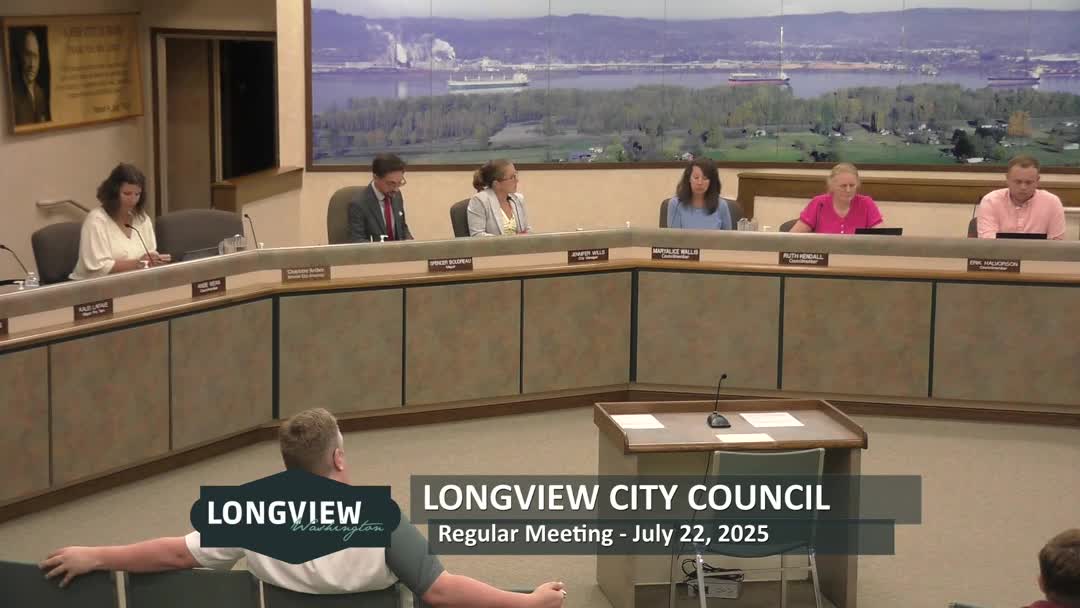
After a series of amendments, tie votes and a suspension-and-reconsideration, the Longview City Council adopted Ordinance 3564 amending Longview Municipal Code section 7.29.002 and 7.29.040 on storage of personal property on public land.
The Longview City Council on July 22 adopted Ordinance 3564 amending Longview Municipal Code sections 7.29.002 and 7.29.040 to regulate storage of personal property on public land. The ordinance passed after council amendments, a tied vote on a key provision, and a later successful motion to reconsider.
City Manager Wills and city staff had no additional presentation but explained a task force will be reconvened to continue work on implementation details, including document-recording fees discussed earlier with partner organizations. Council members reviewed three proposed amendments offered by Council Member Kendall and discussed enforcement and clarity concerns.
Council Member Kendall proposed three amendments: 1) strike the exception for “constructed tents” from the bulky-item definition so constructed tents remain governed under the city’s camping rules; 2) remove subsection (d) from the excessive-storage definition (which read that storage “interferes with the ordinary use and enjoyment of the public space”), because Kendall described it as subjective; and 3) simplify the definition of public property to a short, general phrase covering “publicly owned and maintained or controlled property.”
The council adopted the first amendment (removing the “constructed tent” exception) unanimously. The second amendment — removing the subjective subsection (d) — produced a 3–3 tie and initially failed. Interim City Attorney Don Finley advised that because the ordinance language used the word “or,” only one of the listed criteria needed to be met to trigger the excessive-storage definition; he recommended a small reordering of the phrasing if the council removed subsection (d). After the tie vote the council voted to suspend the rules (a procedural motion requiring a two-thirds vote), the suspension succeeded, and council reconsidered the failed amendment. On reconsideration the council adopted the amendment to retain subsection (d) (meaning the “interferes with the ordinary use and enjoyment” standard remained in the ordinance).
Council adopted the third amendment simplifying the public-property definition unanimously. After amendments were incorporated, a motion to adopt Ordinance 3564 as amended carried by voice vote.
Council and staff discussed enforcement questions. Manager Wills said the subsection at issue had not been fully vetted for enforcement and that staff would need to work further with law enforcement and partner jurisdictions to develop enforceable procedures and educational outreach. Finley advised the council on phrasing and parliamentary procedure during the amendment debate.
Several council members noted concerns about subjectivity and enforcement. One council member said she would vote no unless the council removed the subjective language; after the suspension and reconsideration that member voted in favor and the ordinance passed.
The ordinance’s immediate effect is to update definitions and standards for bulky items and excessive storage on public property; staff said a reconvened task force and further staff work will follow to refine enforcement guidance and outreach before broad enforcement actions.