Get Full Government Meeting Transcripts, Videos, & Alerts Forever!
Get email alerts on the County Budget topic
No spam. Unsubscribe anytime.
Ashland County human services board approves 2026 budget; staff outline program, SNAP and Medicaid concerns
Summary
The Ashland County Human Services Board approved the department’s 2026 budget and voted to forward a resolution urging greater state investment in income maintenance administration.
The Ashland County Human Services Board approved the department’s 2026 budget and voted to forward a resolution urging greater state investment in income maintenance administration.
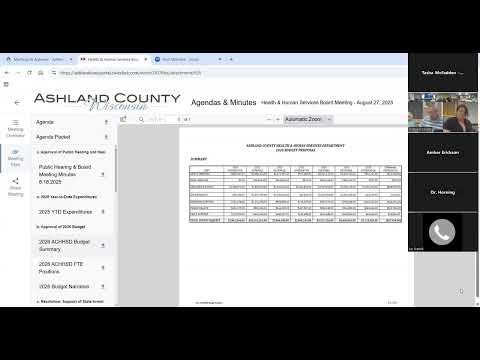
Board members approved the budget after a presentation on year-to-date finances showing revenues and expenditures through June 30. Amber, who presented the financial reports, said the county’s spending is tracking close to last year and that she had “no red flags” from the midyear review. The board voted to submit the budget to the county finance committee; the motion was made by George Boussier and seconded by Doctor Keller and carried unanimously by voice vote.
Why it matters: staff said the budget request includes a modest levy increase largely to cover step increases for wages. Separately, human services staff described program changes and state policy shifts that could increase county costs in 2026–2027, including federal SNAP match changes and a local decision to let one certification lapse because there were no clients.
Key details
- Budget status and levy: Amber said the year-to-date report covers expenses and revenues through June 30 and that the department is “right on track.” The proposed 2026 budget includes a small increase in the levy request to cover step increases in wages; retirements and hiring at lower steps tempered the final amount. The board approved the 2026 budget and forwarded it to finance (motion by George Boussier; second by Doctor Keller). Outcome: approved.
- ADRC line-item variance: Board members asked about an apparent large percentage variance in the ADRC line. Amber explained the variance reflects small-dollar budget lines (for example, a $333 budget item with $1,000 in expenses), and that reimbursements during the year will change the final figures.
- Community Support Program (CSP) / Comprehensive Community Services (CCS): Human services staff explained the county will no longer be certified for the older community support program (CSP), because the county has not had clients served under that certification since CCS has been providing the needed services. Staff said CCS is the rehabilitative program now serving clients and that the state indicated it would not continue certifying CSP if the county is not actively serving clients; staff said the county can reapply for CSP certification if demand returns. The budget continues to assume a 97% reimbursement rate from CCS (staff noted historical reimbursements were about 99.9% through 2023).
- SNAP and Medicaid funding changes: Human services staff summarized anticipated federal and state changes that could shift costs to counties. Staff said changes planned to take effect in part in October 2026 would alter cost-match arrangements for certain administrative reimbursements; staff characterized the likely effect as counties bearing more of the cost (one example provided by staff: a much larger county in the consortium, Wood County, estimated roughly $43,000 in impact from this change). The board was told that direct service levels for clients are not expected to change immediately for 2026, but administrative costs and verification workload could increase in later years.
Board action and next steps
- Motion to approve the 2026 budget and submit it to finance: motion by George Boussier; seconded by Doctor Keller. Vote: aye; motion carries.
- Resolution on income maintenance funding: the board approved a resolution encouraging state investment in income maintenance administration and forwarded the resolution to the full county board for consideration. Motion to accept and forward was seconded by Elizabeth Franck; vote: aye; motion carries.
What board members asked and emphasized
Supervisors questioned line-item variances and asked staff to confirm small numeric entries. Several members pressed staff on the future administrative workload tied to SNAP and Medicaid changes, noting verification requirements and potential staffing impacts. One member said the Wisconsin Counties Association and the Wisconsin Human Services Association intend to push the state for additional funding rather than shifting full cost burdens to counties.
Ending
Staff said they will continue monitoring reimbursements and program demand and will report back as the state clarifies implementation timelines for federal and state policy changes.