Get Full Government Meeting Transcripts, Videos, & Alerts Forever!
Get email alerts on the General Plan topic
No spam. Unsubscribe anytime.
Cottonwood Heights planning commission reviews draft general plan, schedules joint work session with council
Summary
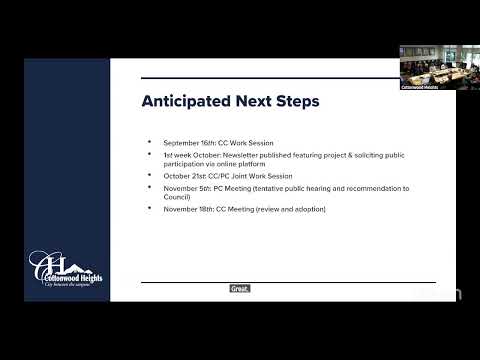
The Cottonwood Heights Planning Commission on Sept. 3 reviewed a draft of the city—s updated general plan and mapped out public outreach and next steps, including a joint work session with the City Council on Oct. 21 and a target public hearing on Nov. 5.
The Cottonwood Heights Planning Commission on Sept. 3 reviewed a draft of the city—s updated general plan and mapped out public outreach and next steps, including a joint work session with the City Council on Oct. 21 and a target public hearing on Nov. 5.
The draft, presented by consultants and staff, would replace the general plan adopted near the city—s incorporation in February 2005 and is intended to guide land use, housing, transportation, water use and preservation, economic development, recreation and sustainability for the next decade. Aubrey Larson, a consultant on the project, said the document treats the plan as an advisory roadmap rather than a regulatory text: "A general plan is required... it really is meant to just be a road map for the community," Larson said.
Why it matters: State law requires cities to adopt a comprehensive general plan and, as of 2022, to include a water-use and preservation element. The city—s draft addresses those statutorily required elements (land use, housing, transportation and water use) and adds chapters on economic development, recreation and sustainability. City staff and consultants told commissioners the plan is intended to coordinate with several existing and recently completed planning efforts, including the town-center planning work, the Fort Union master plan, form-based code work and other corridor/master plans.
What commissioners heard and discussed - Scope and schedule: Consultants asked the commission to review the draft in detail and return comments before the Oct. 21 joint work session, saying the goal is to provide consolidated direction to the consultants at that meeting so revisions can be prepared for a public hearing. Staff and consultants described a draft timetable that includes outreach in the city newsletter and online engagement tools between mid-September and the joint session, followed by a public hearing targeted for Nov. 5 and council adoption expected in November or December.
- Role of the commission: A planning staff member explained the commission—s advisory role to the City Council and said the council often relies on the commission for technical, "in the weeds" review of the plan and recommendations on amendments or code changes that implement the plan.
- Water-use requirement and local creeks: Commissioner Dan Paulson asked who controls Little Cottonwood Creek and how the creek is addressed in the water chapter. Larson said the water element examines watershed health, stream networks, groundwater and regional infrastructure, and noted that Cottonwood Heights is not itself a water provider; water is supplied primarily by the Salt Lake City Department of Public Utilities and in a small portion by Jordan Valley Water Conservancy District. Larson said the chapter recommends strategies to reduce per-capita water demand and coordinates with those outside providers.
- Relationship to existing plans and form-based code: Several commissioners urged the draft to explicitly acknowledge and weave in prior planning efforts (town center studies, Fort Union master plan, form-based code work and other neighborhood/master plans). Mark Vlasic of Landmark Design said the current draft intentionally builds on and summarizes the work completed since the earlier draft (2022), noting, "I would say on this draft in particular, it was the primary focus." Commissioners asked that the plan make clear where those adopted studies are reflected and where they remain separate implementation efforts.
- Economic-development emphasis and the Gravel Pit site: Commissioners pressed for clearer fiscal context in the economic-development chapter, asking that the plan explain how different forms of growth (increased population vs. commercial/retail development) affect the city—s tax base and service costs. Several commissioners suggested lifting explicit discussion of strategic commercial nodes (for example, the Gravel Pit area and the town center) higher in the document to show their potential as fiscal engines rather than only as housing sites.
- Transportation and regional control: Commissioners discussed the difference between locally controlled corridors (e.g., Fort Union Boulevard) and regional facilities where outside agencies (state DOT, UTA) have primary authority. Staff emphasized that the plan should indicate which recommendations are within city control and which will require coordination with external agencies.
Public engagement and next steps: Staff and consultants said the draft will be featured in the city newsletter and posted online with a comment mechanism; they indicated they are still finalizing whether outreach will use structured questions or an open comment field. Commissioners asked for editable review options (PDF redlines, Word or shared document) or printed copies to collect handwritten notes. Staff offered to consolidate comments from commissioners and the public for the consultants to prepare a revised draft.
Votes at a glance - Motion to adjourn (no ordinance or resolution text): Approved by voice vote at the end of the session. The meeting was formally closed after a motion and second; the chair called for "All in favor? Aye." No roll-call tally was provided in the record.
Context and timing: The consultants and staff reported the general-plan project began in 2020, produced an earlier draft posted in 2022, then paused while the city pursued a form-based code and other master plans. Work resumed in late 2024, producing the current draft. Staff emphasized the state requirement that the water-use element be adopted this year and described the plan as a living document that the city can revisit periodically.
What remains unresolved: The draft as presented leaves several implementation questions for future work: whether the city will require fiscal-impact analyses with certain rezones or development proposals; the precise sequencing and extent of form-based code application across activity centers; and specific coordination steps with regional water and transportation providers. Commissioners asked staff to prepare materials that clearly indicate where recommended actions are within city control and where interagency coordination is required.
The meeting adjourned after the vote to close the work session; commissioners and staff will continue review and outreach ahead of the Oct. 21 joint work session with the City Council.