Get Full Government Meeting Transcripts, Videos, & Alerts Forever!
Get email alerts on the Tenant Right To Counsel topic
No spam. Unsubscribe anytime.
Douglas County commissioners hear case for tenant right to counsel; staff to review proposed language
Summary
Presentations from a national coalition and local tenant organizers outlined research and local survey data supporting a government-funded tenant right-to-counsel program. County legal counsel and staff will review proposed resolution language and return recommendations to commissioners for next steps.
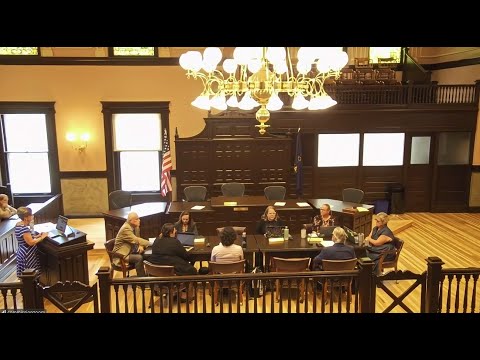
Douglas County commissioners on Wednesday heard a presentation on establishing a tenant right-to-counsel program, with proponents saying government-funded attorneys for tenants facing eviction can reduce homelessness, advance racial equity and correct legal imbalances in eviction court.
Andrew Ashbrook, tenant right-to-counsel implementation adviser at the National Coalition for Civil Right to Counsel, told the commission that jurisdictions with funded tenant counsel show improved outcomes for tenants and cost savings for local government. "Only 4 percent of tenants nationwide are represented, while 83 percent of landlords are represented in eviction cases," Ashbrook said, arguing that government-funded full representation corrects that disparity.
Proponents emphasized local data. Vince Munoz, an organizer with Lawrence Tenants, said the county’s tenant experience survey found that 50.5 percent of housing units in Douglas County are renter-occupied and that half of renters are rent-burdened. He said 45 percent of survey respondents reported feeling unsafe in their homes and 63 percent had unresolved maintenance requests; the survey included reports that a landlord had broken into a tenant’s bedroom and one respondent said that experience would make mediation retraumatizing.
Kansas Holistic Defenders representatives described current local capacity and data tracking. Hetty Pierce Armstrong said their office provides an attorney at the answer docket each week and that, under current grant funding, that attorney is accepting about two to three eviction cases a week. Armstrong said the office logged 54 evictions filed in Douglas County in August 2025 and that typical weekly dockets ranged from nine to 16 cases. "If someone does not appear at the answer docket, a default judgment is issued and a writ can follow," she said.
Commissioners asked legal and operational questions. John Bullock, Douglas County counsel, said his preliminary view is that the county cannot unilaterally create a civil right to court-appointed counsel equivalent to the criminal constitutional right. "My current opinion ... is that while the county would be able to create a program to provide funding and logistics and administration or a service that would provide counsel to tenants in eviction proceedings, we would not be able to create a legal requirement that the courts would be bound to follow," Bullock said.
Discussion also addressed alternatives such as mediation. Proponents said mediation differs from attorney representation because mediators must remain neutral and typically cannot tell participants their legal rights; they noted cases in which survivors or tenants subject to alleged criminal conduct would be retraumatized by being placed in a mediation room with a landlord. Munoz said programs often work best in combination with rental assistance, mediation and other tenant services.
Commissioners and staff discussed funding and next steps. Commissioners noted the county’s 2026 budget process is already complete and that adopting an unfunded new code or resolution could be problematic. Commissioner discussion identified existing, modest commissioner contingency funds for eviction diversion and said some eviction defense work already receives short-term grant funding. Staff and county counsel were asked to review the proposed language Lawrence Tenants provided, evaluate funding and administrative options, and return recommendations to the commission in a future meeting this fall.
No formal vote or ordinance was adopted at the work session. Commissioners recessed the work session and planned to continue the topic at a later public business meeting with the proposed language uploaded to the meeting packet as part of the public record.