Get Full Government Meeting Transcripts, Videos, & Alerts Forever!
Get email alerts on the Zoning Code Modernization topic
No spam. Unsubscribe anytime.
Maricopa County moves to modernize 1969 zoning code; draft will add ADU, short-term rental rules
Summary
Maricopa County planning staff presented a zoning-code modernization that condenses land-use categories, adds graphics and development tables, and incorporates state-mandated accessory dwelling unit (ADU) rules. The county plans to release a draft for public comment in the coming weeks using the Conveio platform.
Maricopa County planning staff provided an update on an overhaul of the county's zoning ordinance, saying the project will condense outdated text, add graphics and land-use tables, and incorporate newly required accessory dwelling unit (ADU) regulations and short-term rental controls.
The county's existing zoning ordinance dates to 1969 and is heavily text based, planning staff said. Tom, a county planning staff presenter, said the modernization aims to make the code “usable, readable, user friendly, very clear to understand” and easier to navigate.
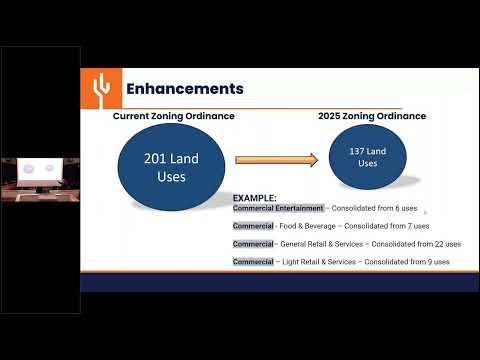
The proposal condenses chapters and land-use categories. Tom said staff consolidated 17 chapters into 14 and reduced the number of listed land uses from 201 to 137. The update introduces a single land-use table that will show whether a given use is allowed by right, allowed with a plan-of-development, allowed by special use permit, or allowed temporarily, with cross-references to any additional regulations.
State ADU requirements are driving part of the schedule. Tom said state statute requires counties to have regulations for accessory dwelling units by the end of the year. Under the statute Tom described, counties must allow at least one attached and one detached ADU on properties with a single-family home; for parcels of one acre or more, counties must permit an additional detached ADU if it meets affordability requirements enforceable by deed restriction or similar recordation. Tom said the draft will reflect that a detached ADU may encroach up to 5 feet into a setback as allowed by state statute.
Tom described how municipalities in the region have already adopted ADU limits: “the ADU ... can't be more than 75% or a thousand square feet of the primary home. 75% of the primary home or a thousand square feet, whichever is less.” He said counties have somewhat different options available than municipalities and the draft will consider those variations.
Staff will also add rules addressing short-term rentals and how they interact with ADUs. Tom said state statute requires the primary property owner to live on the property if an ADU is offered as a short-term rental; the draft will codify how short-term rental rules apply to ADUs.
The modernization will include more graphics and development standards tables to clarify setbacks, height limits and lot-coverage rules. Tom and his team emphasized that visual diagrams and a consolidated development-standards table will replace dense text blocks that currently require readers to flip among multiple chapters.
On outreach and comment collection, Matt (project staff/consultant) demonstrated Conveio, a web-based commenting tool the county will use to publish the draft and gather public input. Matt said Conveio lets users pin comments to specific spots in the document, classify comments (for example, question or suggested edit), upvote or reply to others' comments and download or search the document. “It basically allows you to comment on the document as if you've commented on a PDF before,” Matt said.
Tom and staff encouraged public input: the questionnaire for early feedback remains open through Sept. 12 (Tom said respondents had submitted almost 300 responses to date). Tom also told participants that about 190 people had registered online for the meeting. The county plans to release a near-final draft to the public within a couple of weeks and will notify people on its contact list when the Conveio link is available.
A few procedural and timeline items were emphasized: staff said they will finalize the draft and accept comments via Conveio, then proceed through the county's formal adoption process. Tom asked attendees to submit further questions by email or through the project website; staff said they would keep the meeting chat open for additional questions.
Questions from attendees included how Conveio handles identity when users upvote or comment. Faith Outers of BFSO asked, “If you are voting or up liking, do you have to show your identity in doing that?” Matt and other staff explained that commenters are asked to provide a name and email for follow-up but that the system does not require verification; votes or upvotes from users who do not provide identifying information will appear anonymously or as generic anonymous entries.
The presentation illustrated examples of how several specific land uses (for example, food-service establishments and light retail) were reclassified into broader categories and how development standards tables will present allowable uses and standards by zoning district. Staff said the revisions aim to align the county code with current statute and to add references for emerging technologies such as utility-scale solar, battery-energy storage systems and data centers.
Tom closed by reiterating that staff is seeking broad community input and that the update is intended to produce a clearer, more navigable zoning ordinance: “This isn't a staff driven... it's community heavy,” he said, urging residents to take the questionnaire and review the draft once posted.
Ending note: staff said the draft will be posted to the project website and Conveio link and that the public will have an opportunity to comment before formal adoption steps begin.