Get Full Government Meeting Transcripts, Videos, & Alerts Forever!
Get email alerts on the Charter Reform topic
No spam. Unsubscribe anytime.
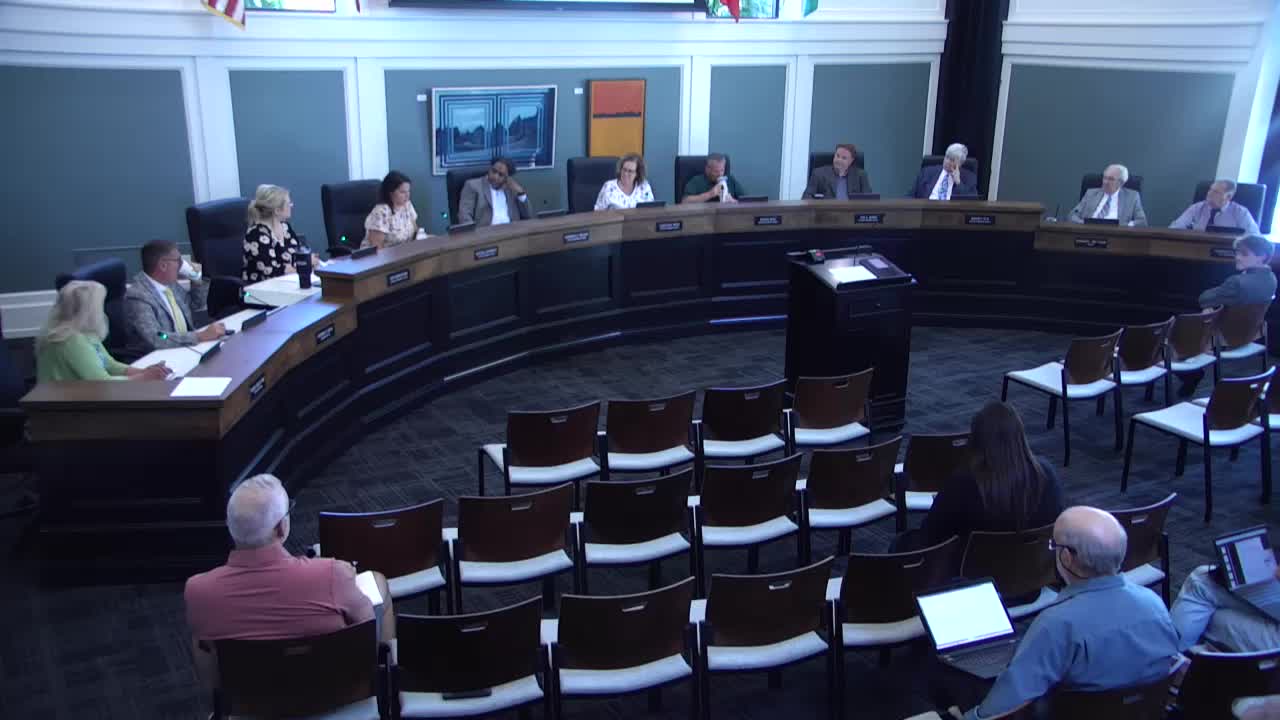
Grove City councilors debate charter changes to create council–city manager government
Summary
Council members reviewed a redlined draft charter to shift Grove City from a strong-mayor system to a council–city manager form of government, discussing ward elections, mayoral powers, vacancies, term limits and appointment/removal rules for the city manager and department heads.
Grove City Council members spent the meeting reviewing a redlined draft of the city charter that would shift Grove City to a council–city manager form of government, discussing election cycles, the mayor’s role, vacancy procedures and other structural changes.
The draft, prepared and presented by Law Director Stephen Smith and circulated in council folders, focuses narrowly on changes needed if the city adopts a council–manager form. Smith told the group he had reviewed prior minutes and tried to incorporate earlier council direction into the draft.
Councilors debated how to stagger ward and at‑large seats, and whether to keep explicit language requiring the two at‑large seats to be elected in alternating cycles. Several members said the transitional language at the end of the charter already establishes the staggered cycle. The group agreed the November election will set the new cycle of 1, 3, 5 in one year and 2, 4 and the alternate at‑large seat in the opposite year.
Members also discussed how to handle vacancies under the new structure. With the mayor’s strong‑mayor powers reduced, several councilors said there must be a time limit for council to fill a vacated ward seat to avoid prolonged lack of representation; 60 or 90 days were mentioned, and council deferred final language.
Term limits were a recurring topic. Some members told colleagues they had not reached a consensus in prior meetings; others proposed limits of two or three consecutive four‑year terms, with discussion of whether terms should be office‑specific (ward versus at‑large) or consecutive. Council deferred a final decision and asked for more research and a return to the issue in a subsequent meeting.
The draft moves many administrative authorities to council, clarifies that ordinances and resolutions will no longer be subject to mayoral veto and proposes an administrative code the council would adopt "subject to the provisions of the charter and after consultation with the city manager," language Smith said he added to explicitly allocate organizational authority.
On the city manager, council debated whether appointment and removal should require a simple majority or a supermajority (two‑thirds). Several councilors said they favored a two‑thirds requirement for appointment and removal to provide stability; Smith noted council could draft either threshold. Council also discussed whether the charter should require the city manager to be a city resident. Smith said Ohio law has limited residency requirements for most employees but that residency for a city manager remains common; several councilors said they would prefer a residency requirement.
Councilors raised the role and appointment of the director of law and director of finance. The draft places both positions under the city manager but also contemplates council consent; some councilors worried about conflicts if the city manager did not have a say in hiring the in‑house attorneys or finance director. Members asked staff to provide examples from other Ohio charters and return with options.
Council also reviewed board and commission appointment language (council retains appointment/removal authority), municipal election provisions (including a discussion about a nominating committee vs. standard petitions) and whether to memorialize requirements for planning‑commission qualifications in the charter or leave them to application and appointment processes.
Council did not take a formal vote on the charter draft during the session; members identified several outstanding questions (term limits, vacancy timing, thresholds for city manager appointment/removal and law/finance appointment procedures) and directed staff to research comparisons and bring suggested language back for further review.
The council said the redlined draft should remain a working document; further edits and follow‑up research will be scheduled before any final referral to voters or formal ordinance.
Looking ahead, council asked staff to assemble example charter language from comparable Ohio cities on term limits, residency language for the city manager and the appointment/removal process for law/finance directors so members can refine the draft before the next review.