
Lake Balboa and Sun Valley residents assail Padilla projects; councilmember urges continued talks
Get AI-powered insights, summaries, and transcripts
Subscribe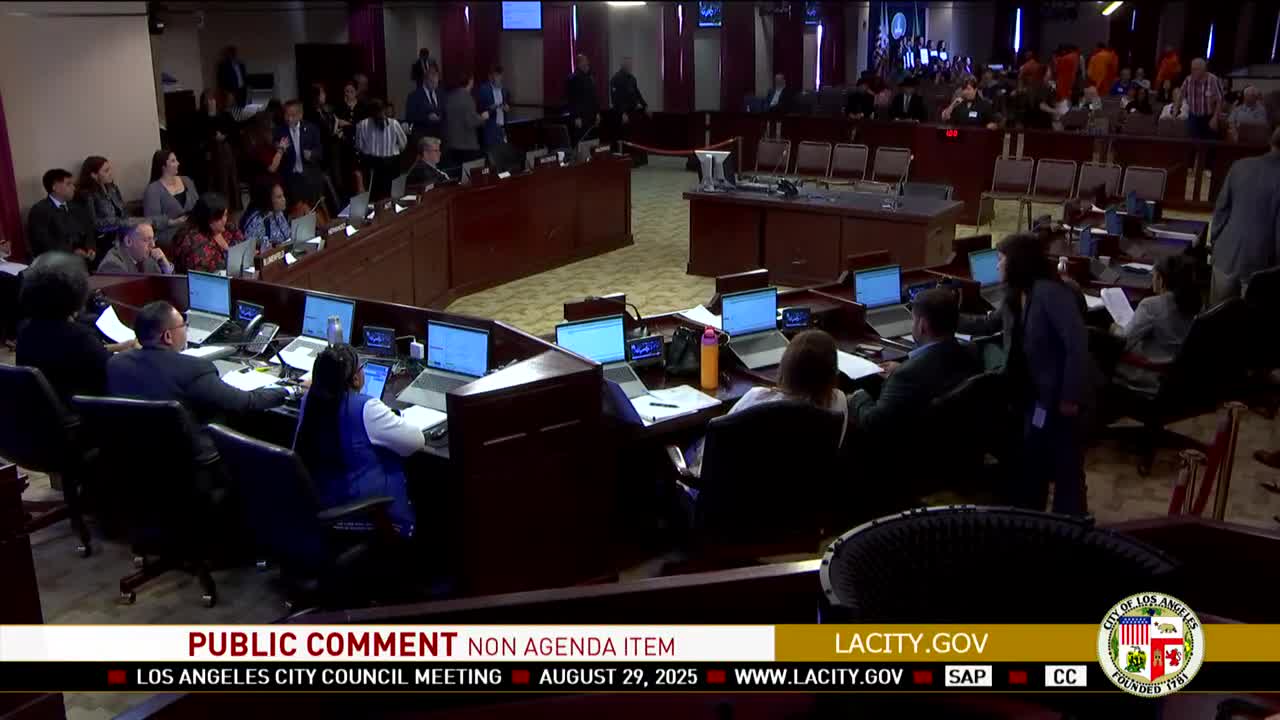
Summary
Dozens of speakers at a Los Angeles City Council field meeting in the San Fernando Valley criticized Councilmember Imelda Padilla’s support for housing and tiny-home projects in Lake Balboa and Sun Valley. Padilla said engagement is continuing and disputed some claims about project details.
Dozens of residents from Lake Balboa, Sun Valley and nearby neighborhoods used general public comment at a Los Angeles City Council field meeting to criticize Councilmember Imelda Padilla’s handling of several housing proposals, saying the projects threaten neighborhood safety, schools and public space.
The speakers singled out two proposals repeatedly: a private housing project at or near Victory Boulevard (described by speakers as a 194-unit development) and a tiny‑home proposal connected to the Sun Valley/Metrolink site (also described by speakers as up to roughly 215 tiny homes). "Councilmember Padilla is well aware from the very beginning that Lake Balboa and Encino stakeholders opposed the construction," said Danica Middleton, who identified herself as secretary of a Lake Balboa stakeholder group. "There will be a student killed by massive amounts of traffic."
The comments were echoed by neighborhood leaders. "Our community vehemently opposes 2 destructive projects on Victory Boulevard," said Linda Gravani, president of the Lake Balboa Neighborhood Council, who said the Birmingham School complex has a collective student population of about 6,000 and that the project site is directly across from the campus. "Instead of protecting our students, Councilmember Padilla motioned to authorize $45,000,000 to help fund this unsafe project," Gravani said.
Other speakers raised related concerns about concentration of shelters and services in environmental‑justice communities, proximity of tiny homes to residences and schools, and a lack of meaningful community engagement. "It is discriminatory and inequitable to concentrate such facilities so close to residential areas and local businesses," said Mark Dutton, criticizing the Sun Valley Metrolink site plan.
Several commenters also disputed whether community input had been considered before decisions were advanced. "She voted politics and personal gain over her constituents," a Lake Balboa resident told the council during remarks that accused Padilla of failing to represent the neighborhood’s wishes.
Councilmember Imelda Padilla responded near the end of the public‑comment period, telling the chamber that many attendees had been part of or aware of ongoing conversations and that the issues are being handled under the city's emergency authority on homelessness. "We are working under an emergency," Padilla said. "There are some things that as a council member I have control over during the emergency and some that I just do not." She urged continued engagement and said the tiny‑home proposal for the Metro lot is intended as an interim measure and that the Metrolink station would not be lost: "You're not gonna lose a Metrolink station. We've talked about it."
Padilla also said some Lake Balboa residents had participated in focus groups, and she denied plans for an RV lot at the corner cited by speakers. "For those who did attend, we are beginning a process to bring something that the community of Lake Balboa is content with," she said.
The meeting record shows a high volume of public comment on the subject across multiple speakers and neighborhood councils. Speakers included residents, neighborhood‑council leaders, and at least one youth speaker who said he had lived in Lake Balboa for 12 years and opposed the proposed units. Several residents urged greater transparency, more robust outreach and for council staff to withhold major site decisions until clearer community agreements could be reached.
Council members did not take a formal vote tied directly to the specific projects during the public‑comment period. Instead, Padilla and other members said engagement would continue and that some items — including work on the Metro lot — were being coordinated with the mayor’s office and other agencies.
The debate underscores ongoing tensions in Los Angeles over how to site interim homeless housing and larger affordable housing projects, how to balance urgency against local input during an emergency declaration, and how council members should weigh constituent objections against broader housing goals. Several speakers repeatedly asked the council to halt or rework projects they said would harm schoolchildren, local traffic and community character.
Padilla invited residents to continue discussions with her office and with the mayor’s office where appropriate. The council did not adopt or reject the specific Lake Balboa or Sun Valley plans during the session covered by these remarks; rather, the record shows continued negotiations and public concern as the council proceeds under emergency authorities.
Ending: Residents and neighborhood leaders left the field hearing with a clear message calling for more transparency and fewer exceptions to local land‑use rules. Councilmember Padilla said she would continue outreach and work with the mayor’s office and county partners to seek solutions.