Get Full Government Meeting Transcripts, Videos, & Alerts Forever!
Get email alerts on the School Facilities topic
No spam. Unsubscribe anytime.
Bureau of School Construction reports hundreds of summer repairs, many projects still active as schools open
Summary
The Bureau of School Construction and Maintenance told the Legislature it completed many life-safety repairs this summer but hundreds of projects remain active or pending; electrical upgrades, HVAC work and mold remediation continue and several contractors await payment.
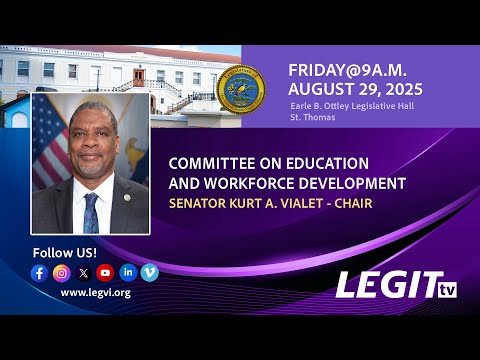
The Virgin Islands Bureau of School Construction and Maintenance (BSCM) told the Legislature on Aug. 29 that crews completed hundreds of summer repairs before the 2025–26 school year opened but that numerous safety, HVAC and electrical upgrades remain active.
BSCM Executive Director Craig Benjamin said the bureau recorded 179 completed projects territorywide and 71 active or pending projects as of the committee hearing. "Since inception just 10 months ago, the bureau has worked not only to address urgent maintenance needs, but also to put systems in place that will ensure long term effective efficiency and resilience," Benjamin said in his prepared remarks.
The bureau described a multi-pronged summer program that prioritized life-safety and kitchen compliance items identified in cross-agency inspections by the Department of Health, fire services and DPNR. Work completed or in flight includes roof repairs, mold remediation, restroom and plumbing repairs, grease-trap cleaning, electrical capacity upgrades for air-conditioning, and installation of dozens of classroom AC units across multiple campuses. Benjamin said roof repairs at John H. Woodson were completed Aug. 24 and mold remediation work there was scheduled to be closed out later in the week of the hearing.
BSCM said many older campuses require both mechanical and electrical upgrades because buildings originally designed for natural ventilation now rely on sealed classrooms and air conditioning. "Expanded air conditioning use requires corresponding electrical capacity upgrades because many buildings were designed for natural ventilation," Benjamin testified. The bureau outlined interim steps — staged electrical upgrades, temporary ventilation fans, staggered AC restarts after outages and emergency relocation procedures — to reduce risk while major work proceeds.
Paul Harrigan, BSCM assistant director of maintenance, provided project counts by district: Saint Thomas and Saint John had 94 completed and 47 active/pending projects; Saint Croix reported 85 completed and 24 active/pending projects. Territorywide totals reported to the committee were 179 completed and 71 active/pending, for 250 projects total.
Benjamin and staff also described a new online work-order system intended to triage maintenance requests into four levels (routine, important, urgent, critical emergency) with corresponding response windows. Cynthia Allen, assistant director of construction, described the system as a transparency tool that creates an auditable log, assigns tasks to maintenance crews or contractors, and sets response timelines.
BSCM acknowledged payment and vendor issues slowed some summer scopes. Commissioner and bureau witnesses told senators that contractor payments tied to ARPA-funded projects were delayed earlier in the year when federal partners temporarily paused draws; the bureau said a first line-of-credit draw and a $4.7 million federal reimbursement permitted recent vendor payments but additional invoices remain in process. At the hearing senators repeatedly pressed BSCM and the Department of Education to speed payments so stalled contractors could remobilize.
Senators raised specific campus concerns during questioning: John H. Woodson’s mold and air-conditioning work; restroom and plumbing outages at multiple schools; and electrical upgrades at schools where AC installations were staged until power capacity improvements were finished. BSCM said some restroom projects required special parts that limited immediate completion and that in other cases work had shifted from contracted scopes to in‑house repairs to avoid further delay.
The bureau presented a 90‑day outlook with targeted milestones: September and October start dates for several school-specific contracts, generator transfer‑switch deliveries, HVAC assessments, and environmental remediation task orders. Several large structural and campus modernization projects remain on longer timelines and are being tracked separately.
Committee members asked for a single, school‑by‑school project matrix showing scope, contractor, contract status, funding source, mobilization/payment dates and estimated completion dates; Benjamin said the bureau maintains district project spreadsheets and agreed to provide a version of that matrix to the committee. Senators also urged BSCM to prioritize smaller, high‑impact fixes that principals can’t otherwise complete during the school day — for example, restroom fixtures and classroom fans — while larger campus work proceeds on staged schedules.
Ending: The bureau asked for continued access to grant and ARPA funds, and for close coordination with the Department of Education and the Board of Education to expedite inspections, permits, and payments. "We remain committed to restoring and maintaining safe, healthy, and fully operational learning environments across all schools," Benjamin said.