
Manatee board, lobbyists map 2026 priorities after session review: construction rules, certificates, transport, workforce housing
Get AI-powered insights, summaries, and transcripts
Subscribe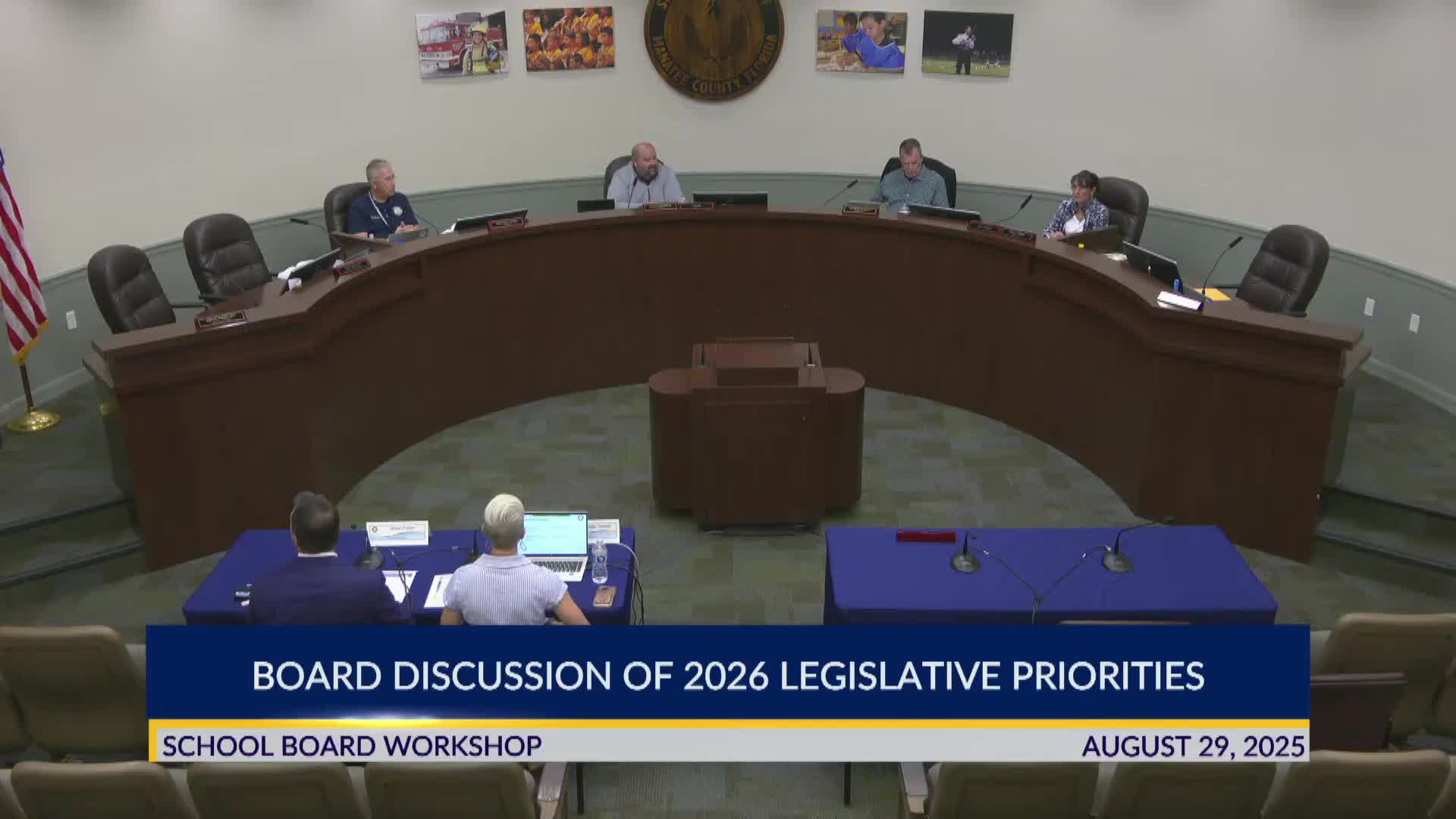
Summary
Consultants briefed the board on the 2025 legislative session and the district discussed priorities for 2026 including possible statutory tweaks to construction requirements, concerns about HB1105’s elimination of certificates of completion, transportation funding, workforce housing projects and sunshine‑law clarifications.
Consultants from Sunrise Consulting and new policy advisor Dr. Danielle Thomas briefed the Manatee County School Board on highlights from the 2025 Florida legislative session and worked with the board to identify priorities for 2026, emphasizing tighter state revenues and a need to prioritize requests.
Dr. Thomas said the legislature increased the FEFP and the Base Student Allocation yet warned districts that some of that increase can be absorbed by mandatory cost growth such as higher employer contributions for retirement plans. She noted the legislature’s recent flexibility on middle‑ and high‑school start times and changes to school‑safety statute that aim to balance access and security.
Board members and staff discussed a slate of district priorities and legislative risks:
- Certificates of completion: House Bill 1105 included language that eliminates "certificates of completion," a change several board members said could affect students with significant special needs and those who are near but not yet meeting graduation requirements. Members asked for clarity from the Department of Education on the required form DOE will issue to notify families if a student is not on track for a standard diploma.
- Construction rules and SREF: Board members explored statutory language that could let a district adopt an exception, by majority vote at a public meeting (after 5 p.m.), to allow use of standard building and fire code rather than the SREF/educational facilities rule for some projects — potentially lowering per‑student construction costs for some facilities. Staff said DOE still enforces Castaldi reporting requirements that can limit local discretion when districts fund a replacement facility using local capital dollars.
- Castaldi reporting: Board members questioned the requirement that districts submit analyses and receive DOE concurrence before replacing or demolishing older school buildings when the district proposes privately‑funded or local‑funded replacements.
- Transportation: The board discussed transportation funding constraints and proposals that surfaced this year to reduce statutory distance thresholds and to pilot AI route‑optimization in several districts to reduce bus costs.
- Workforce housing: Several members supported following up on earlier work to create workforce housing (potentially using district land and nonprofit partners) to retain teachers and staff. Staff noted the need to resolve surplus‑property and charter right‑of‑first‑refusal questions before committing land.
- Sunshine‑law clarifications: Members asked staff and counsel to pursue attorney‑general guidance or narrow statutory changes that would allow routine conference attendance, candidate forums and some conference breakouts without triggering the full meeting‑notice/minutes requirements that can chill day‑to‑day engagement.
- Tax‑collector commission question: Board members flagged a local issue where the tax collector placed a line for a voted millage on the TRIM notice and applied a commission; the board asked staff to seek an attorney‑general opinion and notify the delegation because voters do not expect voter‑approved millage to be reduced by a commission.
Ending: Consultants and staff will prepare a short list of priorities and draft language to circulate to the board before the fall legislative planning meeting. Members asked for follow‑up briefings with delegation staff and for an attorney‑general opinion on the tax‑collector commission question and on sunshine‑law ambiguities.