Get Full Government Meeting Transcripts, Videos, & Alerts Forever!
Get email alerts on the Traffic Safety topic
No spam. Unsubscribe anytime.
Santa Barbara committee reviews Safe Streets survey, flags ebikes, hotspots and enforcement needs
Summary
The Transportation Circulation Committee reviewed results from the Safe Streets for All traffic-safety survey, heard public comment and staff analysis showing 853 responses, concerns about ebikes and speeding, and a plan to target 20% of roadways responsible for most severe injuries.
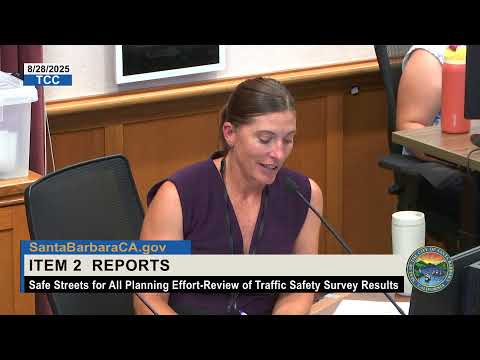
The City of Santa Barbara Transportation Circulation Committee on Aug. 20 reviewed results from the Safe Streets for All traffic-safety survey and discussed next steps for enforcement, education and infrastructure upgrades to address speeding, ebike safety and a small set of high‑injury corridors.
Committee Vice Chair Ian Bauke opened the meeting and turned the item over to city staff member Miss Grant, who presented the citywide survey results. Grant said the survey, open May through Aug. 8, drew 853 responses and will inform the engagement chapter of the Safe Streets for All action plan funded by a federal grant of roughly $800,000. She told the committee staff will combine the survey feedback with a collision‑data analysis presented at earlier hearings to recommend targeted countermeasures.
The report showed respondents most often cited vehicle speeding, drivers failing to stop and parked vehicles obstructing sight lines as top pedestrian concerns; distracted drivers, vehicle interactions and lack of protected bike lanes as top concerns for people riding bicycles or ebikes; and other drivers' behavior and roadway condition as top concerns for motorists. Grant summarized three open‑ended questions in the survey that produced recurring themes: calls for ebike education and regulation, requests for separated bike facilities and continued community outreach.
Grant highlighted staff analysis of collision data that shows about 20 percent of the city's roadways account for roughly 88 percent of severe injuries and fatalities. She said staff will prioritize those corridors for engineering, education and enforcement (the three E's used in traffic safety planning) and will bring more detailed maps and proposed treatments to the committee in October and at an upcoming community workshop.
Committee members asked for additional breakdowns and data products. Member Bickford asked for a layered map showing (1) treatments already completed, (2) projects in design or funded, and (3) remaining needs; Grant confirmed staff is preparing spatial exhibits to show past treatments, current projects and remaining gaps. Multiple members requested cross‑tabulations of responses by travel mode and age to better understand why perceptions about threats (for example, the relative threat from cars versus ebikes) vary across respondents.
Enforcement and education were recurring topics in discussion and public comment. Several committee members and public commenters urged more visible enforcement near schools and noted short staffing limits at the Police Department. Grant said the police department and Move Santa Barbara County have run junior high education programs and recently obtained an Office of Traffic Safety grant to expand junior‑high outreach; she also said staff will coordinate a presentation by law enforcement on enforcement strategies.
Ebike rules and perceived unsafe ebike behavior drew sustained attention. Staff presented survey comments requesting required training or testing for ebike riders, minimum ages, mandatory safety classes, parent responsibility for fines when minors do not complete diversion courses, and stronger enforcement for repeated unsafe behavior. Several committee members and commenters recommended separating faster ebikes from mixed traffic through protected bike lanes where feasible rather than relying solely on enforcement or licensing.
Public commenters and committee members offered a mix of policy preferences: some favored stricter enforcement (including impoundment for repeat ebike violators), others urged more education (including peer‑led youth campaigns and school‑based training), and some asked the city to consider restrictions on throttle‑controlled ebikes similar to rules in other jurisdictions. City staff emphasized that legal authority for licensing or new regulatory regimes may require consultation with law enforcement and legal review; Grant said staff will investigate statutory constraints and report back.
On infrastructure, attendees identified specific corridors repeatedly mentioned by respondents: State Street (including Upper State), Cliff Drive, De La Vena, Shoreline Drive, Castillo/Cabrillo (the beachway), and connections to UCSB/Goleta. Grant said some of those corridors are in the capital plan or design pipeline and that staff will include a timeline of completed and planned engineering treatments in future materials.
The committee also discussed survey representation. Grant acknowledged respondents skewed older and were disproportionately white compared with Santa Barbara's overall census makeup; she said staff plans targeted outreach to younger and Hispanic residents and further cross‑tabulation of survey results.
Votes at a glance: the committee approved the minutes of the June 26 meeting by voice vote with one abstention. No other formal actions or ordinance votes were taken on the Safe Streets item during the Aug. 20 meeting.
Staff said next steps include: publishing the survey results on the city website, producing layered maps and data tables that show where treatments have been implemented and where gaps remain, coordinating with law enforcement on enforcement options and presenting proposed countermeasures and outreach strategies at an October committee meeting and a public workshop. Grant repeated that staff is in a listening phase and will return with more concrete proposals and visuals for committee review.
The committee adjourned at 7:30 p.m., with the Safe Streets for All survey review set for additional discussion at the October meeting and related community workshops planned in the coming months.