
Little Rock board and neighborhood spar over Hall High School's future as enrollment falls
Get AI-powered insights, summaries, and transcripts
Sign Up Free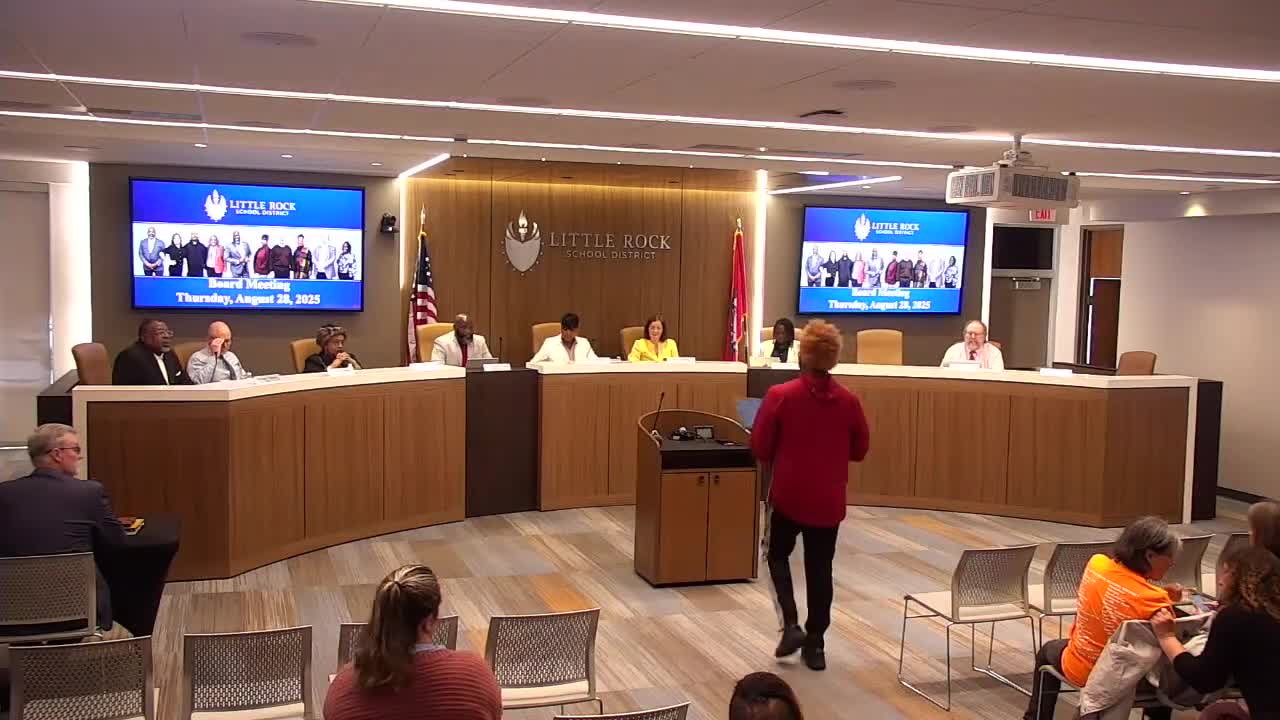
Summary
Board members, neighborhood residents and school staff debated possible futures for Hall High School after public commenters urged the district to preserve a local high school. No formal decision was made; administrators outlined reuse options and said more community engagement and data will be needed before action.
Members of the Little Rock School District Board of Education spent more than an hour on Aug. 25 discussing the future of Hall High School amid steeply declining enrollment, attending community pleas to keep the campus serving students and outlining alternative uses if a traditional high school proves unsustainable.
In public comment, alumni and neighborhood leaders urged the board to preserve Hall as a neighborhood high school. "We have a great opportunity to ensure not only that our school district is on point, our city is on point," said Darius Kinnebrew, identifying himself as representing the Hall alumni association, The Tribe. Carrie McDonald, president of the Hall High Neighborhood Association, asked to be included in planning: "We want to be involved on the future planning also." Parent and neighbor Carrie Case said she supported whatever decision the board reached but urged clarity and follow-through: "Whatever is decided, that you commit to that decision, you be clear about that decision, and that you support that decision."
The board heard that Hall had fewer than 250 students this school year and that the campus lacks an attendance boundary, which complicates reenrollment. "We don't have enough students for the four high schools that we have, and we definitely aren't gonna have enough for the fifth high school once it opens in 2027," Board President Dr. Wright said, describing the districtwide enrollment decline and the scheduling difficulties created when a school has few students in each grade.
Administrators outlined candidate alternatives to keep the Hall campus active for students if a traditional high school is not viable. Options discussed included moving the district's adult education programs to portions of the campus, relocating alternative learning programs (ALE/ACC) into underused Hall buildings, co-locating early childhood seats and establishing career- and community-oriented programs (for example, a ninth-grade academy, a cadet or vocational site, or shared athletic fields). Superintendent Wright also noted the district has considered using the Hall property for Hamilton Learning Academy or other district programs and said some short-term moves were already in planning to improve facility utilization.
Board members and neighborhood speakers repeatedly urged the district to engage the Hall community in planning. "We want to be a part of working, thinking and supporting some of the ideas that we may have," Kinnebrew said. Director Adams asked administration to prepare more formal pros-and-cons material and enrollment projections as a next step; administrators said they would bring more detailed analysis and options to the board for further consideration.
No vote was taken on whether to close, convert or repurpose Hall. Several board members cautioned that previous changes and inconsistent communications had undermined neighborhood confidence. Director Calloway asked for the same level of transparency and community engagement the board provides when discussing other neighborhoods. Several board members said they favored a measured, data-driven process that includes public meetings, and some offered specific ideas — for example, a ninth-grade academy or temporary relocation of early childhood programs while other renovations occur — to preserve neighborhood access to schools.
The board did not set a final timetable for a decision; members said they expected follow-up reports and community meetings in the coming months so the district can present clear options before families make enrollment decisions next year.
Ending: The Hall discussion concluded with no formal action; board members asked administration to return with clearer enrollment projections, facility-cost estimates and community engagement plans to inform any final decision. Community members at the meeting reiterated a request that the neighborhood be included early in planning and that the board make a transparent, durable decision once data and community input are compiled.