Get Full Government Meeting Transcripts, Videos, & Alerts Forever!
Get email alerts on the State Lands Subleasing topic
No spam. Unsubscribe anytime.
Committee asks LSO to draft law simplifying subleasing and fees for grazing on state trust lands
Summary
The Agriculture Committee asked the Legislative Service Office to prepare a bill to clarify when lessees may allow non‑owned livestock to graze on state trust lands and to authorize a per‑head or AUM-based non‑owned‑livestock fee; the committee amended the draft to cap the fee at 50% of the annual AUM rental rate.
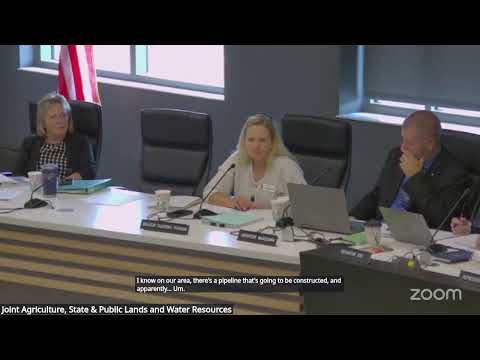
The Agriculture, State & Public Lands & Water Resources Committee asked the Legislative Service Office on Aug. 29 to draft legislation clarifying when a lessee of state trust grazing land may allow non‑owned livestock to use the lease and to authorize a fee for that privilege.
Anna Johnson of LSO introduced a bill draft (26 LSO 112) that would amend Wyoming statute 36‑5‑105(d) to treat some non‑owned‑livestock grazing as not requiring a formal sublease so long as the lessee retains management responsibility and an owner/lessee ownership test is met; the draft also authorizes a board‑set fee per non‑owned head not to exceed a capped share of the annual AUM rental rate.
Office of State Lands proposal and rationale
Stacia Berry, director of the Office of State Lands and Investments, presented a revised approach developed with industry stakeholders. The office recommended a simpler alternative to detailed sublease math: require notice to the office within 30 days of non‑owned livestock arriving, require payment of a non‑owned‑livestock fee within 30 days of removal, and allow the board of land commissioners to set the per‑head fee up to a stated cap (the committee amended that cap during discussion). The proposal would also clarify calculation of “excess rental” (the amount of any sublease above a lessee’s annual rental, which is split with the trust) and would allow common ownership of entities to be certified to the office so separate corporations owned at least 80% in common are not treated as a sublease.
Committee amendment and vote
Committee members and stakeholders debated fee levels and measurement units (AUMs versus per‑head notification). Some ranchers and trade groups argued a per‑head approach is administratively simpler for routine “tourist” or short‑term grazing arrangements; the office argued an AUM calculation is less directly observable on unfenced lands. After discussion the committee adopted an amendment limiting the board’s non‑owned‑livestock fee to not exceed 50% of the annual AUM rental rate (LSO had proposed a higher cap in the draft). Senator Crago moved and the committee voted to direct LSO to prepare the state‑lands draft for the next meeting; the motion passed.
Stakeholder views
- Jim McGagnon (Wyoming Stockgrowers Association) said the original LSO draft addressed many concerns but asked that the cap be lower than 100%, suggested the committee consider 10% to 50%, and asked for a clear definition of “head.” - Brett Moline and Karen Clark (Wyoming Farm Bureau Federation) supported the state lands office draft subject to adjustments and recommended aligning the fee with the state’s AUM framework for administrative consistency.
Clarifying details in the draft
- Notification: lessee must file notice on a state form within 30 days of arrival of non‑owned livestock. - Fee timing: payment of the per‑head non‑owned livestock fee is due within 30 days of removal of the non‑owned livestock. - Common ownership exception: if entities holding the lease and owning the grazed livestock have at least 80% common ownership (certified to the office), no sublease or fee is required. - Effective date: the draft would apply to leases entered or renewed on or after July 1, 2026 (per LSO drafting note).
Next steps
LSO was instructed to prepare a formal bill draft incorporating committee amendments and the state lands office suggested language. The committee chair and director Berry said they expected further adjustments in drafting and consultation with grazing lessees and industry groups.
Ending
The committee’s directive to LSO sets the state lands office and grazing stakeholders on a path to a clearer statutory regime for non‑owned grazing on state trust lands, with a fee cap adopted by the committee and administrative reporting requirements for lessees.