Get Full Government Meeting Transcripts, Videos, & Alerts Forever!
Get email alerts on the Landowner Hunting Licenses topic
No spam. Unsubscribe anytime.
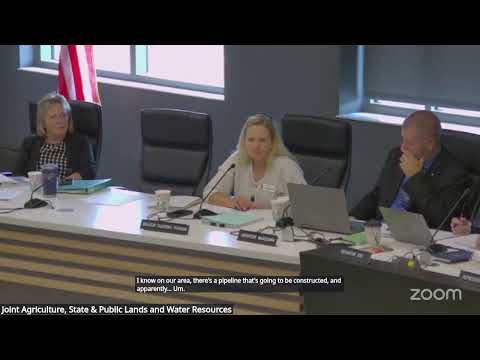
Wyoming committee hears wide-ranging debate over landowner hunting licenses; asks LSO for bill drafts
Summary
Wyoming Game and Fish officials briefed the Agriculture, State & Public Lands & Water Resources Committee on landowner hunting licenses, and the committee asked legislative staff to draft bills on capping landowner licenses and on transferability after extensive testimony from landowners, hunters and industry groups.
Wyoming Game and Fish Director Angie Bruce told the Agriculture, State & Public Lands & Water Resources Committee on Aug. 29 that the Game and Fish Commission largely backed the department’s recommendation after public comment on proposed changes to landowner hunting license rules.
Bruce said the commission implemented three main changes after a July meeting and statewide public outreach: it expanded the definition of “immediate family member” to include step-parents and step-children, clarified landowner involvement in qualifying for tags, and added a provision requiring the department to review and verify landowner license qualifications at least every five years.
The subject drew more than two hours of committee discussion and extensive public testimony. Dan Smith, the department’s chief game warden and wildlife division chief, summarized recent work: the department and commission had proposed changes such as increasing qualifying acreage thresholds and raising the animal-use-days requirement (from 2,000 to 3,000), and tightening ownership interest in an LLC to 20 percent. Smith said public feedback was overwhelmingly opposed to those specific proposals: the department received about 380 public comments (311 online) and, he said, “266 of those comments or 70% were opposed to those recommendations.” He said the commission chose not to adopt the acreage and animal-use-days changes after the public meetings.
Why this matters: landowner licenses award priority access to limited quota big-game tags to landowners who provide habitat, but commissioners, sportsmen and landowners disagree about whether the program has drifted from its original intent. Several lawmakers said the status quo risks concentrating limited quota licenses in a small number of properties and asked whether the commission or the Legislature should set limits.
What the department told the committee
Bruce and Smith recounted the Commission’s July meeting, where the department had presented a package of proposed rule changes intended to address concerns about sales of qualifying parcels and the use of small ownership interests to secure landowner licenses. Smith described the department’s outreach: eight regional public meetings, one centralized commission meeting with about 150 attendees and roughly 26 public speakers on the topic. He summarized the Commission’s final decisions: keep the 160-acre contiguous acreage requirement as written, keep animal-use days at 2,000, drop the proposed 20% ownership threshold, expand the immediate-family definition to include stepparents and stepchildren and add a five-year verification of qualifications.
Committee debate and ideas
Committee members and commissioners pressed for further changes. Senator Pearson said he was not satisfied and wanted stakeholders to continue discussion; he said transferability of landowner tags is “not off the table.” Representative Schmidt urged the committee to consider restoring elements of the program’s “original intent,” including stronger focus on working lands, because he said the program “has run its course” and faces growing pressures. Several members — including Representative Johnson, Representative Winter (co-chair), Representative Provenza and Senator McEwen — asked whether grandfathering current qualifiers, tying qualification to agricultural use on county tax rolls, or requiring a demonstrable working-lands income could address perceived abuses.
Commissioner perspective and task-force history
Game and Fish Commissioner Doug Bell (online) and others summarized a multi-year Wildlife Task Force effort and the Commission’s review. Bell said the task force and commission had spent thousands of hours studying allocation and that the “corporate loophole” (where large properties are subdivided into corporations or LLCs and small ownership stakes were used to claim licenses) had produced a few high-profile cases but was not widespread. He said landowners who provide substantial habitat often do not take agricultural income but still arguably merit recognition. The task force recommended a “cap” option — allowing the commission to limit the number of landowner licenses in a limited quota hunt area — as a flexible, area-by-area tool the commission could apply in future rulemaking.
Public testimony and stakeholder positions
Speakers illustrated the divisions among hunters, landowners and industry groups. Testimony included: - Jim McGagnon, Wyoming Stockgrowers Association: urged careful study and said stockgrowers support options such as allowing a landowner to designate a long-term employee to use a landowner license, raising acreage thresholds for non-cultivated land, and permitting donations of licenses to 501(c)(3) organizations. - Nephi Cole, National Shooting Sports Foundation: said the current system “works best for a few people” and called for broader legislative tools to address perceived problems rather than placing the full burden on commissioners. - Jess Johnson, Wyoming Wildlife Federation, Katie Cheesebrow, Wyoming Wild Sheep Foundation, Sabrina King, Backcountry Hunters and Anglers: urged nuance and transparency; King said members oppose monetizing tags and asked for public transparency when an area is effectively unavailable to public hunters because 100% of limited quota licenses have been claimed by landowners. - Karen Clark and Brett Moline, Wyoming Farm Bureau Federation: opposed a statutory cap and said transferable tags are a tool other Western states use; urged study of neighboring-state approaches.
Actions and next steps taken by the committee
After extended discussion the committee directed Legislative Service Office (LSO) staff to prepare formal bill drafts for its next meeting. Committee members agreed to move forward with two separate draft bills rather than one omnibus measure: (1) a narrowly focused draft to allow the Game and Fish Commission to limit the number of landowner hunting licenses in a limited-quota hunt area (a cap), and (2) a second draft that would address transferability/saleability of landowner licenses and related qualification criteria (for example, acreage thresholds, working‑lands definitions, possible point-system changes and whether transfers could be limited to viable agricultural operations). LSO staff highlighted single‑subject and constitutional considerations and recommended separate drafts; the committee agreed and voted to have the two drafts prepared.
Votes at a glance
- Motion: Ask LSO to prepare a draft to allow the Game and Fish Commission to limit the number of landowner hunting licenses in any limited‑quota hunt area (cap). Outcome: motion approved by committee voice vote. (Mover: committee discussion led by Representative Johnson/LSO; committee consensus recorded.) - Motion: Ask LSO to prepare a second draft addressing transferability/saleability of landowner hunting licenses and related qualification changes. Outcome: motion approved by committee voice vote (committee consensus to prepare separate draft rather than roll all changes into a single bill).
Context and unresolved questions
Officials stressed difficulty of enforcement in some problem scenarios — particularly proving intent when parcels are subdivided for estate planning or corporate structuring — and said any change to statutory qualification (for example, requiring a specified income from the property) would be complex. The Game and Fish Department told the committee it will continue outreach and that the Commission is open to additional proposals including grandfathering and working‑land tie‑ins, though some changes would require statute and others could be done by commission rulemaking.
What to watch next
LSO will draft the two bills for the committee’s October meeting. Lawmakers raised a variety of options to consider between now and then: reinstating county tax‑roll agricultural requirements, clearer working‑lands definitions, point‑system adjustments, donation options for licenses, and caps that can be adjusted by hunt area rather than a single statewide percentage.
Ending
The committee’s vote to request two separate bill drafts sends the dispute over landowner licenses back into formal policy work. The department and commissioners said they will continue public outreach while legislators and stakeholders attempt to produce statutory language that balances private‑land habitat incentives with fair access for public hunters.