Get Full Government Meeting Transcripts, Videos, & Alerts Forever!
Get email alerts on the Pensions topic
No spam. Unsubscribe anytime.
TRS webinar explains pension, survivor and insurance rules for substitute teachers
Summary
A Teachers' Retirement System (TRS) webinar outlined who qualifies for TRS membership, how substitute teachers earn service credit, the pension formula and available disability, survivor and health insurance benefits, plus limits on post‑retirement substitute work.
A representative of the Teachers' Retirement System (TRS) said during a webinar that substitute teachers who are paid by Illinois public school districts (outside the city of Chicago) are TRS members, pay 9% of gross earnings into the system and can earn service credit toward a defined benefit pension.
The TRS presenter said membership and retirement rules differ by tier: workers who first contributed to any Illinois public pension system before Jan. 1, 2011, are in tier 1; those who first contributed after that date are in tier 2. For tier 1 members, the presenter said a member may retire at age 60 with at least 10 years of service credit, or at 62 with five to nine years of service credit. Service credit in TRS is measured by days worked in a TRS-covered position; TRS counts 170 days in a school year as one year of service credit.
Nut graf: The webinar emphasized that substitute teachers who fill certified positions — not paraprofessional or teacher aide roles — contribute to TRS and accumulate the days that determine vesting, eligibility for health coverage and pension calculations. The session also described purchase options for prior service, disability and survivor benefits and limits on working after beginning to collect a TRS pension.
Most important details
- Contributions and pension formula: All TRS members pay 9% of gross pay into TRS. The annual pension calculation described by the presenter is service credit multiplied by a factor of 2.2% multiplied by a member’s final average salary (the standard defined‑benefit formula referenced in the Illinois pension code).
- Service credit rules: TRS counts each day a substitute works in a TRS‑covered certified position as one day of service credit for the July 1–June 30 school year. Once a substitute reaches 170 days in a school year, TRS treats that as one full year of service credit; partial years are prorated (for example, 67 days yields 67/170 years of service credit in that school year, per the presenter).
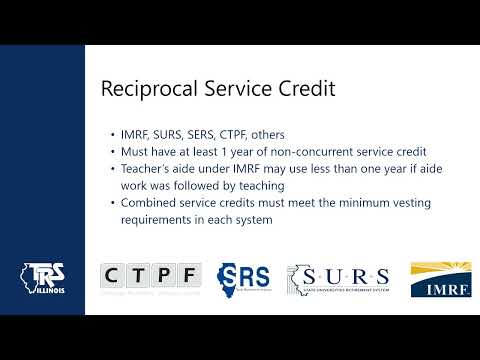
- Reciprocal and optional service: The presenter said TRS can combine nonconcurrent service from other Illinois public pension systems (for example, IMRF, the State Universities Retirement System or the Chicago Teachers’ pension system) if minimum vesting requirements of each system are met. Substitutes may also be able to purchase certain service periods (out‑of‑state public school teaching, refunded TRS service restoration, up to two years of military service and, subject to verification deadlines, up to two years of private‑school service). The presenter noted that private‑school service must be verified by June 30, 2028, unless the legislature extends that deadline.
- Health insurance eligibility (TRIP and TRAIL): A substitute who meets TRS requirements may qualify for retiree health insurance through the Teachers’ Retirement Insurance Program (TRIP) or its Medicare Advantage counterpart (TRAIL) once retired. TRIP eligibility requires at least eight years of TRS service credit specifically with TRS. The presenter urged attendees to contact TRS for the current monthly premium rates and enrollment deadlines; numerical examples in the webinar transcript were garbled and the presenter directed members to TRS for up‑to‑date costs and plan choices.
- Disability and survivor benefits: The presenter said active TRS members may apply for temporary disability benefits if they meet service‑credit and medical documentation requirements (including three years of nonconcurrent service in certain pension systems and medical certification by two state‑licensed physicians within 90 days of the last day of work). Temporary disability benefit amount was described as a percentage of annualized salary while approved. The presenter also described survivor benefits funded by 1% of member contributions (survivor benefits) that may be payable as a lump sum or as a monthly payment to eligible dependents, depending on circumstances and beneficiary designations.
- Beneficiary designations: The presenter explained the difference between the “automatic designation” option on TRS beneficiary forms (which allows TRS to determine eligible dependents at death) and named beneficiary designations (which produce a lump sum to named payees if no dependent qualifies). The presenter recommended reviewing and updating beneficiary forms as circumstances change.
- Post‑retirement work limits: The presenter said a retiree must receive their first TRS pension payment before returning to TRS‑covered substitute work and described current limits on post‑retirement substitute work: 120 days or 600 hours in a school year (the presenter noted those limits are subject to legislative change).
- Social Security and recent federal change: The presenter noted that TRS‑covered service generally does not pay into Social Security. The webinar referenced the Social Security Fairness Act (January 2025) as having eliminated the Windfall Elimination Provision and Government Pension Offset; the presenter advised members to contact Social Security to understand personal effects, but emphasized that the TRS pension itself is unaffected.
Additional context and member steps
The presenter encouraged substitutes to review their annual TRS statements (which list reported days and earnings), confirm beneficiary forms and upload proof of birth date when planning retirement. TRS offers personalized counseling appointments by phone or video; attendees were told to call to schedule a 45‑minute counseling session if they need individualized estimates. The presenter also outlined an option called an accelerated annual increase for members retiring after a specified school year and noted that one must stop working in TRS positions until a single‑sum retirement payment is issued if choosing that single‑sum option.
Ending
For assistance, the presenter provided TRS member phone assistance at (877) 927‑5877, available Monday–Friday, and encouraged members to call or email TRS to set up a retirement counseling appointment or to get current insurance rates and forms.