Get Full Government Meeting Transcripts, Videos, & Alerts Forever!
Get email alerts on the Teacher Pensions topic
No spam. Unsubscribe anytime.
Teachers' Retirement System reviews Tier 2 pension rules, disability and survivor benefits, and post-retirement limits
Summary
Teachers' Retirement System outreach staff summarized how Tier 2 pensions are calculated, options to buy or combine service credit, temporary disability and survivor benefits, post-retirement work limits, and retiree health coverage enrollment rules.
Sandy Benhart, an outreach coordinator at the Teachers' Retirement System, told a Tier 2 member information session that TRS administers a defined-benefit pension for Illinois public educators and explained the rules that determine eligibility, benefit size and post-retirement limits.
Benhart said Tier 2 membership is determined by whether a member's first public-pension contribution date was on or after Jan. 1, 2011. Members contribute 9% of gross earnings to TRS; that contribution funds retiree benefits, survivor benefits and disability coverage. A regular (unreduced) Tier 2 retirement is age 67 with at least 10 years of service credit. Members may retire as early as age 62 with at least 10 years of service, but retiring before 67 carries an age reduction that Benhart described as roughly 6% per year under age 67 (calculated daily).
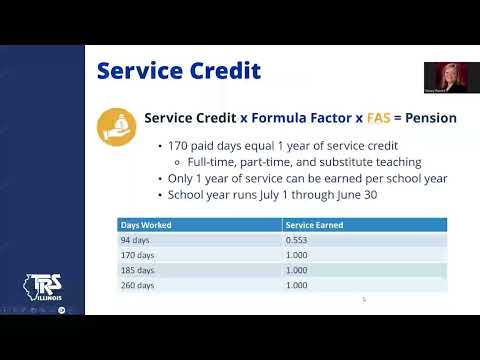
TRS calculates an initial monthly pension by multiplying years of service credit by a formula factor (2.2%) and applying that percentage to a member’s final average salary, defined as the average of the eight highest consecutive salary years within the member's last 10 years. Benhart gave an example: a member with 30 years of service and a final average salary of $85,000 would have a starting pension equal to 66% of that salary ($56,100 per year, about $4,675 per month). She said the statutory maximum pension is roughly 75% of final average salary, reached at about 34 years of service credit.
Service credit is earned four ways, Benhart explained: working a full TRS year (170 days between July 1 and June 30 qualifies as one year), unused and uncompensated sick days reported to TRS (up to 340 days, equal to two years), optional purchases for qualifying out‑of‑system service (including certain out‑of‑state public school service, unpaid leave when the district holds the position, reduction‑in‑force gaps, verified military service up to two years, previously refunded TRS service if repurchased in full, and up to two years of qualifying Illinois private‑school teaching if verified by June 30, 2028), and reciprocal service from other Illinois public retirement systems (subject to the other system's vesting and non‑concurrent rules).
Benhart described temporary disability benefits available when a member is unable to perform required duties for medical reasons: applicants must provide certification from two state‑licensed physicians (one for pregnancy) within 90 days of the last day worked, must have at least three years of combined non‑concurrent service credit across applicable Illinois systems, and must first exhaust current‑district sick leave. Approved temporary disability pays 40% of the member’s contract rate by direct deposit while on leave and counts toward service credit for the year.
On death benefits, Benhart said 8% of the 9% contribution bucket funds a retiree’s own pension payments and any remaining balance at death becomes a beneficiary refund paid to the named beneficiary or estate. A separate 1% contribution funds survivor benefits, which may be paid as a lump sum to beneficiaries or, if the member had a dependent spouse (married at least one year) or eligible dependent children, as a monthly survivor benefit. Benhart emphasized that members should update TRS beneficiary forms and explained the two filing options TRS offers: automatic designation (TRS determines eligible dependents at the time of death and pays monthly benefits to eligible dependents) or named beneficiaries in sections 4 and 5 of the form (which directs lump‑sum payments to listed individuals or organizations).
Benhart covered post‑retirement work limits for Tier 2 members: a retired TRS member must wait to perform TRS‑covered work until they have received their first pension check (typically 60–90 days after TRS has all paperwork) and may not work more than the current reporting limit (presented as 600 hours or 120 days per TRS‑covered year). She said TRS will email retirees when they return to TRS‑covered work and again if hours approach the limit. Benhart warned that a post‑retirement position may not be prearranged (a written agreement to return to work before receiving the first pension check defeats retirement status). She noted that Tier 2 members collecting a TRS pension may not work full time in another public Illinois pension system, and reciprocal systems have their own post‑retirement rules.
Benhart explained retiree health insurance administered through TRIP (Teacher Retirement Insurance Program) and TRAIL (the Medicare program for TRS retirees): TRIP/ TRAIL eligibility generally requires at least eight years of TRS service and enrollment is available at specified times (first of the month after retirement, Medicare eligibility dates, or annual open enrollment windows). She summarized per‑person premium examples discussed in the session (HMO/open access versus PPO and Medicare Advantage overlay for TRS retirees on Medicare) and reiterated that members should verify their TRS account information, upload required identity documents at myTRSIL, and submit a wet‑signed beneficiary form to change beneficiaries.
Benhart closed by encouraging members to request a benefit estimate (TRS will include reciprocal service if members provide details), register for TRS webinars (“It’s Time to Retire” in February–March for people eligible in that year), or schedule a benefits counseling appointment (phone, video or in‑person in Springfield or Lisle). She provided TRS contact information for appointments and basic questions. The session emphasized that TRS is an administrator of benefits and information; law changes to pension rules remain the responsibility of the Illinois General Assembly.