Get Full Government Meeting Transcripts, Videos, & Alerts Forever!
Get email alerts on the Land Use Subdivision topic
No spam. Unsubscribe anytime.
Valley County delays decision on appeal of 20‑lot Eldridge Estates subdivision amid traffic, wildlife and wildfire concerns
Summary
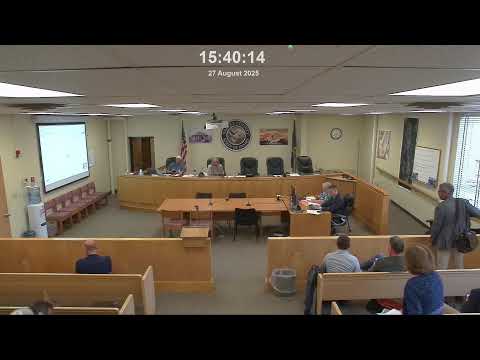
The Valley County Board of Commissioners reopened a public hearing on an appeal of the Planning and Zoning Commission’s July 10, 2025 approval of SUB 25013 (Eldridge Estates), heard extensive public comment on roads, elk and an adjacent bald eagle nest, and tabled final action to Sept. 10 to allow further review.
Valley County commissioners reopened a public hearing on an appeal of the Planning and Zoning Commission’s July 10, 2025 approval of SUB 25013 Eldridge Estates, a proposed 55‑acre, single‑family subdivision that would create roughly 20 buildable lots in the Gold Fork area.
The appeal, filed July 21, argues the commission’s approval did not adequately consider impacts to adjoining subdivisions, local roads, wildlife and wildfire risk. At the hearing county staff summarized the application and the record, several county and state agencies provided written comments, residents offered testimony opposing the approval, and the applicant presented a traffic analysis, a final wildland‑urban interface fire protection plan and other responses. After discussion the Board voted to table the matter for final consideration at 4:00 p.m. on Sept. 10.
Why it matters: The application and appeal touch multiple county regulatory and public‑safety areas — transportation impacts on county roads, potential effects on an elk herd and a documented bald eagle nest, water‑supply and well concerns, and wildfire mitigation for homes proposed adjacent to forested areas. Commissioners said they needed more time to review the record and additional submittals before deciding whether to uphold or reverse the Planning and Zoning Commission’s approval.
What was proposed and what the record shows - Project scope: Staff said the submitted preliminary plat covers 55 acres in the southeast corner of Section 19, Township 16 North, Range 34 East of the Boise Meridian in Valley County and, for Phase 1, proposes 20 buildable lots and two open‑space lots with lot sizes ranging about 1.5 to 4 acres. The application calls for individual septic systems and wells, underground utilities, and paved private roads connecting to Gold Fork Road. The plat includes a 70‑foot dedication for Gold Fork Road.
- Prior approvals and procedural points: The Planning and Zoning Commission held a noticed public hearing on July 10 and approved the application by a 5–0 vote. Staff said the applicant submitted a draft wildland‑urban interface (WUI) fire protection plan and later submitted a final WUI plan (filed Aug. 11) and an applicant response to the appeal (filed Aug. 20). Staff also noted the appeal fee and filing were timely but said the appellants did not state the nature of their interest or estimate damages as required by the appeals section of Valley County code.
Agency and technical input - Health and water: Central District Health flagged septic and groundwater testing and engineering requirements. Water District 65’s water master reported two water rights affect the property and cited Idaho statute 31‑38‑05 requiring irrigation deliveries as applicable in some circumstances.
- Fire and public works: A local fire marshal identified requirements for roads, driveways, addressing, water supply and wildfire prevention; the applicant has proposed a 30,000‑gallon underground water tank for fire suppression. Valley County public works noted county‑maintained roads (including Gold Fork Road) that may see increased traffic and listed mitigation recommendations.
- Fish and Game and environmental review: The record included email exchanges with Idaho Department of Fish and Game. One Fish and Game representative said the agency did not expect a wildlife impact study for the Phase 1 area would add substantial new information, but later correspondence identified a reported bald eagle nest in the northeast corner near the Simcoe property line and cautioned future phases could disturb nesting birds. DEQ provided general comments on air quality, wastewater, drinking water, surface water and best practices.
Public testimony and main concerns Speakers speaking in opposition to the Planning and Zoning Commission’s approval raised several recurring themes during the public comment period: - Roads and traffic: Longtime residents described heavy and accelerating traffic on Barker Lane and Gold Fork Road, dust problems, fast driving (residents estimated many vehicles exceed posted limits), lack of intersection and bus‑stop signage, and the cost of maintaining and repaving roads. One resident said neighbors had spent more than $10,000 on dust control in recent years; another estimated 300–800 vehicle trips per day on Barker Lane (a claim the developer’s traffic analysis did not replicate).
- Wildlife and habitat: Multiple speakers said the area supports a large, resident elk herd year‑round (comments estimated numbers from “up to 100–200” to “up to 300”), and flagged potential increased depredation on private lands if development funnels elk away from traditional areas. Residents also cited the recent Fish and Game note about a nearby bald eagle nest and urged caution for future phases.
- Water and wells: Some residents questioned whether local groundwater and well depths identified in the applicant’s materials reflect neighborhood conditions and said the proposed development could affect local water levels or the downstream flow of reservoir and creek water that currently serves neighboring properties.
- Density, character and cumulative impacts: Opponents argued Phase 1 and the application’s references to future phases (Phase 2 through 7 or Parcel 2 in applicant materials) created uncertainty about full build‑out and the cumulative impacts of multi‑phase development. Several speakers urged that future phases require full public review and additional studies before the county approves the initial phase.
Applicant response and technical work The applicant, Greater Good Investments LLC (represented by Mark Young), said the current application is limited to the Phase 1 parcel (55 acres, 20 lots) and that any future phases would require separate applications and county approval. The developer provided technical materials shared with staff and the commissioners, including: - A traffic memo by Adura Group that estimated average peak hour trip generation of roughly 17–22 vehicle trips (the developer argued these standardized trip rates—derived from urban data—likely overestimate rural trip generation and that the projected incremental traffic would be small relative to county thresholds for additional study).
- Engineering and drainage commentary from Crestline Engineers (Rob Payer) stating the road and subdivision design would meet Valley County standards, that the county does not require sidewalks or ADA pathway construction absent a regional pathway connection, and that a final engineered stormwater plan would be submitted with the final plat.
- A final wildland‑urban interface fire protection plan and a commitment to include wildfire mitigation measures in recorded CC&Rs. The developer said the plan includes tree spacing, vegetation management, “green fuel breaks” (replanting lower‑growing, longer‑green grasses in buffer strips) and the proposed 30,000‑gallon water tank. The applicant also said it would work with federal wildlife authorities and Fish and Game on any future work that approaches known raptor nest sites and obtain any necessary permits.
Decisions and next steps After public comment and applicant presentations, the Board of County Commissioners deferred a final decision and set a date certain for continued consideration. Commissioners said they needed additional time to review the record, the applicant’s newer submittals and the technical materials. The Board set final consideration for 4:00 p.m. on Sept. 10 and closed the public hearing for now.
The Board also moved into an executive session under Idaho Code 74‑206(1)(f) to consult with legal counsel; the roll call recorded “Thompson, aye; Oppen, aye; [call vote] aye.”
What's next: The matter will return to the Board on Sept. 10 for final action. Staff, applicants and appellants may submit additional materials before that hearing; county staff indicated a development agreement and negotiated conditions (including road improvement contributions and recorded notices and CC&Rs referencing wildfire measures and a dark‑sky lighting requirement) would be part of any approval process.
Ending: Commissioners emphasized the hearing record will be the basis for their decision and asked both sides to provide any outstanding documentation in advance of the Sept. 10 session.