Get Full Government Meeting Transcripts, Videos, & Alerts Forever!
Get email alerts on the Aquatic Plant Management topic
No spam. Unsubscribe anytime.
FWC outlines aquatic plant program; residents and commissioners press for lake cleanup and fewer herbicides
Summary
Florida Fish and Wildlife Conservation Commission described its aquatic plant management, citing historic reductions in floating vegetation and herbicide use; public commenters and some commissioners pressed for more lake dredging, clearer oversight, and reduced chemical reliance.
Florida Fish and Wildlife Conservation Commission officials briefed the County Coalition on Sept. 5 about the agency’s aquatic plant management work on Lake Okeechobee and statewide, while several public commenters and coalition members pressed for faster lake cleanup and greater limits on chemical control.
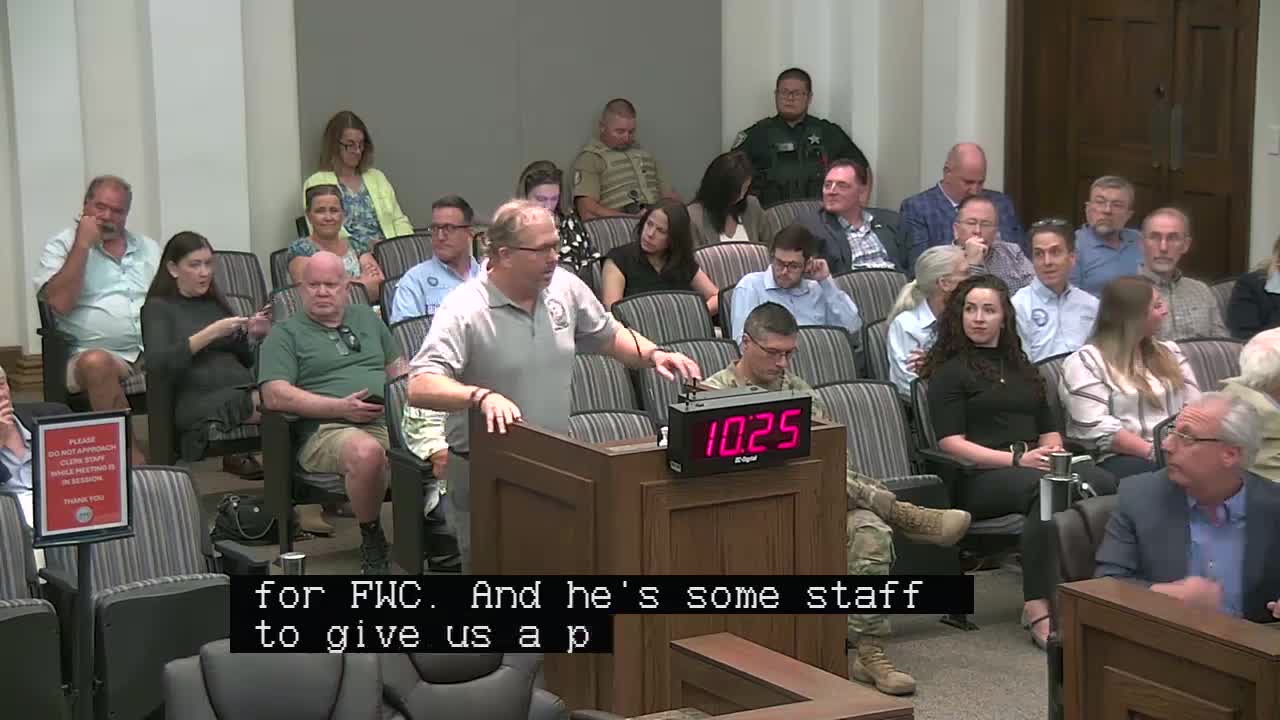
Tom Reinert, regional director for the FWC’s South Region, introduced a presentation by Alex Du, the program administrator for aquatic plant management. Du summarized statewide operations, noting the program covers about 465 lakes and rivers (roughly 1.26 million surface acres) and typically manages roughly 350 active programs yearly. He described the agency’s “proactive” approach: treating invasive plants while populations are small to avoid crisis responses that use more resources.
FWC data presented to the coalition said Lake Okeechobee had historic low floating‑vegetation acreage in 2025: an average of about 37 acres this year (the lake’s surface is about 448,000 acres). Agency figures show crews treated about 717 acres on the lake in 2025 so far; FWC said herbicide use has fallen substantially in recent years — roughly an 80% reduction since 2020 — and that fewer acres required treatment relative to earlier years.
The agency explained methods used: mechanical harvesters, drawdowns and cultural measures, biological control (importing tested, host‑specific insects), and selective aquatic herbicides. Alex Du said selective aquatic herbicides are extensively tested for aquatic applications and have predictable half‑lives; he said FWC prescriptions are specific, with biologists choosing herbicide and rate and enforcing contract compliance and GPS tracking of applications.
Public comments and concerns: Several commenters said the lake is poorly managed and called for more direct action on lake muck and legacy nutrients. Newton Cook of United Waterfowlers urged a new cross‑agency committee focused on Lake Okeechobee. James Watt and Dennis Lee accused agencies of overuse and misuse of chemicals; Du and Reinert replied that herbicides are used selectively, with contract oversight, GPS tracking of spray runs and training requirements for applicators.
Commissioner questions and follow‑up requests: Commissioners asked for updates on dredging and legacy‑nutrient removal. Corps staff and district officials said prior studies on dredging had identified disposal and placement challenges and that no active, authorized large‑scale dredging project for the lakebed is currently under way; they said earlier analyses would need to be revisited if the coalition wished to pursue that course. Commissioners asked agencies to present existing study results at a future coalition meeting so members can assess previously identified barriers and options.
Ending: FWC officials said they would continue interagency flights, bimonthly task‑force coordination and site monitoring; some commissioners and public speakers said they want stronger emphasis on in‑lake removal and clearer, independent peer review of management plans.