Get Full Government Meeting Transcripts, Videos, & Alerts Forever!
Get email alerts on the Infrastructure Wastewater topic
No spam. Unsubscribe anytime.
Santa Rosa commissioners approve Milton Interchange sewer rate schedule to fund new wastewater plant
Summary
The Santa Rosa County Board of County Commissioners approved connection and impact fees for a planned Milton Interchange wastewater treatment plant, adopting a rate package intended to cover debt service and operating costs for the new facility while the county establishes it as an enterprise account.
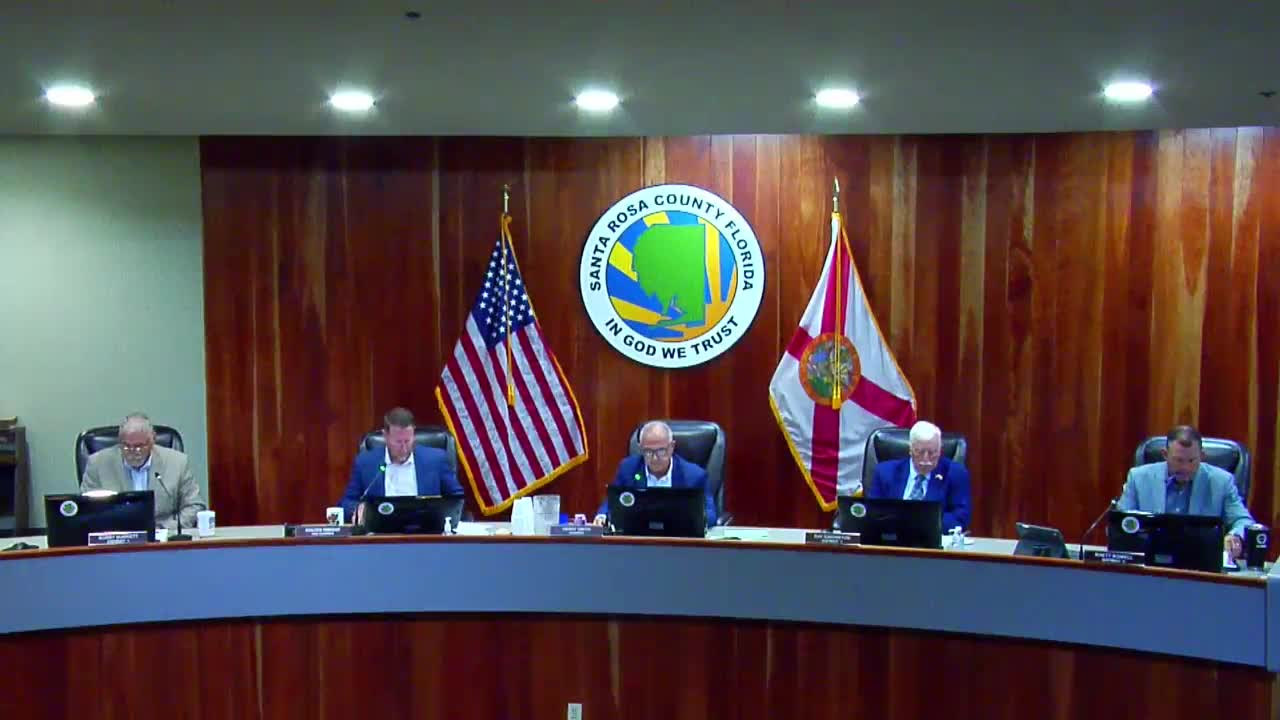
The Santa Rosa County Board of County Commissioners on Aug. 28 approved a rate schedule for the planned Milton Interchange wastewater treatment plant, adopting connection and impact fees intended to cover the plant’s debt service and operating costs.
Commissioner Colton Wright opened discussion on item 16, telling the board that several residents had contacted commissioners with concerns about the proposed fees and asking Jacobs representatives and county staff to explain the assumptions behind the rates. A Jacobs consultant said wastewater plants are expensive to operate and maintain and that many utilities subsidize sewer operations with water sales; because the county’s new plant will not sell potable water, its rate model must reflect higher one-time and operating costs.
The Jacobs representative said the study’s major financial drivers are roughly $2 million in annualized debt service over 25 years at 3.66% and an estimated $1 million a year in early operating costs, producing roughly $3 million of baseline annual obligations. To reduce monthly burdens on customers, the consultant described a model that places a larger share of costs upfront in connection and impact fees. The study scenarios shown to the board included residential connection fees ranging from $3,000 to $7,500 and residential impact fees ranging from $5,000 to $8,000; the option the board discussed in detail and subsequently accepted set a $7,500 connection fee and an $8,000 impact fee for single-family residential units, with higher per-unit fees for commercial units.
County staff and commissioners emphasized that the sewer enterprise will initially rely on county-backed debt (Ad valorem pledges) until the enterprise is established; once operating revenues are reliable, staff said the county will transfer debt to the enterprise to free general debt capacity for other projects. Commissioners and the consultant also noted that existing sewer providers in the region typically recoup costs differently because many also sell potable water and therefore cross-subsidize sewer operations.
After discussion about affordability and the board’s ability to adopt future incentives or adjustments, Commissioner Colton Wright moved to approve and accept the presented rates and impact fee structure. The motion passed without objection; no roll-call vote was recorded.
The board directed staff to continue refining the business plan, monitor connections against projections after the plant goes into service, and consider targeted incentives if the county wants to encourage specific types of development. Commissioners also said the board can revisit the fee structure once the plant is operational and revenue patterns are established.
Notes: the consultant repeatedly emphasized that wastewater treatment plants have limited operating margins, substantial maintenance needs and exposure to single large failures that can create multi‑hundred‑thousand‑dollar repair costs. Commissioners framed the vote as an investment in economic development, saying sewer capacity is necessary to attract larger employers and industrial tenants.