Get Full Government Meeting Transcripts, Videos, & Alerts Forever!
Get email alerts on the Everglades Restoration topic
No spam. Unsubscribe anytime.
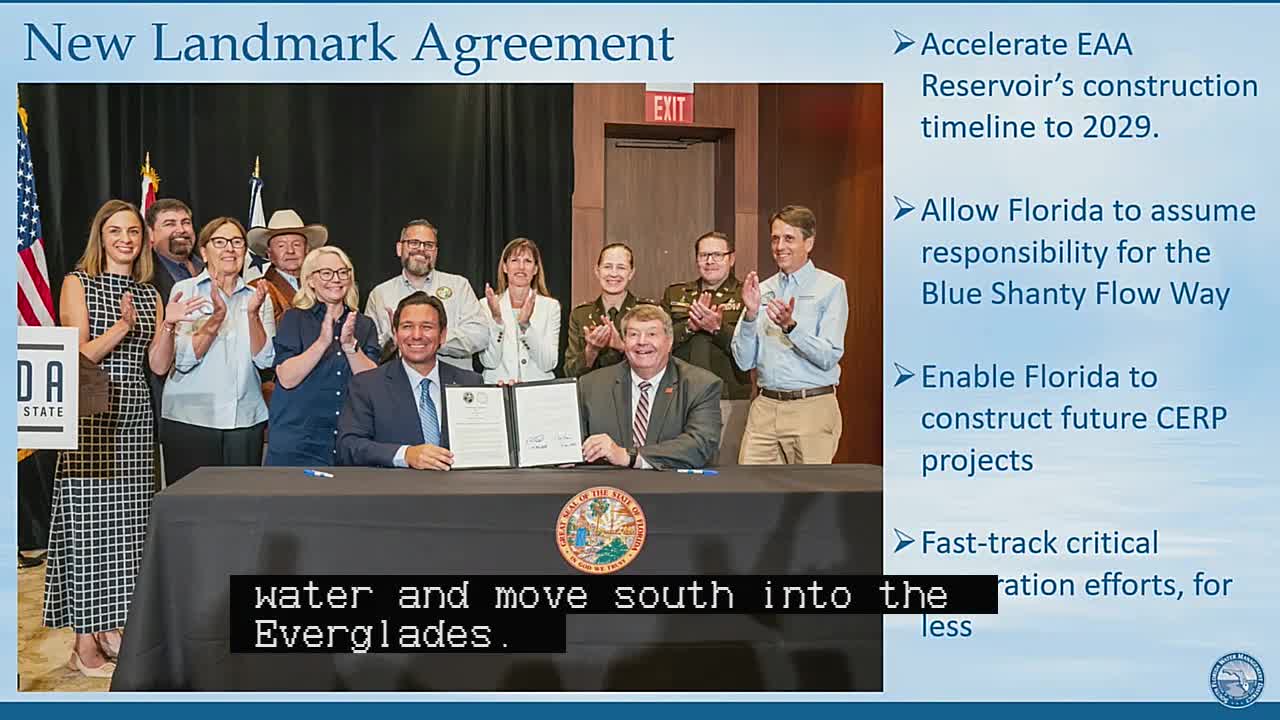
State, Army sign agreement to accelerate EAA Reservoir and Blue Shanty Flowway
Summary
South Florida Water Management District and the U.S. Army, under a new memorandum, agreed to accelerate the Everglades Agricultural Area reservoir timeline and related Flowway work; the state will use fiscal resources to advance design and pump‑station construction while federal funds are expected for major construction.
The South Florida Water Management District and the U.S. Army Corps of Engineers said a landmark memorandum of understanding will speed delivery of key Everglades restoration projects, including the Everglades Agricultural Area (EAA) reservoir and the Blue Shanty Flowway.
Jennifer Reynolds, presenting for the Water Management District, said the July agreement charges the Corps with accelerating construction while the state will assume responsibility for some associated components and use state funds to advance design and permitting. “We are working closely with the federal government to make sure that we can deliver these commitments,” Reynolds said during the coalition meeting on Sept. 5 in Okeechobee.
The agreement aims to move the EAA reservoir timeline to 2029 and advances construction of pump stations and other supporting infrastructure, Reynolds said. The state will fund design and permitting work now and seek federal reimbursement for construction; the Corps will continue to pursue federal construction funds and to identify ways to shorten its delivery schedule.
Why it matters: The EAA reservoir and Blue Shanty Flowway are intended to increase storage and move cleaned water south into the Everglades and Florida Bay rather than discharging it to coastal estuaries. District staff said getting pump stations, seepage control and communication systems ready earlier will allow the storage project to operate sooner when water is available.
What officials said and asked: Major Corey Bell of the Army Corps described broader Corps mission sets and how dredged material can be reused to nourish beaches, a practice the Corps said benefits coastal storm resilience and wildlife. Eva Velez, ecosystem branch at the Corps, said Congress’s appropriations schedule remains uncertain; she described an expected continuing resolution for Oct. 1 and said House appropriations language had increased Everglades funding beyond the president’s request but the Senate position remained to be resolved.
Commissioners pressed both agencies on financial and technical contingency plans. Commissioner David Hurd asked whether the state can “front” design work and be reimbursed by the feds; Reynolds and Corps staff confirmed the state may use its appropriations to complete design and permitting phases and that federal funding would be sought for construction.
Outstanding issues and next steps: District and Corps speakers said the agreement intends to combine state procurement nimbleness with federal funds and oversight to shorten schedules; the agencies will refine the exact implementation steps and bring contracts to the district governing board in September. Officials said the EAA reservoir is being filled deliberately and will require ongoing monitoring as components come online. They also noted the schedule depends on timely federal appropriations and construction execution.
Provenance: Presentation and discussion of the July agreement and acceleration plan took place during Jennifer Reynolds’s district update and related Corps remarks at the Sept. 5 meeting.