Get Full Government Meeting Transcripts, Videos, & Alerts Forever!
Get email alerts on the Comprehensive Plan Growth topic
No spam. Unsubscribe anytime.
Woodland planning workshop flags limited land, divergent growth projections; state law changes expected
Summary
City planning staff told council the comprehensive-plan update shows roughly 30–35 acres of buildable land inside Woodland and warned county and state growth projections diverge; staff also identified several state law (RCW) changes the city must incorporate.
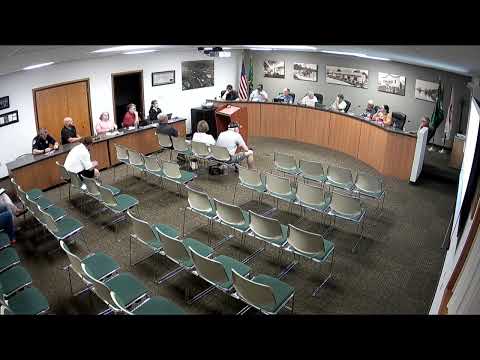
At a September council workshop, planning staff presented an update to Woodland’s comprehensive plan that says the city has a finite amount of buildable land and that county and state population projections differ sharply, potentially forcing policy choices about annexation and density.
The planning presentation, given by Travis (planning staff), said "Within the city limits, we've estimated there's roughly 30 acres of buildable land," and showed that using current land supply Woodland cannot accommodate the largest growth forecasts offered by Cowlitz County or the State Office of Financial Management without changes to the urban growth boundary or large increases in density.
The report matters because county and state projections affect how much housing Woodland must plan for under Washington’s Growth Management Act. Travis told the council that Cowlitz County initially estimated Woodland should expect roughly 200 new housing units under an early allocation approach but later revised its allocation upward—reportedly to an amount that would add about 2,000 housing units—creating a large gap between the city’s land-based capacity and the county’s allocation.
Planning staff said the discrepancy stems in part from scale: small statistical errors across a county translate into large local impacts for a town Woodland’s size. The staff presentation compared multiple local plans (water, sewer, parks) and noted those plans use different growth-rate assumptions (examples cited in the presentation included 2.3% and 2.35% growth rates in several utility and parks documents), which produces varying population and housing-unit projections.
The planning commission reviewed the draft and requested several updates, including refreshed counts for subdivisions and permits now on file and a few minor editorial changes to the plan text. Travis told council he took direction in 2024 to use a December snapshot of projects and land supply rather than continuously update the numbers month to month; the draft was therefore built from that snapshot and professional judgment about where supply and pipeline projects will likely go in the near term.
Staff highlighted other planning constraints that will affect local decisions: a backlog of roughly 380 approved subdivision lots recorded since 2022 that will be built out over multiple years; differing household-size assumptions used by state and local plans; and the presence of sizeable development outside city limits whose residents use Woodland services but do not pay impact fees to the city.
Travis also summarized state law changes that trigger local code updates. The draft comprehensive-plan materials include an RCW compliance matrix and identify items the city must update, including incorporation of recent housing-planning requirements, the State Environmental Policy Act (SEPA) changes from 2022, and rules about accessory dwelling units (ADUs). Travis said the city must adopt code changes for two-unit ADUs within six months of finalizing the comprehensive plan to remain in compliance, and staff prefers that the council adopt local sideboards (limits and conditions) for any new state-mandated allowances rather than have the state default rules apply.
Council members asked for paper copies of the packet and requested staff return with any updated pipeline numbers the planning commission proposed. The presentation materials and an RCW-to-code crosswalk are posted on the comprehensive-plan project page on the city website, according to staff.
Looking ahead, council members will see the planning commission’s formal recommendation at the commission’s next public hearing; any proposed annexation or density changes would return to council for decisions, and council members were reminded that annexation requests are voluntary and that annexation rules consider owner consent and property valuation.
Ending: Staff encouraged councilors and residents to review the plan materials and the RCW summary before the planning commission’s hearing so that policy choices about density, annexation, and local sideboards can be considered before final adoption.