Get Full Government Meeting Transcripts, Videos, & Alerts Forever!
Get email alerts on the School Finance topic
No spam. Unsubscribe anytime.
Neptune board and superintendent defend tax-levy increase as residents raise affordability, charter tuition and attendance concerns
Summary
At a public meeting, Neptune Township School District leaders defended a recent tax-levy increase tied to multi-year state funding losses and rising costs; residents pressed the board on impacts to seniors, charter-school tuition and chronic absenteeism. The board approved routine agenda items by roll call after the public-comment period.
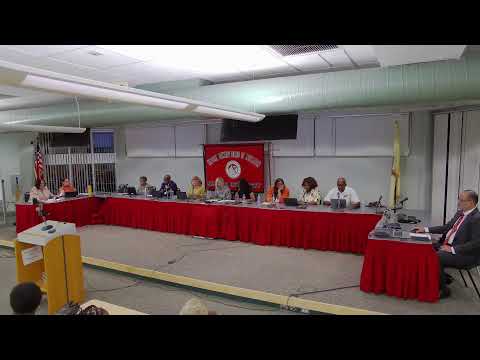
The Neptune Township Board of Education and Superintendent Dr. Crater faced a packed public-comment session focused on a recent tax-levy increase and the district's budget shortfall, as dozens of residents described the hikes as unaffordable and urged state-level fixes.
Board President Della Sala opened the public-comment session with a prepared statement addressing what she called "a wealth of misinformation that has been shared via social media." She said the district had lost "more than $25,000,000 in state and federal funding" over recent years and that administrators had concluded raising the local tax levy was necessary to avoid cutting programs and positions.
Why it matters: Neptune residents told the board that recent property tax increases — several people described them as 30% to 50% in a single year — are forcing seniors and long-term homeowners to consider leaving. Commenters pushed the district to press legislators in Trenton for changes to state funding and to explain budget choices such as charter-school tuition payments and staffing cuts.
What board leaders said
Della Sala, board president, said the district had reduced staffing and trimmed "all accounts" but that continuing increases in health-care costs, utilities and transportation left few options. "Without this tax levy increase, we would have had to cut 40 positions, cancel programs, provide less transportation, and increase class sizes," she said.
Superintendent Dr. Crater summarized recent steps and district context and noted efforts to expand supports for families. She highlighted outreach already under way, saying administrators had formed a budget task force and were researching reconfiguration, transportation and potential program-delivery changes to reduce costs without compromising education quality.
Residents' concerns
Speakers described steep, sudden tax increases as financially devastating. Maureen Eng, who said her taxes rose about 40% in one year, told the board the increase was "unreasonable to expect." Richard and Donna Terrell, Arthur Atkins and others described fixed incomes and foreclosure risks.
Several residents asked why Neptune had to raise local taxes while some other New Jersey districts did not. The board explained the state funding formula and the one-time allowance the district used to exceed the usual levy cap: districts that fall below the state's adequacy and local-share calculations may be allowed to increase the levy by the difference. "Some took all of the money. Some, like us, took some of the money," Dr. Crater said.
Charter tuition and student population
Multiple residents asked about charter-school tuition. The board said state law requires a district to pay tuition for students who live in the district but attend charter schools. The administration identified charter tuition as a significant line item, with one administration statement saying "our charter school tuition right now is about $4,000,000," and other remarks in the meeting referencing higher totals reported from state data. The board encouraged residents to attend public hearings for proposed charters and to press the state for more oversight.
Attendance and outcomes
Board officials acknowledged chronic absenteeism as a continuing challenge. Dr. Crater said New Jersey's statewide chronic-absence rate was about 14.9% for 2023-24 and that Neptune's rate was higher: "Ours was 26.9%." The superintendent and board members described incentives, home visits, and partnerships with local organizations and health providers as part of an attendance plan, while also noting that changes in court enforcement and child-protection staffing had reduced the effectiveness of some prior measures.
Personnel and spending cuts
Board materials and statements listed multiple personnel reductions and program cuts in recent years. Della Sala said the district had cut roughly 100 nonadministrative positions (described elsewhere in the meeting as about 107 positions over six years) and had eliminated certain school-based posts such as reading coaches and department chairs during previous rounds of reductions. The district said it had also trimmed administrative spending and ranked about mid-pack in administrative costs compared with similar New Jersey districts.
Superintendent pay and comparisons
Della Sala read figures for Superintendent Dr. Crater's 2024-25 pay, saying, "for the 24-25 school year, Dr. Crater ... was earning $203,799," and compared that figure with several neighboring districts to show it was not at the top of regional superintendent salaries.
Board action following public comment
After public comment concluded, the board moved through the meeting's consent and action items. By roll call, the board approved minutes from prior meetings and routine agenda items including the superintendent report, finance and transportation recommendations, special-education items, personnel motions and the schedule of meetings. The board repeatedly encouraged residents to contact state legislators about the funding formula and said it would expand a budget stakeholder committee to include parents, staff and community members once administrators complete initial research.
Votes at a glance
- Minutes (work session 07/28/2025; special meeting NJSBA training 07/30/2025; regular meeting 07/30/2025): moved by Miss Harris; seconded; approved by roll call. - Superintendent's report (document A, items 1'10): moved by Mr. Hubbard; seconded; approved by roll call. - Finance (document B1, items 1—): moved by Ms. Jones; seconded; approved by roll call. - Transportation (document B3, items 1—): moved by Vice President Thompson; seconded; approved by roll call. - Education / Special Projects (document C1, item 1): moved by Mr. West; seconded; approved by roll call. - Special Education (document C2, items 1'): moved by Miss Harris; seconded; approved by roll call. - Education and Student Activities (document C3, item 1): moved by Mr. Hubbard; seconded; approved by roll call. - Personnel (document D1, items 1—0): moved by Ms. Morgan; seconded; approved by roll call. - Schedule of Meetings: moved by Mr. West; seconded; approved by roll call.
What the board plans next
The administration said it will expand its budget task force to include parents and community members after initial research on reconfiguration, transportation and program-delivery is complete. Board leaders repeatedly urged residents to contact state representatives about the S-2-era funding changes and to monitor proposed charter approvals and state-level policy changes that affect district aid.
The board also invited philanthropic support and encouraged residents to attend school-year events to see district programs and student work in person.
Ending note
Board President Della Sala closed the meeting's public comment period by stressing the board's openness to community input and the district's immediate focus on stabilizing services while pursuing longer-term advocacy at the state level.