Get Full Government Meeting Transcripts, Videos, & Alerts Forever!
Get email alerts on the Land Use Solar topic
No spam. Unsubscribe anytime.
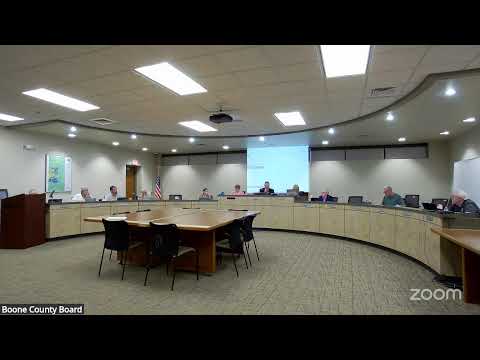
Boone County OKs special-use permit for US Route 20 solar project after lengthy debate over future road funding
Summary
The Boone County Board approved an ordinance granting a special-use permit for a solar energy development on the south side of U.S. Route 20 after protracted debate over whether the project must set aside funds to contribute to possible future road construction.
The Boone County Board approved an ordinance granting a special-use permit for a solar energy development on the south side of U.S. Route 20 after extended public hearings and intermembers debate about road access and mitigation funding.
Chairman Carl Johnson called for a vote after hours of testimony and amendments; the ordinance passed on a roll call vote with a majority in favor and a lone recorded “no” from Brian Schneider.
The ordinance authorizes a solar facility covering roughly 15 acres of site area on an approximately 37-acre parcel, with a racking system under 20 feet and some 3,555 solar modules, according to staff presentations.
The board’s central dispute centered on conditions tied to future roadway needs if the land west of the project later develops. County staff and the county engineer argued the county should require the project to help reserve funding for a future public right-of-way that would improve emergency access for nearby subdivisions. Opponents, including the project attorney, said the state statute governing solar special uses limits conditions and that requiring large escrow sums or road construction unrelated to the solar project exceeded the board’s authority.
Applicant representative Gabriel Bridal told the board Reactivate and the landowner intended to preserve the property for agriculture and that the solar ground disturbance could be returned to agricultural use at decommissioning. He also said the project would use a private access and generate negligible ongoing traffic once built: “There will be no additional traffic impact on current local roads in the area. The solar facility will have its own private access point that will be removed upon decommissioning,” Bridal said.
Attorney Jim Hirsch, representing the applicant, urged the board to accept the Zoning Board of Appeals’ recommended conditions and warned that conditions lacking a direct legal nexus to the project's impacts could be vulnerable to legal challenge. “Can you stick conditions that aren't in the statute onto these types of special uses? Of course, my legal analysis of that is...we don't have any guidance on this. Let me start there,” Hirsch said.
County Engineer Justin (last name spoken as Justin in the record) explained the county’s concern focused on public safety and continuity of access. He said nearby subdivisions have only single access points in places and that prior designs reserved stubbed rights-of-way that the county expects to remain available if development occurs. He noted that Cherry Valley has invested in a water line to the southern parcel and that such investments make development to the west more feasible in the future.
Board members negotiated multiple amendments. The board moved from an initial county-administration proposal that included a $500,000 escrow for potential road work to a reduction of that amount to $200,000 (motion by Tom Wahlberg, seconded by Josh Shoemaker). The board added a 15-year time limit on any escrow account (second amendment) and specified the escrow must be held in an interest-bearing account; if no qualifying development requiring the road is initiated within 15 years, the original $200,000 plus earned interest will be returned to the applicant. Separately, the board voted to remove a previously proposed condition identified as “condition 3” (the portion labeled B on the presented map) that would have required an additional right-of-way.
After the amendments, the final ordinance retained the requirement addressing the right-of-way labeled A (to be funded from the escrow if triggered by development), removed condition 3/B, and required the escrow arrangement described above. The board’s final roll call recorded a majority vote in favor; Brian Schneider was recorded as voting no.
The board took no immediate action to build new public roads. County staff and several board members emphasized the escrow and right-of-way conditions were preventive planning measures to protect future residents and emergency access if adjacent parcels are developed.
The applicant indicated acceptance of the amended conditions and the board adjourned that agenda item after the vote.
The action means the special-use permit may proceed under the board’s amended conditions; implementation steps, such as permitting and any required construction for the solar site access, will follow county practice and are subject to any separate permitting requirements and the county decommissioning plan for solar facilities.