Get Full Government Meeting Transcripts, Videos, & Alerts Forever!
Get email alerts on the Transportation topic
No spam. Unsubscribe anytime.
Yelm planning commission reviews transportation element update, highlights bike/ped network and post-loop reassessment
Summary
The Yelm Planning Commission reviewed a draft update to the transportation element of the comprehensive plan from consultant Greg Ryan of SCJ Alliance, discussed new goals and policies addressing multimodal safety, and agreed to a future reassessment of several intersections after completion of the city—s loop project.
The Yelm Planning Commission on Aug. 19 heard a presentation on a draft update to the transportation element of the city—s comprehensive plan from Greg Ryan, a consultant with SCJ Alliance, who summarized proposed new goals, policy edits and a long-range set of projects intended to guide investments through 2050.
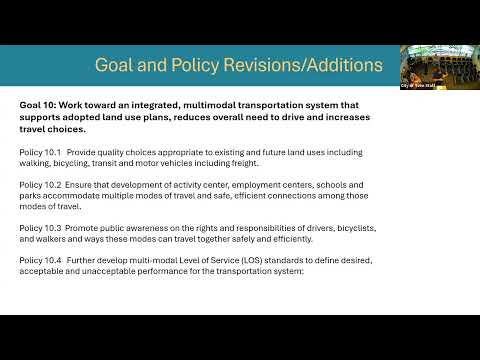
Ryan told commissioners the update keeps much of the previous plan but adds a tenth goal and new policies that explicitly reference emergency-service input, emerging vehicle technologies and multimodal safety. "We've added a tenth goal," Ryan said, "and ... policies based on current trends or current GMA requirements." The consultant said additions include guidance to incorporate emergency-service providers in roadway evaluations and to plan for bike, pedestrian and emerging mobility options.
The commission was shown technical analysis of 22 study intersections used to model projected performance under a 2050 horizon. Ryan said the draft assumes completion of the planned loop and related projects (for example, roundabouts at Walmart Boulevard and Bald Hill Road) and that the modeled improvements reduce delay at many locations. "The goal on a map like this is to show that everything's yellow or green," Ryan said. He noted six red (failing) intersections remain in the model today: three along Yelm Avenue and three along the temporary/"fake" loop. He recommended a follow-up reassessment once the loop is open and traffic patterns stabilize.
Commissioners and staff discussed the timing and method for that reassessment. Ryan recommended waiting until the loop is complete, letting traffic patterns settle for about six to nine months and then taking fresh counts and rerunning the model before recommending permanent fixes for the six red intersections. "Once the loop was fully complete and open, we'd want to let at least 6 to 9 months for the dust to settle so that travel patterns kinda normalize," Ryan said.
The draft also includes a stress analysis of sidewalks and an indexed prioritization of pedestrian gaps and trail connections. Ryan said the team compiled GIS data for existing sidewalks, ran a high-level pedestrian-stress analysis (considering roadway speed, barriers and traffic volume) and prioritized sidewalk infill to connect homes with parks, schools and the planned loop trail. For bikes, the element proposes an alternate "bicycle bypass" network that routes cyclists on less-trafficked north-south and east-west couplets rather than squeezing lane diets onto Yelm Avenue.
Commissioners raised a series of implementation questions that staff flagged for follow-up: mapping and labeling of trail access points and crossings on the Prairie Line/loop trail so the graphic does not imply continuous, uninterrupted dedicated facilities; whether the plan should add a level-of-service standard for access to trails; and the potential creation of a standing transportation subcommittee to provide ongoing review of projects and funding requests.
Gary (city planning staff) said staff will incorporate comments and invited commissioners and the public to submit written feedback during the 30-day review period. "This is our long-term vision for the bike and ped networks," he said, "and that's part of what we should be aiming for is good access." The commission did not take final action on the element at the meeting; the draft will be revised and reposted for review.
Votes at a glance: The only formal motion recorded in the meeting packet was a housekeeping vote to accept the July meeting minutes with a name correction; that motion passed unanimously by roll call.
Why it matters: The transportation element sets policy direction for road, sidewalk and trail investments and influences grant competitiveness, local concurrency/construction timing and future design decisions for roads that will change classification as development occurs.