Get Full Government Meeting Transcripts, Videos, & Alerts Forever!
Get email alerts on the Housing topic
No spam. Unsubscribe anytime.
Alachua County reviews housing-element updates; commissioners debate manufactured homes, RVs, workforce housing
Summary
At a Sept. 2 workshop, Alachua County commissioners and staff reviewed proposed updates to the county comprehensive plan's housing element, focusing on manufactured and modular housing, tiny homes and RV living, workforce housing definitions, and funding and implementation steps ahead of a March 31, 2026 statutory transmission deadline.
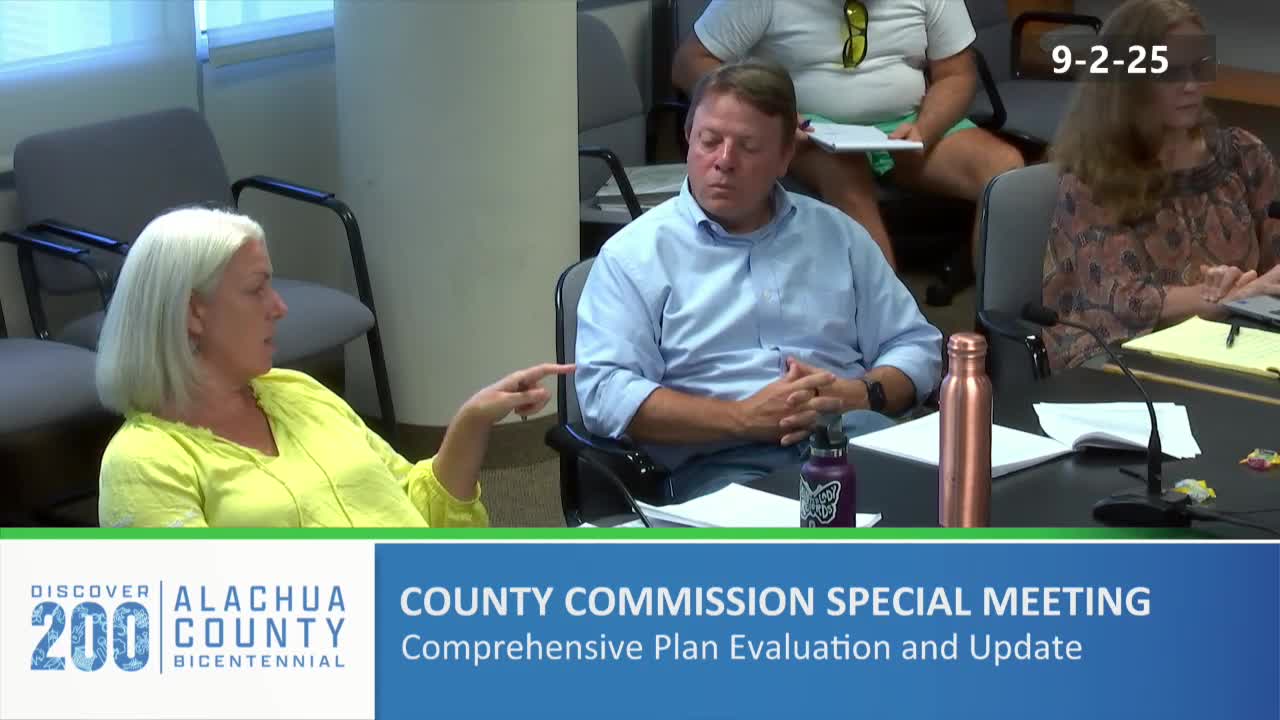
Alachua County commissioners and staff on Sept. 2 began a multi-session review of proposed updates to the county comprehensive plan's housing element, focusing on manufactured and modular housing, tiny homes and RV parks and how to reflect recent funding programs and statutory changes. "This is your second workshop on the comprehensive plan evaluation and update," Planning staff member Ben Chumley told the board, framing the discussion and next steps.
The workshop was framed as a high-level review of the current housing element and staff recommendations, with the county required by state law to transmit any necessary comprehensive plan amendments by March 31, 2026. Chumley told commissioners staff will draft amendment language after the workshop series and bring it to the planning commission and the board for consideration.
Discussion focused first on the element's emphasis on manufactured housing. Several commissioners said the existing language appeared to treat manufactured housing as older mobile homes rather than modern modular construction. One commissioner noted that modern modular homes can meet the same building-code and hurricane standards as site-built homes and should be treated differently from older mobile units. Planning staff said modular housing that meets building code is treated as single-family construction and is allowed anywhere single-family dwellings are allowed; manufactured housing and mobile-home parks are regulated under different standards and are primarily allowed in agricultural zoning or in the county's RM (mobile-home) zoning district.
Commissioners debated how to address tiny homes and tiny homes on wheels. Ben Chumley and other staff said tiny homes on wheels and RVs have been allowed as principal units or accessory dwellings in agricultural zoning in recent code changes, but that permanent RV parks require tourist-entertainment land use and appropriate water/sewer hookups. One commissioner said, "I am not in favor of us creating RV parks as permanent housing in our county," adding safety concerns for storms and long-term infrastructure limits.
Housing director Ralston Radica described existing repair and aging-in-place work under the county's SHIP (State Housing Initiatives Partnership) program. "As part of our SHIP home repair program, our partners do those type of assessments, for seniors to be able to age in place," Radica said. Commissioners asked staff to consider adding a policy to the housing element to support home-evaluation and low-cost upgrades for older homeowners to reduce hurricane vulnerability and insurance losses.
Commissioners discussed workforce housing terminology required by state statute. One commissioner asked, "Should we, everywhere when we say affordable housing, should it say affordable and workforce housing?" Staff noted the statute requires the plan to address workforce housing and recommended adding the term and the statutory definition (commonly discussed in the meeting as roughly the 80–120% area median income range) across the element.
Staff also recommended adding policies to reflect newly available local funding sources. Chumley told the board the element should recognize the infrastructure surtax (IST) and the county's affordable housing trust fund and revise older policy language that previously only suggested exploring those tools. A commissioner pointed out that the county currently has "$54,000,000 sitting in a bucket," and commissioners discussed using trust-fund and IST dollars for land acquisition, motel conversions, multifamily development and other strategies.
On adaptive reuse and motel conversions, staff proposed adding language to allow the county to undertake motel conversions as one implementation strategy, and commissioners said any motel-conversion policy should also consider wraparound services and avoid concentrating people with high needs in a single location. Staff noted the element already contains a general adaptive-reuse policy and said they would add language describing county-led motel reuse if the board wanted that option explicitly.
Commissioners raised the "missing middle"—small multiunit housing that looks like single-family development (sometimes called "mansion apartments," cottage-style multifamily or duplex/triplex forms). Several commissioners asked staff to return with options to allow small-scale multifamily or ADU-based strategies in new developments, with safeguards for existing single-family neighborhoods. Staff said the county already allows many mixed forms in traditional neighborhood development and could bring options for new development and targeted infill, but that explicit changes for existing platted single-family neighborhoods would require further discussion.
Staff outlined several specific drafting tasks and directions for the board: add workforce-housing language and the statutory definition; incorporate IST and the affordable housing trust fund into the element; add policies encouraging hurricane-hardening upgrades in rehab programs; and include explicit recognition of motel conversions as a county strategy. Commissioners also asked staff to evaluate parking-reduction incentives and to add redevelopment language encouraging the reuse of vacant structures.
Distinguishing discussion from formal decisions: the workshop generated multiple policy directions to staff but did not adopt final ordinance language at the meeting. Staff will return draft amendment text to the board and to the planning commission later this year and in early 2026, with the statutory transmission deadline of March 31, 2026 noted as the target date for any required amendments.
The board scheduled additional workshops: Oct. 7 (environmental protection and resilience topics), Oct. 21 (community facilities and services) and reserved Dec. 2 as a potential overflow date if needed. The county's next step is for staff to produce draft comp-plan amendment language reflecting the board's direction and to circulate that language for public and agency review.