Get Full Government Meeting Transcripts, Videos, & Alerts Forever!
Get email alerts on the Roadside Vendors Food Trucks topic
No spam. Unsubscribe anytime.
Marion County panel tables proposed roadside-vendor rules after hours of public comment from food-truck operators
Summary
The Land Development Regulation Commission voted to send proposed changes to rules for temporary roadside vendors — including limits on tents, structures and the number of trucks — back to a workshop after extensive testimony from food-truck operators and property owners.
The Marion County Land Development Regulation Commission on Tuesday voted to take proposed changes to the county's temporary roadside-vendor rules back to a workshop after more than an hour of public comment from food-truck operators and property owners.
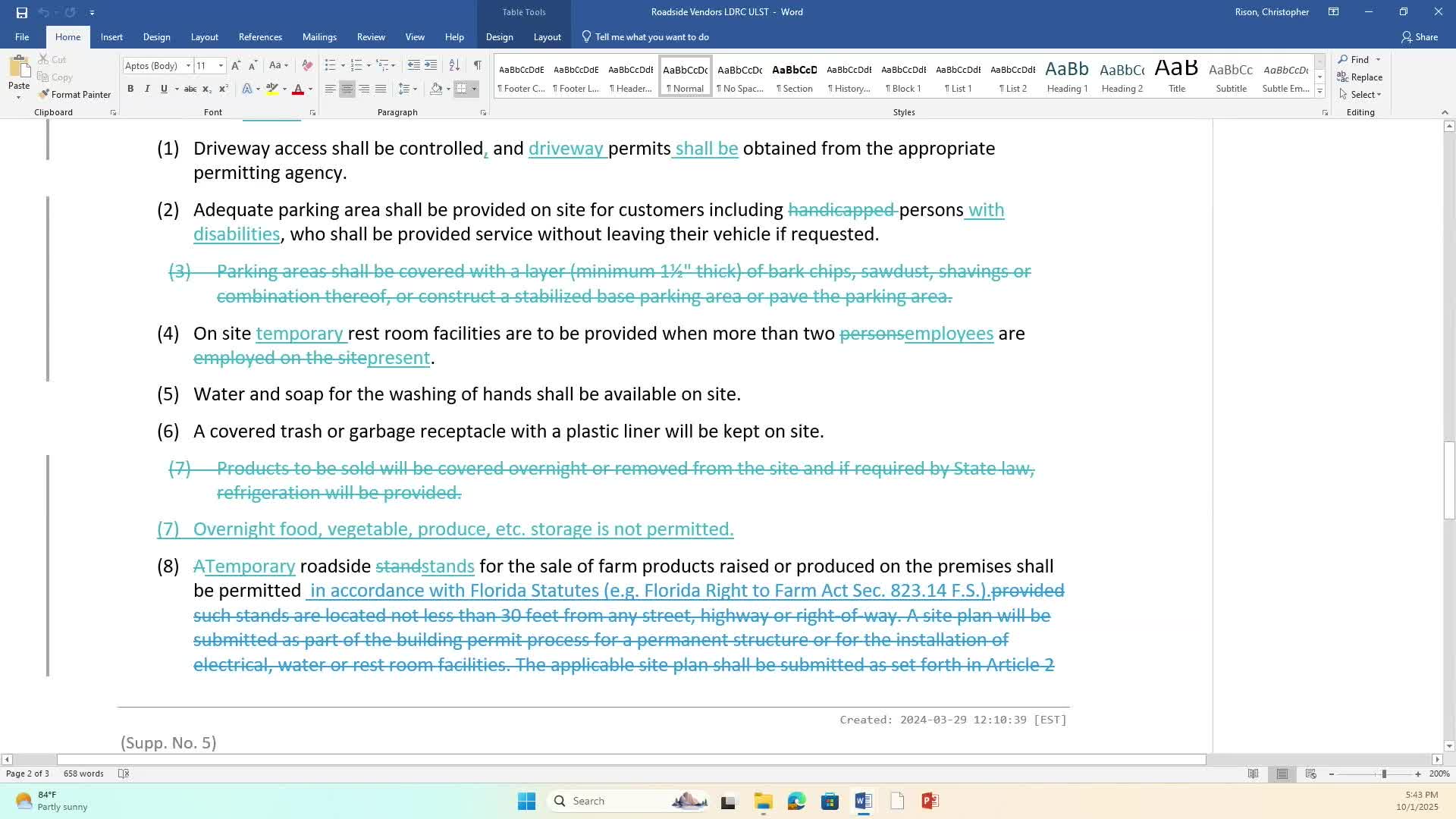
The proposed amendments would add clarity to where and how temporary vendors may operate, ban permanent utility connections on vacant land, require temporary structures to be removed at the end of each day, and require site-plan review if more than two temporary vendors operate at a single parcel.
Staff planner Chris Rising told the commission the updates aim to implement a recent state statutory requirement for solar facilities elsewhere in the code and to provide more detail for temporary roadside vendors. "Temporary roadside vendors are intended to function temporarily and independently. Services such as electric, water, and sewer shall not be permitted on vacant land," Rising said while explaining the draft language.
Food-truck operators and property owners who spoke said they only recently learned of the proposed changes and expressed concern the rules would make small, low-cost food businesses unviable. "If we put the bar too high, then [food trucks] won't be a small-business business," said Luis Betanzas, who described investing in a truck and parking it on private property. Several speakers described losing customers when tents or tables were removed for weather reasons and said daily teardown is costly and impractical.
Some vendors asked whether tents and temporary tables would be allowed. Staff replied that temporary tents and portable equipment may be used, but "what's brought in, set up, goes out with it," and larger or more permanent setups require approval through the zoning and site-plan process. Matt Aloni of Growth Services said staff's longstanding interpretation had been to allow one truck that is removed at the end of the day; the proposed text would formalize that limit and require a site plan if more than two vendors operate on a parcel.
Several operators said they had obtained site approvals or had been advised previously by county staff that certain configurations were permissible; commissioners and staff repeatedly urged people to consult zoning staff about specific sites and noted differences between truly temporary roadside vending, special event permits, and permanent food-truck parks that must meet zoning and infrastructure requirements.
After public comment, commissioners discussed two recurring concerns: (1) defining "temporary" with a specific time frame or clear criteria and (2) whether tented seating and portable tables would be allowed on commercial property without triggering a permanent-use review. Commissioner discussion noted that roadside vendors (for example, a peanut vendor or Christmas tree seller) differ from modern food-truck operations that can function as de facto restaurants, and that some proposals might better belong in a separate section addressing more-permanent food-truck parks.
A motion to send the item back to a dedicated LDRC workshop passed following a motion and second. Commissioners asked staff to publish the proposed language and to work with operators on clarified language before the Board of County Commissioners (BOCC) public hearings; staff noted the BOCC public hearings were scheduled for Nov. 4 at 10 a.m. and Dec. 2 at 5:30 p.m.
Commissioners emphasized they are "pro-business" but want a structure that ensures safety, sanitation and zoning compliance. The panel will schedule a workshop to address definitions of "temporary," the tent/table question, and the difference between temporary roadside vending, special events and permanent food-truck parks.
Ending: Staff asked vendors and property owners to review the draft code on the Marion County website, meet with zoning staff for site-specific questions and prepare specific suggested language for the workshop.