Get Full Government Meeting Transcripts, Videos, & Alerts Forever!
Get email alerts on the State Zoning Law Notice Protest topic
No spam. Unsubscribe anytime.
City attorney outlines new state zoning rules; notice and protest standards change for "comprehensive" zoning updates
Summary
Rowlett city attorney briefed the commission and council on recent state changes affecting zoning notice, signage and protest thresholds, noting the city is currently bracketed out of some provisions but that the law favors higher-density residential changes.
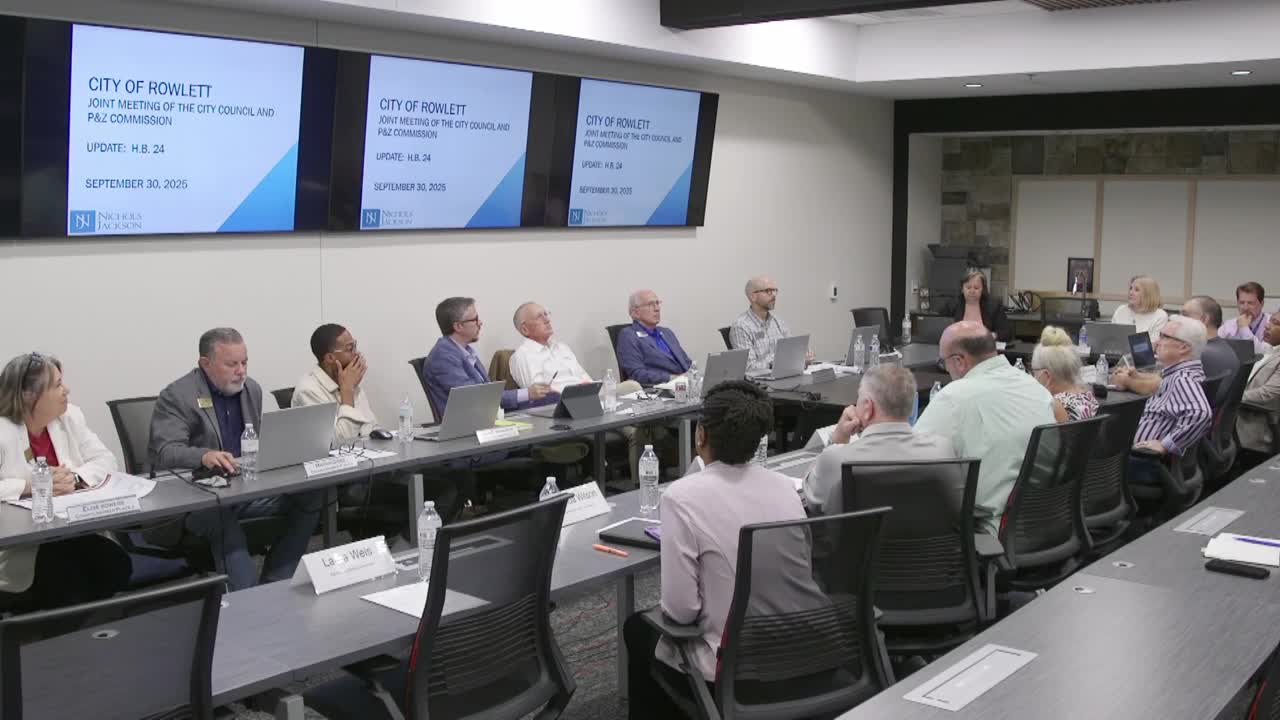
Rowlett City Attorney Victoria Thomas summarized recent state legislation affecting local zoning procedures during the Planning & Zoning Commission and City Council joint meeting on Sept. 30.
Thomas said the statute adds a formal definition for a “proposed comprehensive zoning change,” which can mean a city proposal to alter regulations to allow more residential development uniformly in one or more districts, the adoption of a new citywide zoning code or map, or an overlay that would allow additional residential density along major corridors. She told the meeting that changes of that scale carry simplified public-notice requirements: for a proposed comprehensive zoning change, notice must be published in a newspaper and on the city’s website 15 days before the hearing; individual mailed notices are required only for owners whose properties would become legally nonconforming as a result of the change.
Thomas said there is no statutory protest mechanism that applies to a citywide proposed comprehensive zoning change in the same way there is for ordinary rezoning requests. For other, parcel-specific rezoning proposals, the new law requires mailed notice to property owners within 200 feet (the city still mails to a 500-foot radius as a courtesy) and signage on the affected property not later than 10 days before the Planning & Zoning hearing. The sign minimum dimensions described during the meeting were 24 inches by 48 inches; staff noted the city’s existing 4-by-4-foot signs exceed that minimum and can remain in use.
The statute also revises protest thresholds. For many rezoning proposals, a written protest by owners of at least 20 percent of the land in the affected area or within the 200-foot mailing radius will trigger a requirement that the council approve the rezoning by a supermajority (three-fourths) of all members. But if a rezoning would have the effect of allowing more residential development (without adding commercial/industrial uses beyond limited ground-floor exceptions) and owners within the 200-foot radius generate written protest signatures covering at least 60 percent of the lots, then the council need only approve the measure by a simple majority of the full governing body to overcome the protest — a threshold that effectively reduces the power of protests in those cases, Thomas said.
Thomas also said that if the council approves a zoning change that makes residential development less restrictive, the approval is “conclusively presumed valid” 60 days after adoption unless a court action to annul the ordinance is timely filed, which raises the procedural hurdle for court challenges.
Staff told commissioners that Rowlett’s current population size keeps it outside the most sweeping legislative requirements that apply to larger cities, but council and staff discussed the likelihood that state policy trends favoring greater residential density could expand in scope in future sessions. Thomas and staff recommended the city maintain careful notice practices and consider community engagement before citywide code changes to reduce confusion about legal-nonconforming consequences and to ensure residents understand potential effects.
No council action was taken at the meeting; the presentation was informational and intended to prepare commissioners and councilmembers for how state law affects local notice, protest and timeframe requirements.