Get Full Government Meeting Transcripts, Videos, & Alerts Forever!
Get email alerts on the Recode Rowlett topic
No spam. Unsubscribe anytime.
Recode Rowlett committee seeks to consolidate overlapping zoning codes; recommendations targeted for late October/early November
Summary
Staff told the Planning & Zoning Commission and council that Recode Rowlett — a committee reviewing the city’s two parallel zoning ordinances — has met eight times and is recommending consolidation of districts, updated purpose statements and further review of tree-preservation rules before public roll-out.
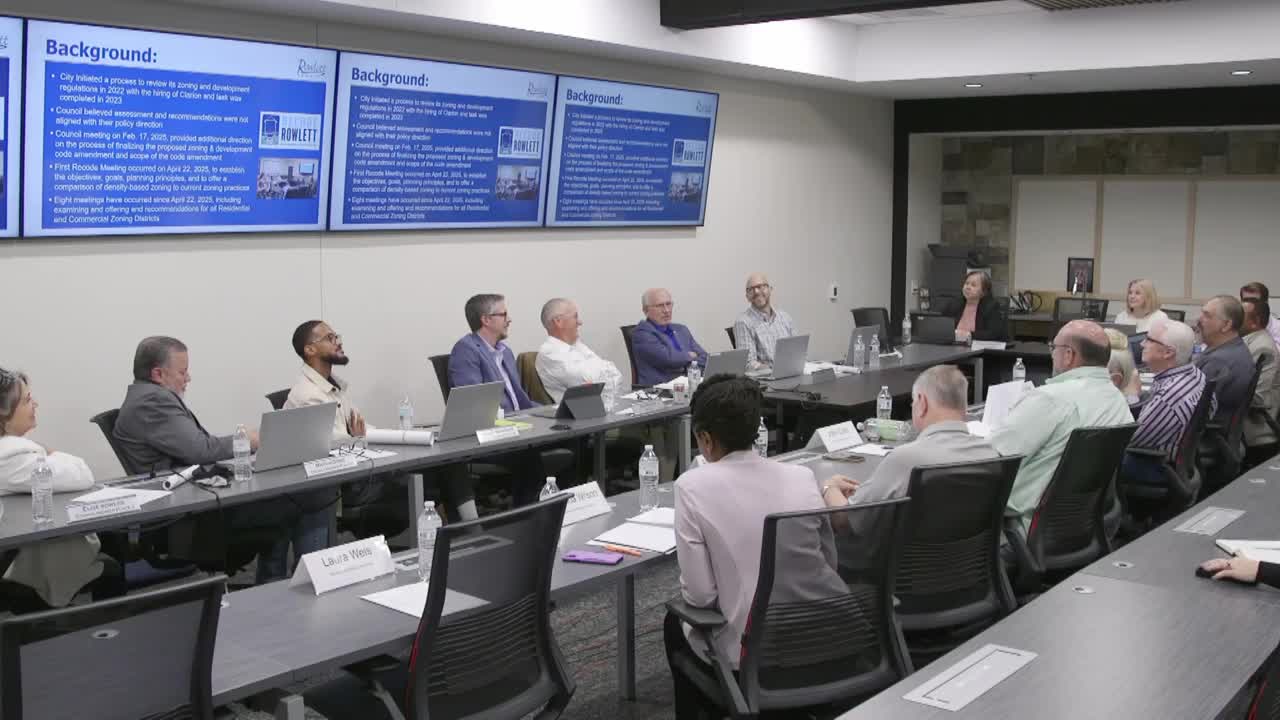
City staff and the Recode Rowlett committee updated the Planning & Zoning Commission and council Sept. 30 on an effort to reconcile Rowlett’s two zoning frameworks and simplify the city’s land-use rules.
Director of Community Development Derek Cole said the project’s purpose is to eliminate conflicts between the Rowlett Development Code (the city’s traditional zoning ordinance) and the city’s form-based code, to create a unified, functional code and to ensure the rules are easier to apply and enforce. “The overall objective helps us to achieve a unified zoning ordinance that will take into account those things that are currently, you know, built, that are existing, and then those things that are gonna come,” Cole said.
Cole said the initiative began in 2022, a consultant produced a first-phase assessment, and a second directive in 2025 narrowed the scope to address the most pressing inconsistencies. Recode Rowlett convened its first committee meeting on April 22, 2025; staff said the committee has since held eight meetings, reviewing residential and commercial districts and drafting consolidated purpose statements.
The committee is proposing to reduce the number of residential zoning categories — staff noted the Rowlett Development Code currently contains a dozen residential districts while the form-based code has additional, overlapping residential categories — and to consolidate them into fewer, clearer districts (staff cited an example of combining multiple single-family and urban-neighborhood districts into a “low-to-medium density” category). Staff emphasized that the exercise respects existing, lawfully established uses and that legal nonconforming uses will remain subject to standard nonconforming-use rules (no expansion or intensification beyond specified limits).
Planned next steps include finishing institutional and special-use categories, resolving areas of conflicting development standards (including tree-preservation rules where form-based and traditional code differ), preparing a proposed zoning map, updating the city’s use table, and holding community meetings prior to formal public hearings. Staff said it expects to complete the committee’s district recommendations by late October or early November and then proceed with ordinance refinement, public engagement and formal public hearings at Planning & Zoning and City Council.
Committee membership cited during the meeting included Councilmembers Reeves and Mayor Pro Tem Shupp, Planning & Zoning Chairman Stanley Cote and commissioners Pollard and Williams, along with other appointed members such as Mark Dammer. Cole said the committee is emphasizing purpose statements and a “toolbox” approach so developers have predictable options without requiring a planned-development overlay for routine flexibility.
No decisions were adopted at the Sept. 30 meeting; staff said they will circulate the committee’s slides to committee members and begin community outreach once the draft maps and use tables are ready.