Get Full Government Meeting Transcripts, Videos, & Alerts Forever!
Get email alerts on the Corridor Planning topic
No spam. Unsubscribe anytime.
CalSTA, Caltrans outline Losan corridor planning timeline; statewide working group to convene in November
Summary
CalSTA and Caltrans told a California State Senate subcommittee they will convene a multi‑agency working group in November to implement SB 1098 guidance and coordinate Corridor Identification and Development Program (CIDP) work on the Los Angeles rail corridor, with a draft report targeted for January 2026 and legislative submission in February.
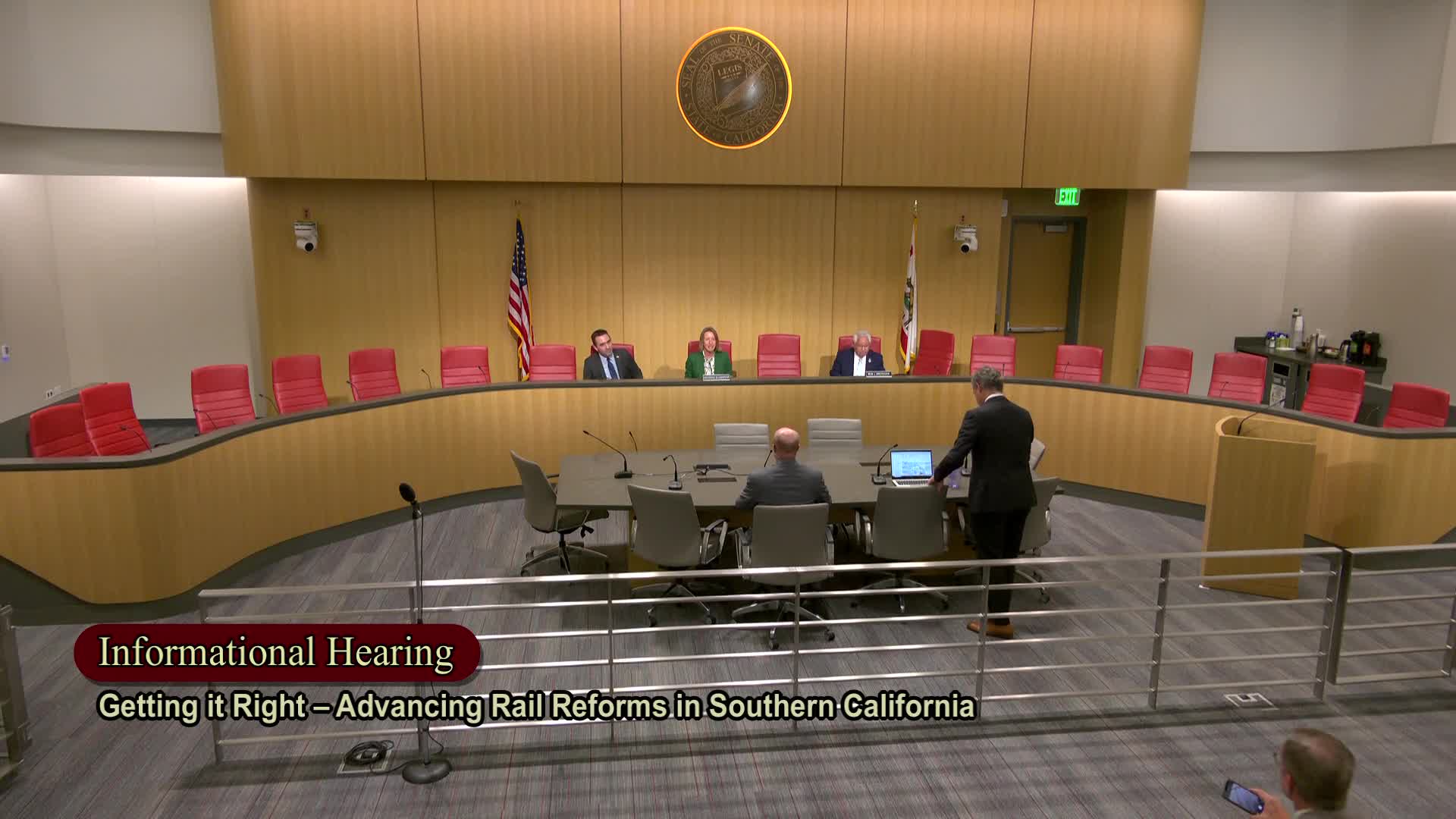
CalSTA and Caltrans told a California State Senate Transportation Subcommittee hearing that they are launching a multi‑agency, SB 1098‑mandated process this fall to set a coordinated pipeline of capital projects for the Los Angeles rail corridor.
CalSTA Chief Deputy Secretary for Rail and Transit Chad Edison said SB 1098 “tasks CalSTA with leading a comprehensive coordinated effort to ensure the performance, resilience and sustainability of the corridor” and described a working group that the agency will convene to draft recommendations on nine topic areas. Edison told the subcommittee the working group will meet monthly in person beginning in November and that CalSTA plans “to complete a final draft by January 2026, allowing time for final refinements before submission to the legislature in February.”
Why it matters: The corridor links multiple commuter and intercity services and faces near‑term climate and coastal hazards, large capital needs, and a limited window to improve service ahead of major international events. Chair Senator Blake Spear opened the hearing by noting the urgency: the state is “just over a thousand days away from welcoming the world to Southern California for the 2028 Olympics and Paralympics” and less than a year from the first 2026 World Cup games in Los Angeles.
Key planning steps described at the hearing - Corridor Identification and Development Program (CIDP). Kyle Graettinger, Chief of the Division of Rail at Caltrans, said the Federal Railroad Administration identified 69 corridors nationwide and selected Caltrans to lead CIDP work for Losan and four other California corridors. Caltrans has completed “step 1” of CIDP and expects a Federal NOFO (notice of funding opportunity) in October or November; if funded, Caltrans expects to obligate grant funds and begin the service development planning (step 2) by mid‑2026. - Federal pipeline mechanics. Graettinger described the CIDP pipeline: the service development plan (SDP) will identify specific projects; the FRA can then fund up to 80% of preliminary engineering and environmental work on discrete projects, after which projects may enter a federal funding pipeline for construction grants. - San Clemente / Del Mar workstreams. Edison and Caltrans highlighted near‑term analyses on San Clemente and Del Mar realignment options. Edison said the agencies will advance corridor‑level business case analyses that group high‑cost realignment and hardening options together to measure corridor‑wide benefits. Caltrans noted the long‑term railroad adaptation study (LTRAS) required by a Coastal Commission emergency permit; that study must include recommendations by January 1, 2034. - Partners and scope. Edison listed partner agencies expected to participate in the working group and CIDP inputs: the Caltrans Division of Rail, OCTA (Orange County Transportation Authority), Los Angeles Rail Corridor Agency, Metrolink, NCTD and other corridor stakeholders.
What the agencies were directed or committed to do - Convene monthly public working group meetings beginning in November and use working‑group input to draft the SB 1098 report. - Produce a complete draft for internal review by January 2026 and submit a final report to the Legislature in February 2026. - Advance corridor‑level CIDP work if federal NOFO funding is obtained and assemble business case analyses that include San Clemente and Del Mar realignment alternatives.
Context and constraints mentioned - The corridor touches multiple track owners and passenger operators, which complicates project delivery and sequencing. - Multiple speakers emphasized the need to prioritize reliability and frequency as “cornerstones” of corridor performance before higher‑speed or service expansions can attract and hold riders.
Ending: CalSTA and Caltrans committed to a structured, federally coordinated planning path should federal CIDP funds be available, and they asked for legislative support as CalSTA prepares the SB 1098 report due to the Legislature early next year.