Get Full Government Meeting Transcripts, Videos, & Alerts Forever!
Get email alerts on the Student Activity Fee topic
No spam. Unsubscribe anytime.
Twin Valley board committee forwards policy changes and fiscal items after debate on activity fees
Summary
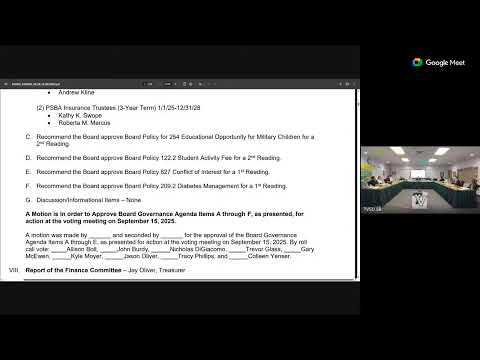
The Twin Valley School District committee of the whole debated changes to the district's student activity fee policy and forwarded several governance and finance items for final action at the Sept. 15 voting meeting.
The Twin Valley School District committee of the whole debated changes to the district's student activity fee policy and forwarded several governance and finance items for final action at the Sept. 15 voting meeting.
The discussion, led in committee by Trevor Glass, chair of the board governance committee, focused on proposed language in the student activity fee policy that would change several mandatory-sounding provisions to discretionary ones and clarify how fee waivers tied to free-and-reduced-price meal status would be handled. Board members and administrators also discussed where fee amounts are published, how payments are assessed in the student information system, and whether schools should allow payment plans or administrative discretion to prevent students from being barred from activities because of inability to pay.
Why it matters: activity fees affect student access to extracurriculars and clubs, and changes could alter who is eligible to participate, how waivers are applied, and how the district budgets for activities.
Discussion and policy detail Members debated revising the policy language that currently reads as mandatory ("shall be charged" or cause a student to be "deemed ineligible") to softer language ("may be charged" and allowing administrative discretion). Several board members said they wanted to avoid creating a rule that automatically bars students from participation for nonpayment; others warned that broad discretion without objective criteria could lead to inconsistency or reduced revenue.
Administrators acknowledged that the district now issues many fee assessments electronically through Infinite Campus and that fees often appear at the time a student is placed on a team or issued a uniform. One board member said she received different athletic fee amounts for a high-school and a middle-school child ($75 and $50, respectively), underscoring a desire for clearer publication of fee schedules. Board members asked staff to: (1) revise the policy language to add administrative discretion and payment-plan options, (2) identify where the district will publish the current fee schedules (several said the athletic web page and linked FAQ would be appropriate), and (3) report back with data on how many students were deemed ineligible for activities this year for nonpayment (the district indicated such tracking is available in Infinite Campus).
Other governance items The committee reviewed other policy updates that will be presented for board action, including: conflict-of-interest revisions described as required by federal regulations and audit requirements (board policy 827) and an update to policy 209.2 to incorporate the Pennsylvania Department of Health Type 1 diabetes fact sheet and the requirement that the fact sheet be made available to parents and guardians. During discussion about diabetes management, board members asked staff to consult legal counsel and peer districts on whether district Wi-Fi or network accommodations are needed to support student medical-monitoring devices (for example, devices that transmit glucose data) and whether administrative regulations should be added to ensure consistent practice across buildings.
Finance and referrals At the finance committee report, Tracy (presenting financial results) said district expenditures exceeded budget by about $1.6 million, driven in part by increased out-of-district placements (including Abraxas) and contracted services. Revenues were stronger than budgeted by roughly $3.4 million (including interest income that outperformed expectations, $1.7 million, and additional state and federal grant revenues). After those variances, the committee showed an estimated general-fund surplus of about $1.8 million for 2024-25; staff said the figures remain subject to final audit and that a more detailed board letter will explain line-item drivers such as debt service and athletics transportation costs for extended play.
The committee referred the following items to the full board for action at the Sept. 15 voting meeting: board governance agenda items a through f (which include approval of committee minutes dated Aug. 11, 2025; PSBA election of a candidate; the second reading of the student activity fee policy; first readings of conflict-of-interest and diabetes-management policies; and related housekeeping). The finance committee also referred its items for the voting meeting, including approval of the committee's Aug. 11, 2025 minutes, a transportation-related item for the 2025-26 school year, a student settlement and release agreement listed as SSA 25-26-04, and a recommendation to contract with Collinson Incorporated for a vehicle replacement at $17,600. Those finance items were presented for referral; final approval will be on the Sept. 15 agenda.
Other committee highlights The instructional and technology committee reported that a 33-item technology audit action plan is underway and that an induction program for new educators received positive feedback. Superintendent-level updates noted that the district opened schools successfully, that 10 high-school students will participate in an ROTC partnership with Owen J. Roberts, that a YMCA before-and-after-school program in Honey Brook is operating with initial enrollment, and that the high school marching band appeared on a regional television program; the district plans to invite student representatives to a future board meeting.
Next steps The committee voted to forward governance items a through f for final action at the Sept. 15 voting meeting. District staff were asked to revise the student activity fee policy language to add discretionary wording and options for publications or payment plans, return with tracking data on ineligible students if available, consult legal counsel about diabetes-management device connectivity, and include clearer references to where fees are published.