Nevada County planners explain how general plan, zoning and CEQA shape development; safety element update expected in 2026
Loading...
Summary
Nevada County Planning Department staff gave a public workshop outlining how the county’s general plan, zoning ordinance and CEQA review guide land‑use decisions, described discretionary and administrative permitting processes, and said the county’s updated safety element is expected to be ready for the Board of Supervisors’ consideration in early
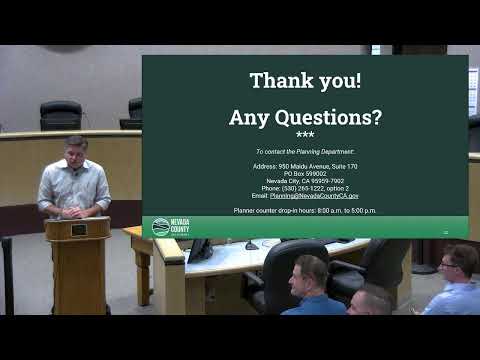
At about 5:30 p.m., Nevada County Planning Department staff held a public workshop to explain how the county’s general plan, zoning ordinance and California Environmental Quality Act (CEQA) review shape land‑use decisions and public participation, and to describe current and advanced planning activities.
The meeting provided residents and prospective applicants with timelines, review procedures and where to find project documents. Planning Director Brian Foss said the session’s purpose was “to meet the people of the planning department” and to clarify how staff, the planning commission and the Board of Supervisors interact in land‑use reviews.
The workshop outlined the county’s two core planning functions. Advanced planning prepares and maintains policy documents — including the 19‑element general plan and area plans for places such as Penn Valley, North San Juan, Greater Higgins and Silver Springs — and drafts zoning ordinance amendments. Current planning processes day‑to‑day permit reviews and applies those policies to individual applications, from lot‑line adjustments to large discretionary projects.
Steve Geiger, senior planner, described a current advanced planning project: the county’s safety element update. He said the safety element is one of the state‑required general plan elements that addresses emergency preparedness, flood and fire hazards, hazardous materials, mining and extreme heat. Geiger said the county is preparing the environmental document required under CEQA and anticipates bringing the item to the Board of Supervisors for adoption consideration in early 2026.
Staff summarized the difference between discretionary and administrative reviews. Discretionary projects — examples include conditional use permits, development permits, tentative parcel maps, rezonings and general plan amendments — require environmental review and public hearings before a zoning administrator, the planning commission or the board. Discretionary applications enter a review clock once deemed complete; staff said hearing bodies typically receive a project within 90 days after completeness and that environmental notices are mailed to nearby owners (commonly within either 300 or 500 feet, depending on zoning and parcel size).
Administrative permits are processed at staff level without a public hearing and are intended for smaller‑scale or ministerial matters, such as accessory dwelling units, some lot‑line adjustments and certain cannabis cultivation permits. Assistant planners Alina Church and Justine Queally described the administrative 30‑day initial review period, criteria staff check (setbacks, streams, slopes, zones) and the resubmittal process when applications are deemed incomplete. Queally noted that a notice of conditional approval becomes effective 10 days after issuance to allow for appeals.
Planners reviewed CEQA’s role: it is a disclosure and decision‑support process that can lead to an exemption, a negative declaration, a mitigated negative declaration or an environmental impact report depending on the initial study. David Nicholas, an associate planner, emphasized that significance determinations use scientific and professional evidence and commonly adopted thresholds.
Staff highlighted public‑facing tools and procedures. The county’s My Neighborhood online map shows parcel boundaries, zoning and planning permits; staff recommended using it for preliminary research but advised that it is not a substitute for a professional survey. Citizen’s Access (the public portal) can be used to look up applications by application number or APN. Staff offered one‑on‑one assistance at the front counter for people who need help using the portal.
On existing and pending ordinances, planners said the Tiny Home on Wheels ordinance was adopted earlier this year. The county has circulated drafts and received public comment on a proposed cell tower ordinance and an alternative housing ordinance; Brian Foss said staff is reviewing comments and expects the cell tower ordinance to go to the planning commission in October or November and then to the Board of Supervisors after the new year. Foss said all public comments are part of the record and summarized for decision makers in staff reports.
Susan McLendon described how planning review interfaces with building permit issuance: planning must confirm zoning conformity, setbacks and resource‑protection conditions before building permits are finalized. Dan Collins, the county fire planner, explained his role reviewing fire protection and vegetation‑management requirements and coordinating with Cal Fire and local fire districts on planning matters.
During a question‑and‑answer period, staff confirmed that: applications may be denied (or not accepted) if inconsistent with zoning; staff generally works with applicants to revise proposals before a hearing; decision makers may approve a project contrary to staff recommendations; and the public can sign up for notification lists for particular project types or for all projects within a distance threshold.
Where to find documents: staff said the county planning website provides links to the general plan, zoning ordinance, fee schedule, design guidelines for western and eastern Nevada County, the discretionary process flowchart and the My Neighborhood map. Staff also noted that county records (recorder’s office) and private surveyors/title companies are resources for older subdivision maps, easements and legal descriptions.
The presentation closed with staff offering ongoing assistance from the planning counter, the building department and other Community Development Agency units for residents and applicants seeking guidance or document access.