Get Full Government Meeting Transcripts, Videos, & Alerts Forever!
Get email alerts on the Alcohol Licensing topic
No spam. Unsubscribe anytime.
San Bernardino planning panel denies Arco’s request to sell beer and wine at Highland Avenue station
Summary
The Planning Commission voted 6-1 to deny a conditional use permit and public convenience and necessity finding that would have allowed an Arco gas station at West Highland Avenue and North Mountain View Avenue to sell beer and wine (ABC Type 20). Staff cited an overconcentration of off‑sale licenses in the census tract, elevated crime statistics,
The San Bernardino Planning Commission voted 6-1 to deny a conditional use permit and a public convenience and necessity (PCN) finding that would have allowed an Arco gas station at the southeast corner of West Highland Avenue and North Mountain View Avenue to sell beer and wine under an ABC Type 20 license.
Staff presented the item as Conditional Use Permit 23-01 and Public Convenience or Necessity 23-01 and recommended denial. Planner Angeline Mendoza told commissioners the site is in Census Tract 54, where state Alcoholic Beverage Control guidance allocates five off‑sale licenses; the tract currently has seven active off‑sale licenses, an overage of two. Mendoza said city staff reran a police report for 2024–2025 and found the subject site saw about 140 crimes during the reporting period, exceeding the city average by roughly 104.65 percent. She also noted two places of worship and two other alcohol outlets within a 500‑foot radius, which factor into local locational restrictions.
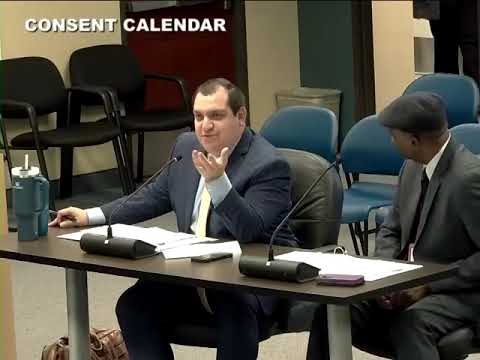
The applicant and the store owner argued for approval and offered conditions intended to reduce potential harms. An applicant representative (identified in the hearing as Ms. Diaz) said mitigating measures and post‑approval reviews — for example, a plan approval return after two years — are commonly used in other cities and could be conditions of approval. Owner Kevin Bibayan, who identified himself as the station owner and said his family operates more than 35 ARCO locations, said the business uses point‑of‑sale ID checks and offered additional precautions such as camera integration with police and magnetic door locks. “I...would greatly appreciate it,” Bibayan said, asking the commission to allow the license.
Commissioners discussed three primary factors staff cited: the census‑tract license overage, the high crime statistics for the reporting district, and the proximity to sensitive uses. Several commissioners said the overconcentration and crime data together justified denial; one commissioner recalled a previous city evaluation showing a high density of alcohol outlets in low‑income areas. Another commissioner noted police reported only two alcohol‑related incidents at the proposed location during the reporting period but said staff’s recommendation considered the totality of data and locational context.
Vice Chair Quayle moved to approve staff’s recommendation to deny the permit; the motion was seconded. The roll call vote recorded six “yes” votes to deny and one “no” vote (Commissioner Ivan Garcia). The commission’s action was to adopt the staff recommendation and the denial resolution (listed in staff materials as Resolution No. 2025-038). Staff told the applicant the right to appeal the commission’s decision to City Council within 15 days.
Why it matters: The decision keeps the census‑tract count of off‑sale licenses above the state guideline and illustrates how local planning decisions weigh state ABC guidance, local crime reports, and proximity to sensitive uses when deciding whether a retail location can sell alcohol. The commission’s finding also signals that site‑specific mitigation alone was not sufficient, in staff’s view, to overcome the combined concerns in this location.
Meeting context and next steps: Staff noted the applicant may appeal to City Council within 15 days. The city’s report and draft resolution remain the public record for the commission’s findings on the conditional use permit and PCN.