Get Full Government Meeting Transcripts, Videos, & Alerts Forever!
Get email alerts on the Combined Sewer Overflows topic
No spam. Unsubscribe anytime.
Residents and environment groups press council for stronger Alewife CSO controls; council asks manager for analysis
Summary
Public commenters urged the council to pursue ambitious combined sewer overflow (CSO) controls for Alewife Brook and the Charles River watershed and to form a public commission. The council voted to request staff analysis of options, costs and benefits and to consider a CSO commission.
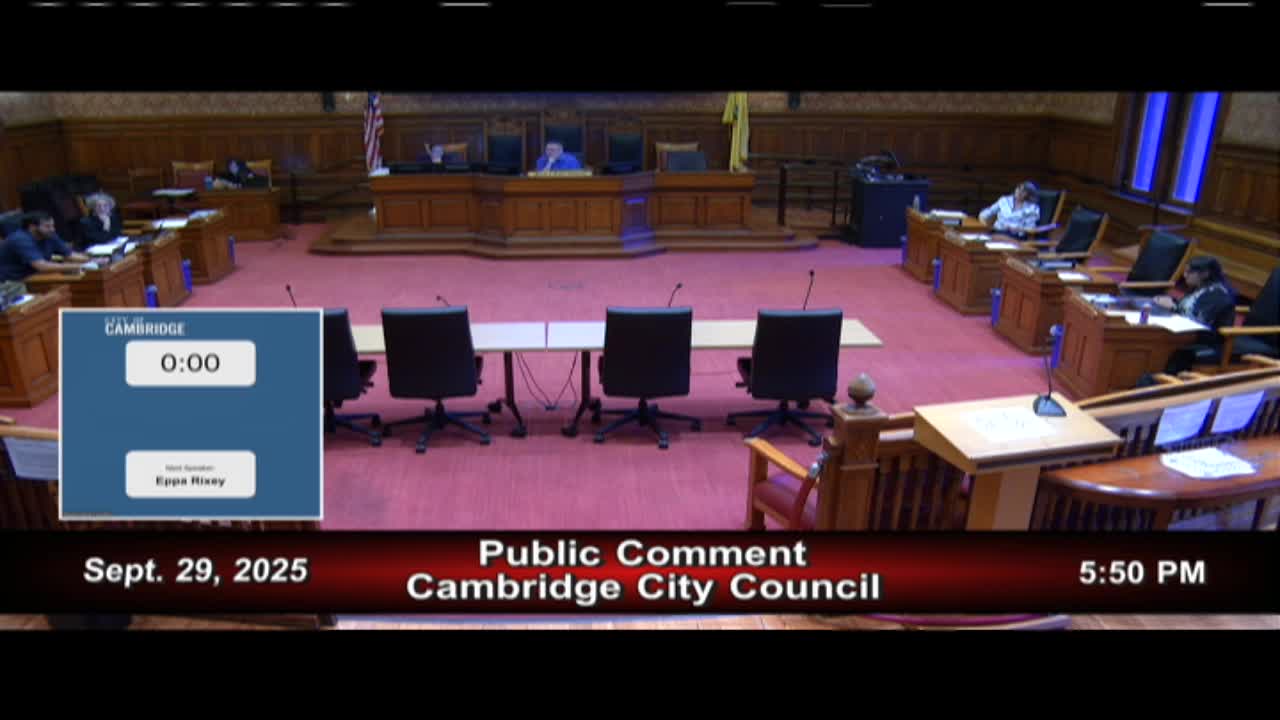
Dozens of residents, environmental groups and watershed associations urged the Cambridge City Council on Sept. 29 to seek more aggressive control of combined sewer overflows (CSOs) into Alewife Brook and the Charles River.
Speakers from Save the Alewife Brook, Green Cambridge, the Mystic River Watershed Association and the Charles River Watershed Association described ongoing discharges and pushed for options that would exceed minimum compliance. "The goal should not be the minimum level of compliance, but rather a process that builds towards a healthy community and a healthy ecosystem along the Alewife Brook and the Charles," said Epper Ricksy, a coalition representative.
Water quality professionals and advocates asked for a city-level CSO commission and an analysis of options including sewer separation, green infrastructure, and different storm-event control levels (for example, 25-year storm or 2050 climate projections). Andy Harsena, water-quality program manager at the Mystic River Watershed Association, told the council the Brook ‘‘is the scene of the largest completely untreated sewage releases into any river or stream in Greater Boston’’ and urged Cambridge to pursue the highest feasible controls.
At the Health and Environment Committee meeting on Sept. 9 staff had presented a timeline and a long-term control planning process driven in part by MWRA and intermunicipal planning with Somerville; commenters said those processes had not fully evaluated more ambitious alternatives and sometimes limited public input.
The council approved a committee report directing the city manager to work with relevant departments and the newly formed coalition to evaluate options, costs and benefits of meeting a 2050-era, 25-year storm level of control for CSOs, improving green infrastructure, and considering formation of a combined sewer overflow commission. Staff representatives said the draft long-term control plan is being developed with MWRA and Somerville and that a public review is underway; councilors asked staff to ensure timely reporting and follow-up with advocates.
The motion to request the analysis and to consider a public commission was adopted by the council; the vote was 8 in favor, 0 opposed, 1 absent. The council directed the city manager and DPW to return with a matrix of options and to coordinate with the community coalition before the long-term control plan is finalized.