
Wyoming Valley West principals present ATSI/TSI school improvement plans emphasizing attendance and targeted interventions
Get AI-powered insights, summaries, and transcripts
Subscribe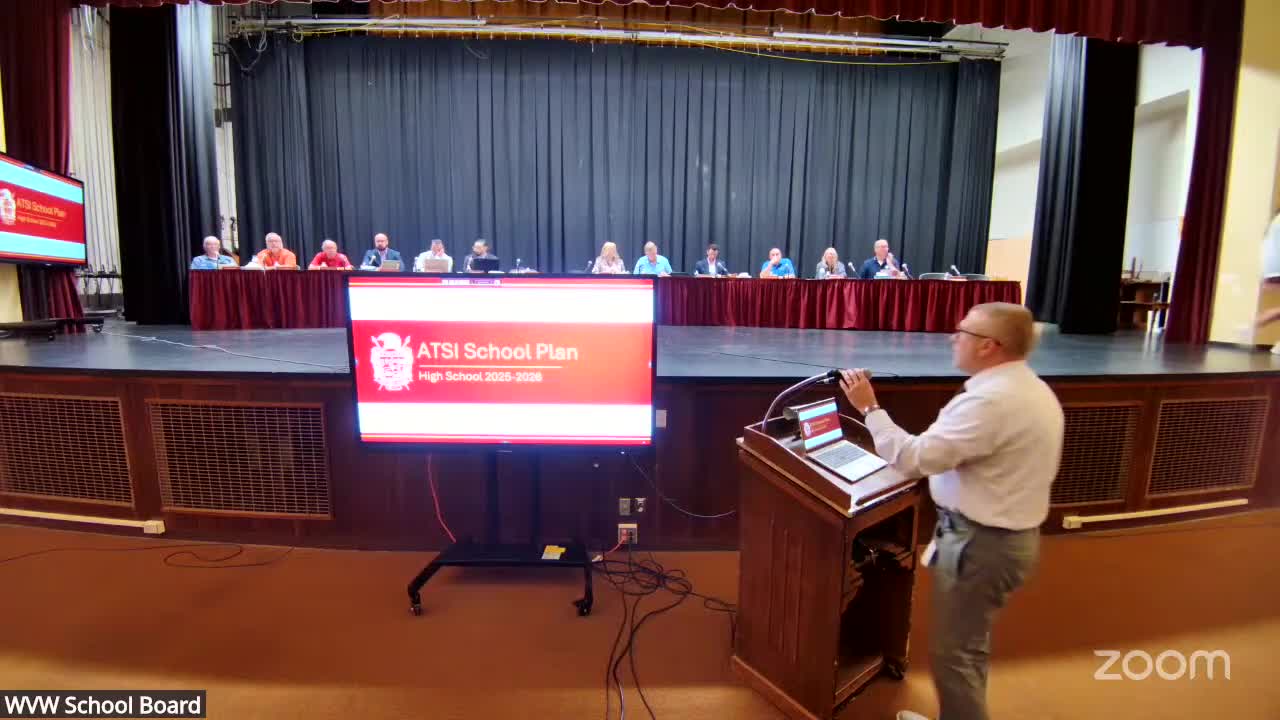
Summary
High school, middle school and State Street principals outlined ATSI/TSI improvement goals — increasing attendance and targeted academic support in biology, algebra, ELA and foundational math — and described tools (Firefly, LinkIt, IXL, Star Renaissance) and Title I staffing to track progress.
Tara Carey, the high school principal, Tim Needle, the middle school principal, and Kevin Heiley, principal of State Street Elementary, presented annual school improvement plans to the Wyoming Valley West School District board outlining goals and interventions tied to federal designations for low-performing subgroups.
Carey told the board the high school’s ATSI (Additional Targeted Support and Improvement) plan has “three key goals this year: to increase student attendance, increase student growth and achievement in biology, and increase student growth and achievement in algebra.” She said the building will continue using benchmark tools from a PDE pilot (referred to as Firefly), the LinkIt data warehouse and IXL for mathematics to provide frequent diagnostics and immediate feedback to teachers.
The plan links attendance work to PBIS incentives and direct family outreach. “One of the key pieces we want to focus on again this year is increasing parental awareness, and this is via direct contact made with the parents,” Carey said. She described quarterly PBIS attendance rewards and senior incentives tied to graduation as part of the attendance strategy.
Needle described the middle school’s TSI (Targeted Support and Improvement) plan as a three-pronged effort focused on attendance, English language arts and math, with particular attention to students of low socioeconomic status. He said the building will use increased Remind messages, support from a parent-family liaison and a Title I reading specialist to provide small-group and one-on-one intervention. “As of right now, we have Title I in the building. We have a reading specialist that’s primarily working with our sixth grade students,” Needle said, naming Stephanie Gover as the building’s reading specialist who will use IXL benchmarks and PSSA data to identify needs.
Kevin Heiley described State Street’s four goals: grow attendance, improve phonemic awareness/phonics/reading comprehension, increase accuracy of grade-level math facts and problem solving, and improve school climate through PBIS (the building’s “armor” program). Heiley cited Misty Simon as the building attendance officer and said the school uses Star Renaissance and IXL to establish baselines for K–5 students and to guide WIN (What I Need) intervention periods.
All three principals described progress-monitoring systems that include frequent benchmark assessments during the year and end-of-year state assessments (PSSAs and Keystone-aligned measures). Carey and Needle both noted use of Firefly assessments in January and other classroom diagnostics during the school year to monitor and adjust interventions.
Board members acknowledged the presentations and thanked principals and staff for their work preparing the plans.