Get Full Government Meeting Transcripts, Videos, & Alerts Forever!
Get email alerts on the Transportation topic
No spam. Unsubscribe anytime.
Traffic study finds higher volumes on East Sixth Street; council to post full report
Summary
A consultant presented a traffic study of Sixth Street showing highest traffic volumes between Broad Street and Cedar and 85th-percentile speeds higher on the East Side; the borough will publish the full study and consider follow-up counts and targeted calming measures.
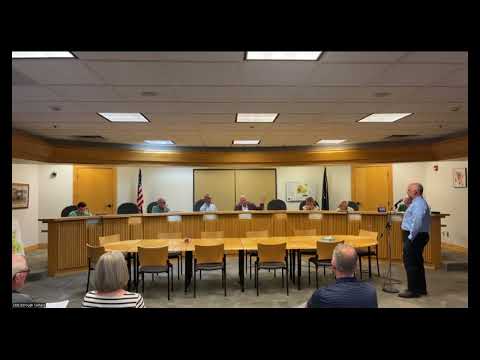
A traffic consultant from Grove Miller summarized a study of Sixth Street at the Lititz Borough Council meeting on Aug. 25, 2025, finding the highest vehicle volumes on the stretch between Broad Street and Cedar and somewhat higher speeds on the east side of town.
The study covered Sixth Street from West Orange Street to Kissel Hill Road and used automated road-tube counts at four locations over seven consecutive days in December 2024. “The study is about 20 pages in text and about 90 pages in data,” Jay, the Grove Miller consultant, told council. He said traffic volumes measured near West Orange were about 600 vehicles per day, rose to about 4,000 vehicles per day near Broad Street, peaked at roughly 5,400 vehicles per day in the short section between Broad and Cedar, and fell to about 3,800 vehicles per day east of Cedar.
Why it matters: the study gives the borough a baseline now that Sixth Street is fully connected through the roadway project. That baseline will be used to decide whether and where to add pedestrian crossings, traffic-calming features and enforcement measures.
Jay also reported speed data. ‘‘The 80th‑percentile speeds on the western section range from 23 to 28 miles an hour,’’ he said. On the eastern section, where the roadway is wider and less built up, the 80th‑percentile speeds were generally in the 30–34 mph range. Jay said those speeds fall short of levels that typically trigger urgent engineering countermeasures but recommended planning options for the east side.
Recommendations in the report included: contacting a private property owner near an apartment complex about adding stop signs at private‑street approaches to reduce conflict at those driveways; installing Type C “piano‑key” high‑visibility crosswalks when crosswalks are upgraded so they match recent improvements on South Broad Street; and, as a longer‑term planning matter, considering targeted traffic calming on the East Side in the Locust–Laurel area such as raised crosswalks, speed tables, cushions or curb extensions. Jay emphasized the need to weigh impacts on residential driveways when placing physical calming devices.
Council and public reaction. Council members and residents asked technical and operational questions and encouraged a data‑driven follow up. Council member Chris Sensenig said the borough would make the full study public. ‘‘We can post it as of tomorrow,’’ Chris said.
Residents at the meeting pressed for quicker action in specific spots. Jean Homan of Warwick Woodlands described seniors, people with limited mobility and children near Moravian Manor and urged measures to slow drivers approaching the roundabout and the woods apartments. ‘‘Those speed tables are pretty much worthless to slow people down — you can go over them at 35 with no problem,’’ Homan said. Dave Hilbert, who lives on Kislev Hill Road, noted a playground near the eastern block and urged earlier consideration of calming measures there.
Borough staff and police said they can augment the study with local radar trailer data and move mobile speed units to trouble spots for 3–12 month comparisons. Police Chief Jared noted the borough already has a mobile program and offered to relocate devices to build short‑term benchmarks. Jay agreed the study establishes a baseline that can be rechecked with temporary-count machines at low cost.
What happens next: council directed staff to post the full report online and consider periodic follow‑up counts to measure possible changes as the area continues to develop. The consultant and staff identified several practical next steps — public posting of the study, targeted repositioning of borough speed‑recording units, and outreach to the affected property owner about private approach stop signs — rather than immediate capital work.
The study, its full data appendices and the consultant’s recommendation pages will be posted on the borough website so residents can review the maps and spreadsheets described at the meeting.