Get Full Government Meeting Transcripts, Videos, & Alerts Forever!
Get email alerts on the Municipal Finance topic
No spam. Unsubscribe anytime.
Allentown audit: auditors give ‘unmodified’ opinion; pensions largely funded and debt well below statutory limit
Summary
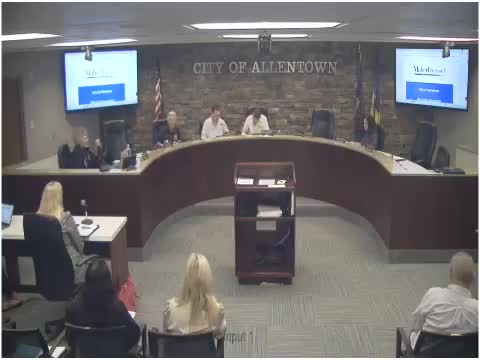
At a Budget & Finance Committee meeting of Allentown City, external auditors presented the city’s Comprehensive Annual Financial Report for the 2024 fiscal year and issued an unmodified opinion, the highest level of assurance on municipal financial statements.
At a Budget & Finance Committee meeting of Allentown City, external auditors presented the city’s Comprehensive Annual Financial Report for the 2024 fiscal year and issued an unmodified opinion, the highest level of assurance on municipal financial statements.
The auditors’ presentation said the city reported a $34,300,000 change in net position on a government-wide, full-accrual basis and a $17,600,000 increase in the general fund balance for 2024. Auditors noted that about 45.2% of the city’s revenue came from taxes and that operating grants (including increased use of American Rescue Plan Act funds and public-safety grants) rose compared with the prior year.
Why it matters: an unmodified opinion indicates the auditors found the financial statements presented fairly in accordance with generally accepted accounting principles (GAAP). The report’s revenue, pension and debt figures shape policy choices on capital planning, borrowing and service levels for Allentown residents.
Auditors and staff
Jennifer Krivier Kibbe, identified in the meeting as the partner leading the audit engagement, told the committee that the firm issued an unmodified opinion and that management agreed to post material proposed adjustments the auditors identified in grants receivable, accounts payable and grant funding. “So that’s the best opinion that the city can receive,” Krivier Kibbe said.
On pensions, the auditors summarized funding levels shown in the actuarial disclosures: the PMRS (nonuniform) plan was reported at 97.4% funded (measurement date one year behind), the fire pension was reported at about 98% funded as of Dec. 31, 2024, and the police pension was reported at 91.4% funded.
Revenue, expenses and one-time items
The report showed an increase in total governmental revenues of $8,400,000 for the year; auditors attributed part of the revenue increase to greater spending of ARPA funds and other grants. The city also reported an increase in EMS revenue (about 17% higher than the prior year) and a one-time payment near $2,000,000 from an advertising company related to billboard-lease buyouts.
On the expense side, auditors said overall expenses rose about 12% from the prior year, with public safety the largest single expense (43.9% of expenses) followed by public works (14.8%). Auditors noted increases in payroll and healthcare costs and transfers to the city’s risk fund tied to unexpected healthcare cost increases.
Debt and borrowing capacity
The auditors presented debt figures on two slides: one slide listed total debt outstanding at $96,900,000 (a net decrease of $6,000,000 from the prior year); another slide stated total debt outstanding as $72,300,000 and noted that amount was about 20% of the city’s legal debt limit. The presentation said the city’s debt limit under the Local Government Unit Debt Act as of Dec. 31, 2024, was $367,600,000. The auditors told the committee that, under the debt-capacity calculation shown, the city had room to add approximately $295,000,000 in additional debt as of the 2024 calculation.
Internal controls and management letter
Auditors said they did not identify significant difficulties performing audit procedures but did include best-practice recommendations in a management letter. Continuing items included an auditor-general pension report finding related to differences between governing documents and collective-bargaining agreements for a fire pension plan, periodic testing of the city’s IT disaster contingency plan, and improved documentation for accounts receivable reconciliations. Auditors emphasized these items were recommendations rather than reportable deficiencies.
Committee response and next steps
The city controller praised the council and administration for fiscal discipline, saying the audit “shows that the discipline that council and the administration has exercised over the past couple years is paying off.” Committee members asked follow-up questions about pensions and debt capacity; Krivier Kibbe referred the committee to actuarial footnote disclosures and the slides for funding percentages and said the PMRS measurement is one year behind market activity.
Auditors and city staff offered to meet with committee members to go over specific numbers. The committee accepted the audit presentation and moved on to meeting minutes and adjournment. Staff recognized accounting manager Erica Stroller, senior accountant Mike (last name not specified), and Sherry Young for their roles in preparing the financial statements and supporting the audit.
Ending
Auditors will complete the single-audit work required because the city expended more than $750,000 in federal funds, and the city will await the Government Finance Officers Association review for the certificate-of-achievement submission included in the report.