
St. Mary’s County planning commission hears options to expand ‘attainable housing’ as values rise, sewer limits shape choices
Get AI-powered insights, summaries, and transcripts
Subscribe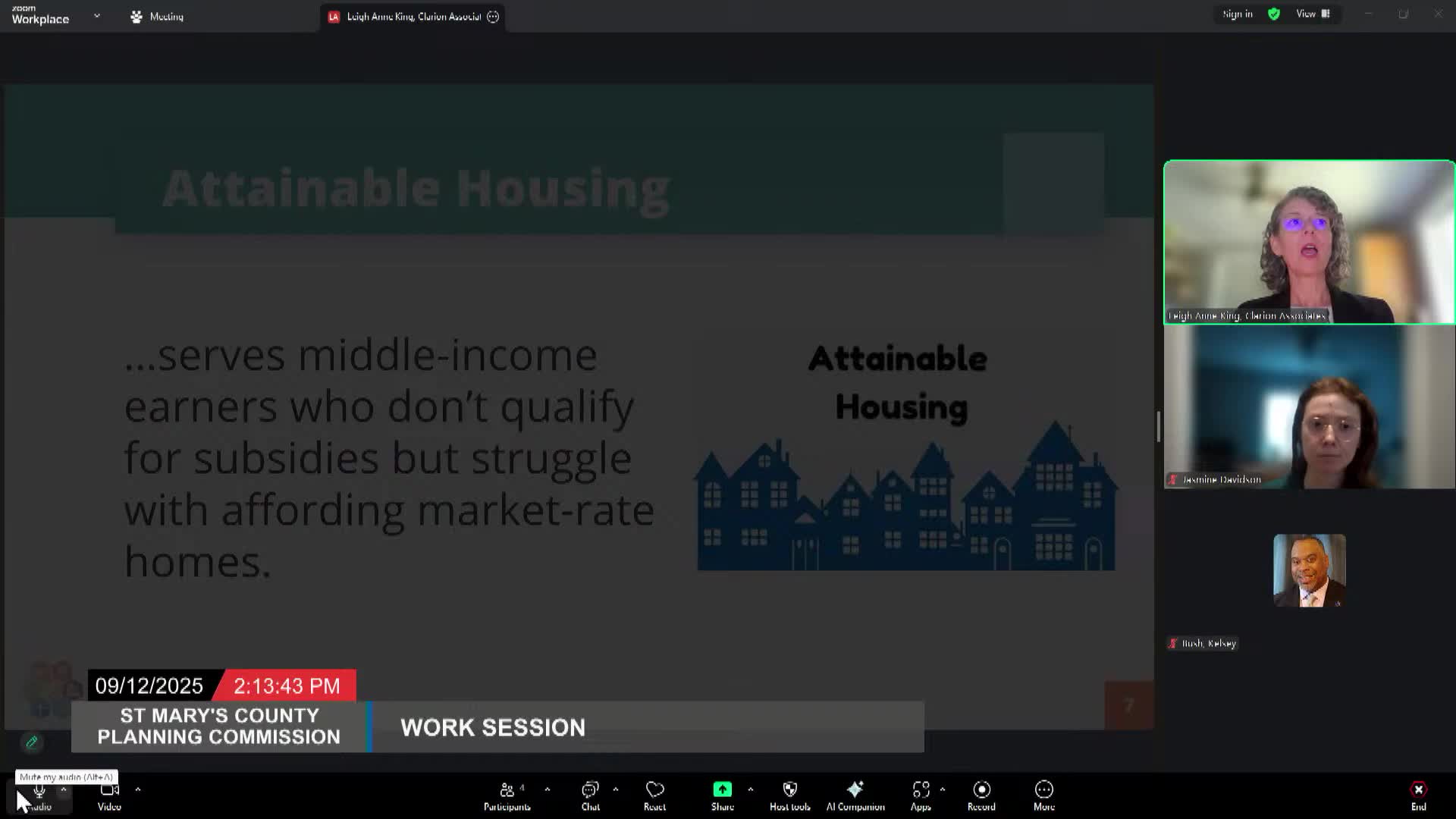
Summary
Leanne King, a Clarion Associates consultant, told the St. Mary’s County Planning Commission that "attainable housing" refers to market housing for middle‑income earners who do not qualify for subsidies but cannot afford current market prices.
Leonardtown, Md. — St. Mary’s County Planning Commission members and county staff spent a work session reviewing data and policy options Sept. 12 as part of the St. Mary’s 2050 comprehensive‑plan update, focusing on “attainable housing” for middle‑income earners, young families and workforce households.
Leanne King, a consultant with Clarion Associates, said the project team defines attainable housing as “housing that serves middle income earners for the market in St. Mary’s County who don’t qualify for subsidies but struggle with affording market‑rate homes.” King presented census and state projection data showing growing demand, rising values and a shrinking inventory of lower‑priced homes.
That context — and infrastructure limits — framed most of the discussion. Commissioners, county staff and Clarion representatives reviewed: population and income data; housing inventory and vacancy patterns; the 2010 comprehensive plan’s workforce/affordable housing goals; and zoning and utility constraints that limit where higher‑density or multifamily housing can be built.
Why it matters
The data presented show pressures on middle‑income households seeking rental or starter homes and a mix of policy tools county officials could use to respond. With median household income reported at $114,580 for 2023 and median home value near $391,000 in the same period, speakers said the county now has far fewer homes selling for $300,000 or less than a decade earlier, constraining options for people who earn too much to qualify for subsidized housing but cannot afford current market prices.
Key details from the presentation and discussion
- Population and projections: King said the county population in 2023 was a little over 114,000 (up about 7% from 2013), with state projections near 154,000 by 2045 (an increase of roughly 34% from 2020 to 2045). Ninety‑six percent of residents live outside Leonardtown.
- Income and prices: Clarion staff reported a 2023 median household income of $114,580 and a 2023 median owner‑occupied home value of roughly $391,000. King noted the number of homes selling under $300,000 declined by about 40–46% between 2013 and 2023.
- Housing inventory and cost burden: The county had about 46,000 housing units in 2023 (a roughly 10% increase since 2013). About 66% of units were owner‑occupied, 25% renter‑occupied and 9% vacant; 2.5% (approximately 1,100 units) were seasonally vacant. Clarion noted renter households report a substantially higher share of cost‑burden (paying 30%+ of income for housing) than owners.
- Zoning and development patterns: Most recent building permits produced single‑family detached homes; Clarion’s map and staff analysis showed higher‑density development tends to concentrate in the county’s development district and in parts of Lexington Park and California/Wildwood. Zoning districts range from very low density in rural preservation (base density about 1 unit per 5 acres, max 1 per 3 acres) to mixed‑use districts that allow up to roughly 20–30 units per acre in higher‑intensity zones. Commissioners noted limited acreage in high‑density categories and environmental constraints on specific sites.
- Infrastructure constraints: Several commissioners emphasized sewer and wastewater capacity as binding constraints on where multifamily or higher‑density housing can be built. Commissioners cited the Marley Taylor treatment plant improvements and the need for MetCom (Metropolitan Commission) extensions or package treatment plants in some northern areas as prerequisites for major new development.
What participants proposed or raised
- Incentives and tradeoffs: Commissioner Howard Thompson suggested tax incentives for builders and density bonuses in exchange for workforce or affordable units, while warning of the fiscal tradeoffs (lower initial tax revenue from lower‑priced homes). King confirmed the current 2010 comprehensive plan already includes policy language encouraging bonus density in exchange for affordable units; participants discussed whether implementation details should change in the 2050 update.
- Redevelopment and mixed use: Several commissioners pointed to Lexington Park and commercial corridors (for example, the former Ford site and nearby shopping areas) as locations for mixed‑use redevelopment with retail or offices at ground level and housing above — a strategy that could produce higher tax yield and housing supply without expanding sewer infrastructure into new rural areas.
- Accessory apartments and “gentle density”: Clarion and staff discussed accessory apartments (limited by county rules to either 60% of the principal dwelling or 900 square feet, whichever is less) as a low‑impact way to add units on existing lots, a potential near‑term source of attainable rental or owner options.
- Manufactured/modular homes and financing: Participants noted a state bill requiring jurisdictions to allow manufactured homes wherever single‑family dwellings are permitted; they discussed differences among manufactured, modular and stick‑built homes, financing hurdles for manufactured units, and newer modular construction that can match market quality.
- Public land, land trusts and public‑private partnerships: Clarion described models in other jurisdictions where publicly owned land or community land trusts support targeted affordable or middle‑income housing — options the commission asked staff to study for feasibility in St. Mary’s.
Community input and priorities
King summarized two rounds of public engagement and household survey results: strong community interest in aging‑in‑place services for seniors (66% of respondents) and substantial support for adding smaller homes and townhouses in growth areas as a solution to house critical‑service workers and young families. Responses were more mixed on manufactured housing and multifamily housing; roughly a third to two‑thirds of respondents supported multifamily or smaller starter homes in specified growth areas, while about 25–30% said they did not support multifamily housing anywhere in the county.
No formal decisions
The meeting was a work session; commissioners and staff discussed options and data but did not take formal votes. Commissioners asked staff and Clarion to return with more detailed policy and zoning recommendations, and the project schedule calls for follow‑up sessions on the future land use map and water/sewer/growth areas before the team drafts the plan for review in November and December.
Quotes
"When we talk about attainable housing, we are essentially talking about housing that serves middle income earners for the market in St. Mary's County who don't qualify for subsidies but they struggle with affording market rate homes," Clarion consultant Leanne King said during her presentation.
Commissioner Connor Loughran, speaking from local real‑estate experience, said market rents and mortgage payments are often similar: "For the community rentals ... you're probably looking at probably $2,200 a month," and "for a $300,000 home, you're probably looking at about $2,200, $2,400 a month." He also noted only about two dozen active listings met a strict low‑price threshold the previous day.
Commissioner Howard Thompson urged incentives: "The best way that the county can get involved ... would be some kind of tax incentive to have builders build these homes," while acknowledging the developer profitability challenge.
What’s next
Clarion and county staff will meet again with the commission for a future land‑use discussion and to review water, sewer and growth‑area alignment. The consultant team expects to incorporate feedback in October and present draft plan modules to the commission in November and early December as part of the St. Mary’s 2050 comprehensive‑plan process.
Reporting note
This article is based on the St. Mary’s County Planning Commission work session recording on Sept. 12, 2025, and the county’s trends and projections materials presented by Clarion Associates. Direct quotes are attributed to meeting speakers; data points were presented by Clarion and county staff during the session.