Get Full Government Meeting Transcripts, Videos, & Alerts Forever!
Get email alerts on the Comprehensive Plan Built Environment topic
No spam. Unsubscribe anytime.
Pitkin County planning commission reviews draft built-environment chapter of Vision 2050 comprehensive plan
Summary
At a Sept. 30 work session, county planning staff reviewed the draft built-environment chapter of the Vision 2050 comprehensive plan with the Planning and Zoning Commission, seeking policy feedback and outlining next steps and public outreach dates.
The Pitkin County Planning and Zoning Commission on Sept. 30 held a work session on the draft comprehensive plan’s built-environment chapter, hearing staff present policy direction and a timeline for public outreach and implementation.
Planning staff said the session was the second of two work sessions on the draft plan and that comments from the commission and public will be incorporated before the plan returns for formal adoption by the commission and subsequent approval by the Board of County Commissioners. "We've spent a year and a half compiling a lot of information, existing conditions, working with the community to develop the comprehensive plan content," said Ellen (planning staff), summarizing the project background and next steps.
Hannah Hunt, long‑range planning staff, framed the chapter around the county’s "rural‑urban continuum," a graphic staff used to show how land‑use characteristics vary across the county and why built‑environment policies must align with natural‑resource protection. "We've been using this image that we're calling the rural urban continuum," Hunt said, explaining that policies should reflect different needs in remote, rural and urban‑serving areas.
Why it matters: The built environment chapter translates Vision 2050 goals — including bold climate action, rural and wild‑lands preservation and an economically balanced community — into land‑use, building, transportation, utilities and waste‑management policies. Staff told the commission the chapter is policy‑heavy and will inform future land‑use code and building‑code amendments.
Key policy topics discussed included climate action (building electrification and energy code alignment), land‑use intensity in rural areas, incentives for smaller homes, the transferable development rights (TDR) program and growth‑management tools, rules for short‑term rentals and special‑event venues, building and remodel standards, utility and telecommunications resilience, and wildfire hardening.
Staff identified implementation pathways as code updates, carrying‑forward actions from other county plans (for example, the climate action plan and hazard mitigation), programs and partnerships with regional entities. They asked the commission to flag policy areas that should be priorities for implementation.
Commission discussion covered several implementation and policy tradeoffs. Commissioners and staff debated how strongly the plan should push for smaller houses and how to align energy‑code goals with transportation and service impacts in remote areas. Commissioners also asked staff to consider whether the TDR program should keep its current intent or be adjusted to make lower‑denomination TDRs more marketable.
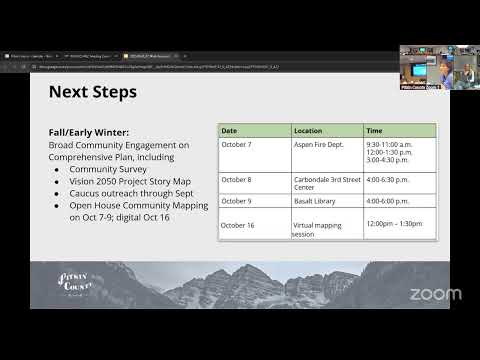
Public outreach and scheduling: staff noted an online survey and a story map on the Vision 2050 web page (link to be circulated by staff) and announced three in‑person community mapping open‑houses Oct. 7 (Aspen Fire Department), Oct. 8 (Carbondale Third Street Center) and Oct. 9 (Basalt Library), plus a virtual mapping session on Oct. 16. Staff said the commission will be asked to review the community‑housing element at the Oct. 21 meeting and that the final draft and recommended implementation approach are expected back to the commission in December 2025 before the formal hearing process.
What staff will do next: staff said they will incorporate the commission’s feedback, circulate the digital materials and outreach schedule, and return with the community‑housing discussion Oct. 21 and additional chapters Nov. 18. The commission did not take any formal legislative action at the Sept. 30 session; the meeting concluded with a procedural motion to adjourn.
Ending: Staff encouraged public participation in the mapping events and the online survey and said they will circulate web links and outreach materials before the events.