Get Full Government Meeting Transcripts, Videos, & Alerts Forever!
USBE staff review LEA indirect cost rate proposals; deadlines, coding, contract classification emphasized
Summary
Utah State Board of Education Financial Operations staff led a recorded virtual training on LEA indirect cost rate proposals, reviewing the FY27 rate formula, required data submissions, contract-classification guidance and filing deadlines.
Utah State Board of Education (USBE) Financial Operations staff led a recorded virtual training on preparing local education agency (LEA) indirect cost rate proposals, reviewing the FY27 rate formula, required data submissions, contract-classification guidance and filing deadlines.
USBE school finance specialist Laura Wilson explained how indirect cost pools, the modified total direct cost (MTDC) base and carry‑forwards are used to calculate rates that districts can apply to federal and, in some cases, state restricted programs. "This is the formula we use," Wilson said, describing the indirect cost pool plus or minus any carry forward divided by the MTDC base.
Why this matters: an LEA's indirect cost rate determines reimbursement for administrative costs such as accounting, payroll and custodial services. Wilson warned that data coding and large swings in cost pools can cause rates to fluctuate sharply and that carry forwards from prior calculations can prolong rate volatility.
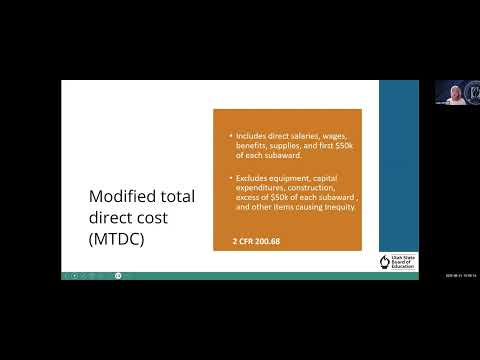
USBE staff emphasized basic definitions and the MTDC base. Direct costs are expenditures easily allocable to a single program (for example, teachers' salaries or classroom supplies). Indirect costs are centralized administrative costs recorded in function codes USBE cited as the 2500–2600 range. The MTDC base includes salaries, wages, benefits, supplies and the first $50,000 of each subaward or subcontract; it excludes distorting costs such as equipment, capital expenditures and amounts above the $50,000 subaward threshold.
Wilson and other presenters repeatedly noted…
Already have an account? Log in
Subscribe to keep reading
Unlock the rest of this article — and every article on Citizen Portal.
- Unlimited articles
- AI-powered breakdowns of topics, speakers, decisions, and budgets
- Instant alerts when your location has a new meeting
- Follow topics and more locations
- 1,000 AI Insights / month, plus AI Chat