Get Full Government Meeting Transcripts, Videos, & Alerts Forever!
Get email alerts on the Indirect Cost Rate Proposal topic
No spam. Unsubscribe anytime.
USBE staff review LEA indirect cost rate proposals; deadlines, coding, contract classification emphasized
Summary
Utah State Board of Education Financial Operations staff led a recorded virtual training on LEA indirect cost rate proposals, reviewing the FY27 rate formula, required data submissions, contract-classification guidance and filing deadlines.
Utah State Board of Education (USBE) Financial Operations staff led a recorded virtual training on preparing local education agency (LEA) indirect cost rate proposals, reviewing the FY27 rate formula, required data submissions, contract-classification guidance and filing deadlines.
USBE school finance specialist Laura Wilson explained how indirect cost pools, the modified total direct cost (MTDC) base and carry‑forwards are used to calculate rates that districts can apply to federal and, in some cases, state restricted programs. "This is the formula we use," Wilson said, describing the indirect cost pool plus or minus any carry forward divided by the MTDC base.
Why this matters: an LEA's indirect cost rate determines reimbursement for administrative costs such as accounting, payroll and custodial services. Wilson warned that data coding and large swings in cost pools can cause rates to fluctuate sharply and that carry forwards from prior calculations can prolong rate volatility.
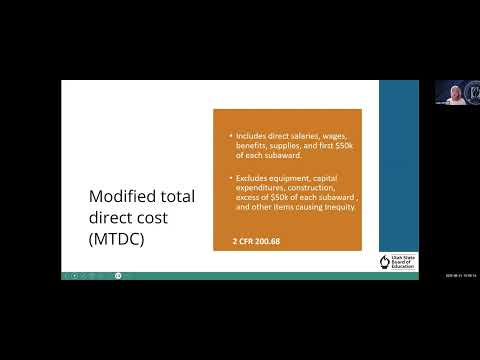
USBE staff emphasized basic definitions and the MTDC base. Direct costs are expenditures easily allocable to a single program (for example, teachers' salaries or classroom supplies). Indirect costs are centralized administrative costs recorded in function codes USBE cited as the 2500–2600 range. The MTDC base includes salaries, wages, benefits, supplies and the first $50,000 of each subaward or subcontract; it excludes distorting costs such as equipment, capital expenditures and amounts above the $50,000 subaward threshold.
Wilson and other presenters repeatedly noted that certain costs are "unallowable" to charge directly to federal programs (examples named: bad debts, judgments, entertainment, fundraising and lobbying), but those unallowable costs can still be included in the MTDC denominator when appropriate for rate calculation. She directed participants to federal regulation and guidance, saying attendees could "dig into the CFR yourself" and pointed them to EDGAR (34 CFR part 75 and 34 CFR part 76) and the Uniform Grant Guidance.
The presenters walked through a sample Schedule K in USBE's UP EFS module showing how a rate calculated from 2025 data will be applied in FY27 and how over‑ or under‑recovery becomes the carry forward in subsequent calculations. They illustrated how a large increase in the direct cost pool combined with a decline in the indirect cost pool can drive a computed rate down (example shown in the presentation: a drop from about 4.95% to 0.45%). Wilson advised LEAs to review coding for contracts, function and object codes and to keep documentation of contract classifications to reduce future fluctuations.
On contracts, USBE presented the Department of Education rubric used to distinguish subawards (carry out a portion of a federal award and create a federal assistance relationship), subcontracts (procurement relationships for goods or services for the entity's own use) and professional services (consultants or contractors with specialized skills who are not LEA employees). Wilson noted the rubric previously used a $25,000 exclusion but now follows the $50,000 threshold for the first portion of subawards included in the MTDC base.
LEA staff asked how to record journal entries when an indirect cost rate is applied. Wilson showed a journal-entry example: if a program registers $100 in eligible program expenses and USBE applies a 5.01% restricted rate, Utah Grants will add $5.01 to program expenditures and the LEA will recognize $105.01 in revenue; the LEA then posts offsetting entries to move the indirect cost amount into a holding program (for example, program 9999) so expenditures are not double counted.
Attendees raised common implementation concerns. Jamie (Jordan School District) said, "it's really frustrating when programs are adding to their board rule that indirect costs are not allowed to be charged against their program," arguing that payroll, purchasing and HR also support those programs. Laura Wilson acknowledged the trend, said USBE would raise the concern with program specialists, and added USBE leadership will discuss the issue at an upcoming internal meeting to promote clearer guidance.
Small LEAs were encouraged to consult USBE staff and to consider the de minimis (simplified) rate until they have a full operating year of actuals. Nicole Laird, a small LEA business manager, described weighing whether to use a negotiated rate: "I'm the business office...trying to decide if it's worth it," she said. Wilson noted LEAs may choose to charge less than the calculated rate but must apply a single rate consistently across unrestricted programs and should notify USBE if they elect a different percentage than the calculated rate.
Systems changes: USBE said it is developing a replacement for the UP EFS indirect cost module in the USIMS/UCIMS system. Staff said the new module is intended to keep the same core requirements while improving documentation and usability, and they invited LEA participation in working groups.
Deadlines and submissions: USBE staff reminded attendees that the Oct. 1 audited-actuals upload provides roughly 90% of the data needed for the proposal, that USBE's internal due date for indirect cost proposals is Dec. 15 (the federal requirement is Dec. 30 or six months after fiscal year end), and that the Part 2 training will take place Nov. 20 at 1 p.m.
USBE staff closed by offering follow-up support and resources. John, a USBE staff member moderating the session, said they would send the recording and the rubric slides and encouraged LEAs to email or call with questions. "We may not have the answer right away, but we'll definitely look into it and get back to you," he said.
For LEAs preparing FY27 indirect cost proposals, the training emphasized three practical actions: (1) verify coding for function and object codes (notably 2500–2600 ranges), (2) classify contracts consistently and document the basis for classification, and (3) review the Oct. 1 actuals upload carefully because data errors are the most common cause of rate volatility.
Upcoming: USBE will share the presentation materials and the contract-classification rubric by email and will hold a follow-up session Nov. 20 focused on the contract-adjustments module and other detailed adjustments.